Blog Archives

A Day in the Life of the Red- Throated Loon, Gavia stellate

A Day in the Life of Gavia stellate A Day in the Life of Gavia stellate, a Red-Throated Loon Today we are reporting on a very interesting species of bird known as the “Red-throated loon”, whose scientific name is Gavia … Continue reading

Share
More Galleries | 1 Comment

Snowy Owl’s General Information

Bubo scandiacus Appearance: Large bulky body 20.5-28 inches in length Wingspan:49.6-57.1  in Dense feathering on legs Thick feathers Smoothly rounded head; no ear tufts Yellow eyes Fur covered talons Females are generally larger than the males, and have more black markings … Continue reading

Share
More Galleries | Comments Off on Snowy Owl’s General Information

Spotted Sandpiper, blog post I

This gallery contains 19 photos.

Fig. 1: Developmental stages of the Spotted Sandpiper Fig. 2: Range map of Spotted Sandpiper Fig. 3: Nest and eggs of Spotted Sandpiper Fig. 4: Respiratory system of the Spotted Sandpiper Fig. 5: “The teeter” of a Spotted Sandpiper Fig. … Continue reading

Share
More Galleries | Comments Off on Spotted Sandpiper, blog post I

Singing Behavior of the American Crow (Corvus brachyrhynchos)

This gallery contains 4 photos.

We’ve all heard the sound of a single crow’s caw loud in the morning air, but did you ever question how the American Crow, or Corvus brachyrhynchos, produces the vocalizations it does? How does the American Crow get its caw, … Continue reading

Share
More Galleries | Comments Off on Singing Behavior of the American Crow (Corvus brachyrhynchos)

Gall Lab publishes in Functional Ecology

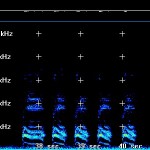
Our new paper on the on how song frequency, song structure and habitat affect auditory frequency sensitivity in nine species of new world sparrows is out in Functional Ecology. We had predicted that song frequency and habitat would be the … Continue reading

Share
More Galleries | 1 Comment

Summer Summary (We’re back at Vassar!)

This gallery contains 7 photos.

The school year is approaching and I’m back at Vassar (my office will be temporarily moved for the fall 2014 semester, so you can find me in Blodgett 234). This summer I was down in Atlanta, working out of my … Continue reading

Share
More Galleries | 2 Comments

The Gall Lab attends the Animal Behavior Society Conference

This gallery contains 2 photos.

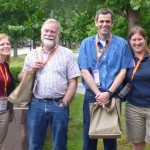
The Gall lab headed to the 2014 Animal Behavior Society Conference at Princeton University this past week. It was a great chance to talk about science, connect with old friends, and learn about where the field is going! At the conference … Continue reading

Share
More Galleries | 1 Comment

What’s the hoot about peacock deception?

Dishonest signals give misleading information about an animal’s size, intention, and quality. In animal communication, dishonest signals are maintained if they are rarely made or used in aggressive contests. However, when dishonest signals are commonly used in a population, they … Continue reading

Share
More Galleries | 2 Comments

Lost? Birds’ magnetic compasses may be compromised by man-made electronics

This gallery contains 2 photos.

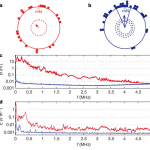
While many organisms have impeccable sight, hearing, or smell, some species are able to sense aspects of their environment through mediums that humans cannot naturally perceive. For example, night-migratory songbirds have the ability to use the Earth’s magnetic field to … Continue reading

Share
More Galleries | 1 Comment

A Parting Song: Signaling Costs and Benefits in Song Sparrows

This gallery contains 2 photos.

Until recently, research on songbird calls has been biased towards the study of male calling, with female calls receiving relatively little attention. In many species this is because male songbirds are more vocal than females, but many females produce their … Continue reading

Share
More Galleries | 1 Comment