
Stingless Bees and Color Vision

CMYK

Roses are red, violets are blue… stingless bees have color vision too!

     A group of researchers at the University of Würzburg in Germany and Monash University in Australia have discovered that stingless bees have the ability to discriminate a wide range of color, despite research which states that bees have three classes of color photoreceptor (‘UV’ at 350 nm, ‘blue’ at 440 nm, and ‘green’ 440 nm). Compared to honeybees, stingless bees have a limited range of color detection, which serves as a testament to the heavy reliance upon color/flower discrimination in honeybees.

     Overall, there are significant tradeoffs between color sharpness and color detection in bees. For example, honeybees have a high ability to discriminate between colors, but lack in their general ability to detect color. Conversely, bumblebees can detect color changes but cannot discriminate between colors as well as honeybees.
stingless-bee-petero-3514

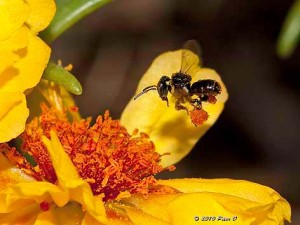
Australian Stingless Bee

     Stingless bees differ in their demands for color acuity and discrimination, given their diet and foraging mechanisms. A number of stingless bee species will forage throughout the year, and are thought to feed on one type of flower. The researchers tested two groups of stingless bees (Trigona fuscipennis from Central America and Tetragonula carbonaria from Australia) to determine if methods used for color-detection in honeybees and bumblebees, originally outlined by von Frisch, will apply to stingless bee species as well.
dyer_1_gross

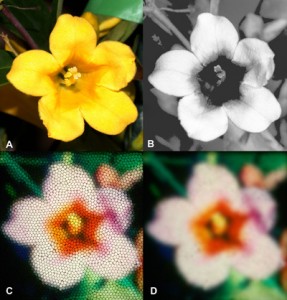
A) How humans see color
B) UV rays through the eyes of a bee
C) Simulated image of a bee’s trichromatic color compound eye
D) How bees would hypothetically see color

     Through a series of three experiments, the authors found that two species of stingless bees were able to discriminate between colors when allowed the opportunity to locate a target (sucrose solution) on a colored paper square (either blue, purple, yellow or pink) placed within a set of gray squares. The bees were also able to distinguish the color contrast between gray squares that featured a colorful star at the center and gray squares without stars. Interestingly, the bees were less able to distinguish differences between the color boxes and the gray boxes when the contrast decreased.

     This data is important for several reasons. First, the researchers were able to prove that stingless bees might be able to discriminate colors similarly to honeybees and bumblebees. Second, the threshold for differentiation between two colors was determined in stingless bees (0.05 hexagon units), and was found to be higher than in both honeybees (0.01 hexagon units) and bumblebees (0.02 hexagon units). This proves that the discriminatory abilities of various kinds of bees is different, and likely depends on the demands of their foraging mechanisms. The authors note that this may also be due to a trade-off between light sensitivity in ommatidia of the eyes of the stingless bee and the overall quality of spatial resolution. However, the signal to noise ratio would also be rather high and may allow for decreased color discrimination compared to honeybees and bumblebees.
frisch_postcard

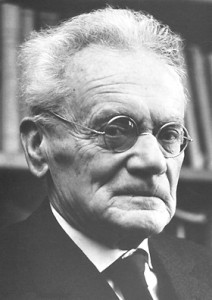
Karl von Frisch

     Lastly, the authors had hoped to prove that the methodology used by researcher Karl von Frisch, who investigated bee social behavior (earning him a Nobel Prize), could still be used as a valid measurement of bee vision.

     Overall, it seems that while stingless bees may not have the same color vision of honeybees and bumblebees, this article may lead us to understand more about the demands of their environment and perhaps allow us to make inferences about their foraging preferences and pollination patterns to improve the distribution of bee pollinators in the environment.

If you’d like to read more from this article, you can find it on the website for the Journal of Comparative Physiology (reference listed below).

Spaethe, J., Streinzer, M., Eckert, J., May, S., & Dyer, A.G. (2014) Behavioural evidence of colour vision in free flying stingless bees. Journal of Comparative Physiology A, DOI:10.1007/s00359-014-0886-2.


Share
Posted in Animal Physiology, What's New in Sensory Ecology? | 1 Comment

Floral Mimicry in the Orchid Mantis

Orchid Mantis

He loves me… He loves me not… As you peel the petals off your flowers this Valentine’s Day, it may be important to ensure that it’s not an orchid mantis. Floral mimicry is most commonly found in orchids, where approximately a third of the species depend on deception for pollination. Until now, there has not been any documented case of floral mimicry occurring outside of angiosperms.

Orchid mantises are elusive creatures and are hypothesized to use floral mimicry as a means to attract pollinators as prey. Hanlon et al. (2014) applied color modeling to compare orchid mantis and flower coloration from the perspective of a hypothetical pollinator. Then, observation of behavioral responses of wild pollinators to live orchid mantises were used to test the hypothesis that the orchid mantis is a flower mimic.

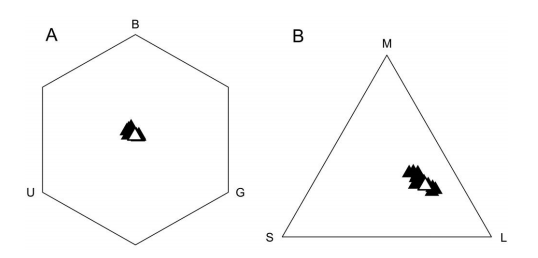
Average color coordinates of orchid mantises are in the filled triangles, while the color coordinates of 13 wild flower species are shown in open triangles.

Average color coordinates of orchid mantises are in the filled triangles, while the color coordinates of 13 wild flower species are shown in open triangles.

Hanlon et al. (2014) used two separate models of trichromatic hymenopterian vision: the color hexagon and the receptor noise limited model. Their results showed that the colors of orchid mantises fall within the range of flower petal colors of numerous local flowers, and the average chromatic contrast values between orchid mantises and 13 flower species were either significantly below or not significantly different from the discrimination threshold values of honeybees.

Visitation rates of wild pollinators to field stimuli.

Visitation rates of wild pollinators to field stimuli.

In field experiments, Hanlon et al. (2014) found that visitation rates per-hour differed between the flower, the mantis, and the bare stick control. Wild pollinating insects, primarily bees but occasionally butterflies and flies, inspected the live juvenile female orchid mantises significantly more frequently than the bare stick. Hanlon et al. (2014) recorded two successful prey captures as well as numerous prey capture attempts by the orchid mantises; their prey capture attempts did not deter pollinating insects from inspecting and visiting the orchid mantises.

This study by Hanlon et al. (2014) confirms the mimicry hypothesis of orchid mantises: floral mimicry, in the orchid mantis, is used to attract pollinators as prey. While many species use floral camouflage to catch prey, the orchid mantis uses a more aggressive form of mimicry; pollinators are deceived and attracted to the orchid mantis rather than flowers within the general vicinity.  The orchid mantis provides some of the first evidence for floral mimicry as a predatory strategy.

For more information, here’s a neat BBC Earth video on the orchid mantis: https://www.youtube.com/watch?v=FUKyETJZqM8

Hanlon, J., Holwell, G., Herberstein, M. (2014). Pollinator deception in the orchid mantis. The American Naturalist 183:1, 126-132

Share
Posted in What's New in Sensory Ecology? | 1 Comment

Active cooling helps rattlesnakes detect prey

Playing it cool helps rattlesnakes find prey – at least according to a recent paper in the Journal of Comparative Physiology A.  Researchers from Brock University in Canada in collaboration with researchers in Brazil found that South American rattlesnakes (Crotalus durissus) can use respiration to actively cool their heads. These cooler animals were more accurate when striking prey, and were quicker to relocate and consume prey after a strike. But why does cooling down help the animals find prey?

Pit_Viper_text

Rattlesnakes belong to a group of animals called pit vipers. Snakes are ectothermic animals, which means that they cannot generate body heat through metabolic processes.  Instead, they rely on their behavioral response to the environment to regulate their body temperatures.  However, their prey are small endothermic mammals that generate their own body heat.  The snakes have special sensory organs called facial pit organs that can sense the body heat of their prey.  These organs allow the animals to accurately strike at prey, even when it is dark and they cannot use their vision.

Wiki_snake_eats_mouse

Although it has been hotly debated, current research suggests that the membranes in these pits are sensing heat and not infrared light (e.g. not a photoreceptive organ). When the pits are heated ion channels called TRPA1 open, starting a cascade of information from the sensory system to the brain. When these pits are relatively cool, it provides more contrast between the temperature of the pit and the temperature of the prey and should, in theory, provide more accurate information to the snake about the location of the prey item. In many animals cooling is achieved by the evaporation of water (like panting in dogs, which is a form of respiratory cooling, or sweating in humans). The more humid the environment the less effective this evaporative cooling becomes, because the air is already saturated with water vapor. This means that liquid water is less likely to evaporate.

panting

The research found that animals did indeed cool their heads relative to the rest of their body and that this cooling was more effective when humidity was low.  This suggests that the environment plays a very important role in the functionality of these thermal detectors.  The snakes may be more successful predators if they hunt from a location with lower humidity. This is a great example of how the environment and the sensory biology of animals interact to influence their behavior (sensory ecology!).  If you want to learn more about this system you can check out the paper in the latest issue of the Journal of Comparative Physiology A. 

Cadena V., Andrade D.V., Bovo R.P.,  & Tattersall G.J. 2013. Evaporative respiratory cooling augments pit organ thermal detection in rattlesnakes. J Comp Physiol A 199:1093–1104
Share
Posted in Animal Physiology, What's New in Sensory Ecology? | Comments Off on Active cooling helps rattlesnakes detect prey

Our first birds!

It was 14 degrees on Monday morning when Arick Wong, an undergrad in my lab, and I packed up the car and headed out to Vassar Farms.  It was chilly, but clear and still, a perfect day for banding birds!

photo_1

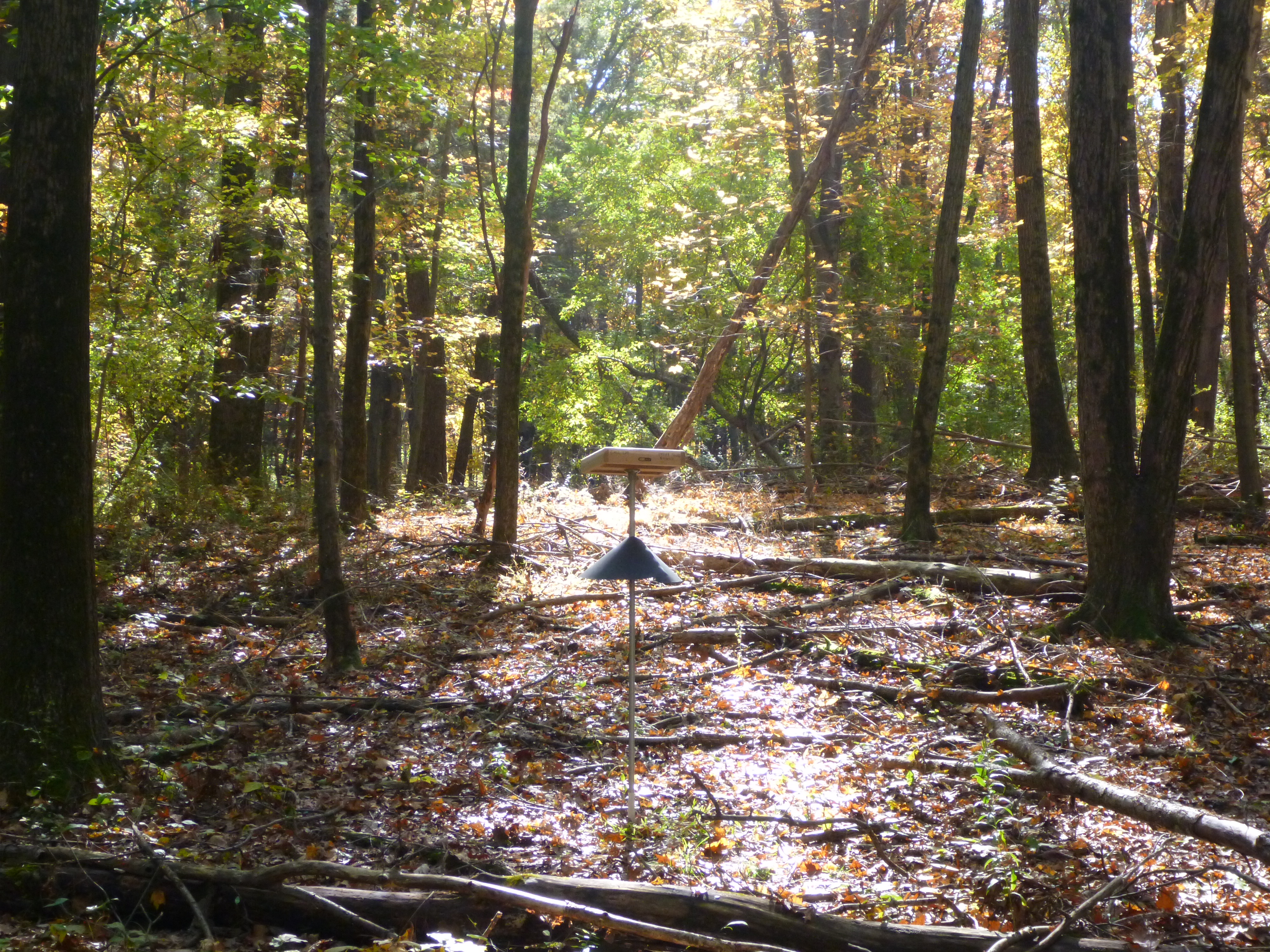
We’ve had our platforms up at Vassar’s Ecological Preserve for several months now (note the still green leaves in the photo below). Every 2-3 days we put blacksunflower seeds out on the platforms to attract birds like black-capped chickadees, tufted titmice, white-breasted nuthatches and a number of woodpecker species.

P1000587

For months, we’d had our NY and Federal scientific collecting permits in hand, as well as our DEA permit. We had our auditory evoked potential rig (the computer and electronics we use to measure bird hearing) calibrated and all our equipment ready to go. We’d just been waiting on our banding permit (a permit issued by the US Geological Survey that allows you to capture and mark the birds with a small metal band) and bands to arrive. photoWe had received our bands the previous week (this was actually very fast once we had our permit in hand!), but we hadn’t yet had a day where we had a good chunk of time free and it wasn’t raining.  Monday was perfect! We took three of our treadle traps (see above) out and placed them on our baited platforms.  The animals come into the traps to get at the bird seed, they step on the “treadle” which allows the door to drop, trapping the bird inside. Within about 30 minutes we had captured a red-bellied woodpecker. We aren’t using these birds, so we snapped a few pictures and let it go.  We also caught a second red-bellied woodpecker and 3 tufted titmice.  We brought the tufted titmice back to the lab to test their hearing and then released the birds on Tuesday at the farm.  Each bird was fitted with a band with a unique number, so we’ll know if we catch them again!photo_2


Share
Posted in Gall Lab News | 1 Comment

Welcome!

Welcome to the Sensory Ecology Blog at Vassar College!  Here you will find posts about current research in sensory ecology (including physiology, behavior, and evolution) that has caught our eye.  These posts are contributed by guest writers from the Sensory Ecology course at Vassar College.  You will also find posts from the Gall Lab about our research activities

Not in keeping with our sensory ecology theme, you will also find posts about items in the news that may be of interest to students in Bio 228: Animal Physiology and Bio 106: The singing life of birds. Enjoy!

Share
Posted in Animal Physiology, Dutchess County Birds, Gall Lab News, What's New in Sensory Ecology? | Comments Off on Welcome!

Hello world!

Welcome to Vassar College WordPress. This is your first post. Edit or delete it, then start blogging!

Share
Posted in Uncategorized | 1 Comment