Chicks use sensation of leg muscles to practice walking even before they hatch

This gallery contains 2 photos.

Chicks can do pretty amazing things. One of these things includes getting up and walking around within hours after hatching. How do they walk so well right after hatching? A new study in the Journal of Experimental Biology looked at … Continue reading

Share
More Galleries | Comments Off on Chicks use sensation of leg muscles to practice walking even before they hatch

There’s No Straight Path Home for a Pigeon in the City

This gallery contains 3 photos.

It is no secret that birds have impeccable navigational skills. Flight permits long distance-travel, and tools such as differentiating smells in the air and using an internal compass make a smooth journey to the destination. For pigeons, it turns out … Continue reading

Share
More Galleries | Comments Off on There’s No Straight Path Home for a Pigeon in the City

Stoeger Hears A Who: Estimating Age Ranges of Elephants from Acoustic Cues

This gallery contains 3 photos.

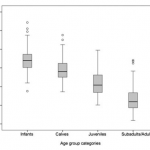
In Dr. Seuss’s book, Horton Hears A Who!, Horton finds a speck of dust containing a microscopic town called Whoville. While Horton is able to hear the townspeople, he is criticized by other animals for believing in something they cannot … Continue reading

Share
More Galleries | Comments Off on Stoeger Hears A Who: Estimating Age Ranges of Elephants from Acoustic Cues

The Ripeness Hype: How Fruit Color Affects Foraging Behavior

This gallery contains 4 photos.

Communication, which can be loosely defined as a transfer of information, is vital to structuring the development and interactions between a signaler and perceiver. This transfer of information can be perceived as a one to one transfer of stimulus to … Continue reading

Share
More Galleries | Comments Off on The Ripeness Hype: How Fruit Color Affects Foraging Behavior

The Sounds of Selection

This gallery contains 4 photos.

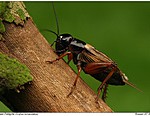
When it comes to cricket mating habits, what exactly are these insects looking for in a potential mate? What really makes a male stand out when competing for a female’s attention? Is it his strength, his intellect, his appearance or … Continue reading

Share
More Galleries | Comments Off on The Sounds of Selection

Ocean acidification leads to legally-blind fish

Estimated change in sea water pH caused by human-emitted CO2 between the 1700s and the 1990s (Global Ocean Data Analysis Project (GLODAP) & the World Ocean Atlas)

The widespread consequences of human activity are both remarkable and startling. Nearly 30 to 40% of human-emitted carbon dioxide (CO2) in the atmosphere dissolves into our oceans, leading to a steady increase in ocean acidification that is projected to increase significantly into the future.

Yet ocean acidification, the process of decreasing pH and therefore increasing ocean acidity, is just one of the results of decades of substantial human-caused air pollution. In fact, the rising amount of CO2 in our atmosphere and oceans has a largely unknown consequence for marine life. A recent study suggests that increased CO2 may cause some fish to struggle with the sight of fast-moving elements in their environment. While previous research has illustrated that ocean acidification can negatively impact a fish’s smell and hearing senses, less is known about its impacts on fish sight.

The spiny damselfish, Acanthochromis polyacanthus

To investigate the effects of ocean acidification on fish vision, researchers turned to the spiny damselfish, Acanthochromis polyanthus, largely present in Australia’s Great Barrier Reef and easy to breed in a laboratory setting. The spiny damselfish uses its eyes to detect rapid flickering light, similar to the flickering humans can see on computer or television screens. Therefore, the quality of fish vision can be determined by how well fish interpret various speeds of flickering light.

Researchers exposed fish to different levels of CO2 and used electrodes to detect nerve activity within the eye. If the electrodes detect activity coincidentally with flashing light, it can be assumed that the fish recognize the flickers. However, each fish has a flicker threshold, where flickering light becomes too fast for the fish to process. When introduced to high levels of CO2, this threshold decreases and the fish are unable to recognize quick flickering light.

The results from this study reveal that damselfish exposed to high levels of CO2 have lower flicker thresholds than damselfish exposed to lower levels of CO2. This phenomenon is most likely caused by essential sight and behavior neuron proteins in the eye that are altered by increased CO2.

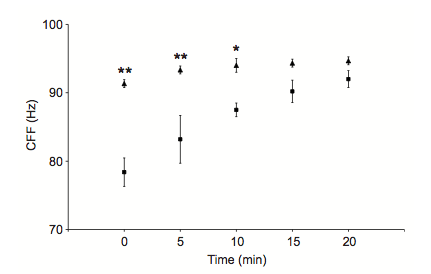
The low critical flicker fusion (CFF) threshold in high-CO2 treated fish is restored over 15 to 20 minutes after receptor blocker treatment.

The low critical flicker fusion (CFF) threshold in high-CO2 treated fish (squares) is restored over 15 to 20 minutes after receptor blocker treatment. Fish treated with low-CO2 (triangles) have consistently higher CFF thresholds.

However, all is not lost for the fish affected by high levels CO2 in this experiment; CO2-induced low flicker thresholds are reversible. Fish exposed to high levels of CO2 were treated with a GABA receptor blocker that restores normal neuronal activity and were able to regain their regular flicker threshold just fifteen minutes after being treated. But while the GABA receptor blocker injections may work to cure fish in a laboratory setting, it would be costly and impractical to treat fish in the wild.

Though the spiny damselfish is just one of thousands of fish species that use this particular family of nerve cell protein, many other fish species also rely on these proteins for normal eyesight and behavior. With the possibility of increased ocean acidification in the future, many fish may suffer similar eyesight deterioration.

Chung, W.S., Marshall N. S., Watson, S.A., Munday, P.L., Nilsson G.E. 2014 Ocean acidification slows retinal function in a damselfish through interference with GABAA receptor. J. Exp. Biol. 217: 311-312.

Share
Posted in What's New in Sensory Ecology? | 2 Comments

The rise in CO2 levels slows vision and interfers with GABA receptors in damselfish

Spiny Damselfish: Acanthochromis polyacanthus

Spiny Damselfish: Acanthochromis polyacanthus

Every day humans are emitting carbon dioxide (CO2) into the atmosphere and causing problems to the environment. The first issue that comes to mind is always global warming and how the earth is going to melt away. I hope you realize by now that this information is false and that there are actual problems that are affecting the way our ecosystem functions.

One actual problem is the rising of carbon dioxide levels in the ocean. This disrupts the marine organisms and may impair the sensory systems and alter the behavior of marine fishes. How can one simple molecule such as CO2 cause all of this?

Molecule of Carbon Dioxide

Molecule of Carbon Dioxide

CO2 is a naturally occurring chemical compound that causes a decrease in the pH of Earth’s oceans, which is known as ocean acidification. When the pH drops, this also affects the fish’s ion balance and disrupts an important neurotransmitter in the brain called GABAA. GABAA is the chief inhibitory neurotransmitter in the central nervous system. Alterations to this inhibitory system can disrupt the visual system of a fish and delay the response time to a predator. This implies that the rise of CO2 levels in the ocean causes impairment in the vision of fish.

Chung et al. (2014) decided to study the affects of CO2 levels on visual responses in damselfish (Acanthochromis polyacanthus) in the Great Barrier Reef. To measure the visual response, Chung focused on vision at the retinal level and how the retina responses to a flickering light.  He measured the critical flicker fusion (CFF) threshold of a fish which is the frequency at which light becomes continuous and the retina stops responding. Typically organisms that are fast moving and live in bright environments have higher CFF  than organisms who spend most of their time in dark environments and are slow.

Chung and his colleagues measured the electrical light response of the retina in damselfish exposed to high levels of CO2 and high levels of CO2. The fish exposed to normal CO2 levels had a high CF of 90 Hz (frequency) while the fish exposed to the high CO2 levels after 6 days had a 68 Hz. This is a great prediction for the future to show if damselfish will have a harder time detecting fast moving objects.

The experiment also tested whether increased CO2 levels in the ocean waters affected GABA signalling system. The GABA receptor was activated by treating the high exposure of carbon dioxide with gabazine As shown in Figure 1 below, the treatment restored the fish’s retinal performance and the CFF threshold increased.

Overall the study showed that when a damselfish is exposed to high levels of CO2, their vision is impacted. However, there are no results indicating what happens in the ecosystem when their vision is impaired. We will need to perform more studies in the future to predict the predation and prey threat in the marine ecosystem

If you want to learn more about the methods and techniques of the experiment you can check out the latest article in the Journal of Experimental Biology.

Chung, W.S., Marshall N. S., Watson, S.A., Munday, P.L., Nilsson G.E. 2014 Ocean acidification slows retinal function in a damselfish through interference with GABAA receptor. J. Exp. Biol. 217: 311-312.

Share
Posted in What's New in Sensory Ecology? | Comments Off on The rise in CO2 levels slows vision and interfers with GABA receptors in damselfish

How do I love thee? Let me smell the ways.

This gallery contains 2 photos.

Love is in the air – quite literally – in the lemur world. A new study has found that the strength of sifaka bonds is reflected by the similarity of their scent signals. Yes, it’s all about chemistry. Researchers from … Continue reading

Share
More Galleries | Comments Off on How do I love thee? Let me smell the ways.

The Use of Multisensory Social Information in Birds to Warn Flock Members of Danger

Animals generally live in multisensory worlds, relying upon many different types of information to ensure survival. For animals living in groups who use social information to make decisions, two types of information may be available from other group members: cues and signals. Cues are behaviors inadvertently left by an individual, such as seeing a friend running over to the stove while something is cooking, while signals are behaviors produced by an individual and directed toward others, such as your friend yelling to you that she needs help because the stove is on fire. While both pieces of information are informative, it is hard to say whether they elicit the same response in an individual. Is it possible that having both pieces of information, compared to just one, is advantageous?
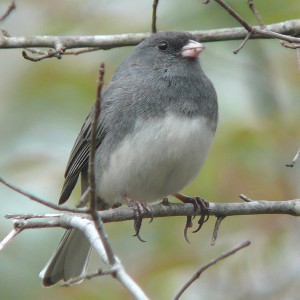
Dark-eyed Junco

Dark-eyed Junco

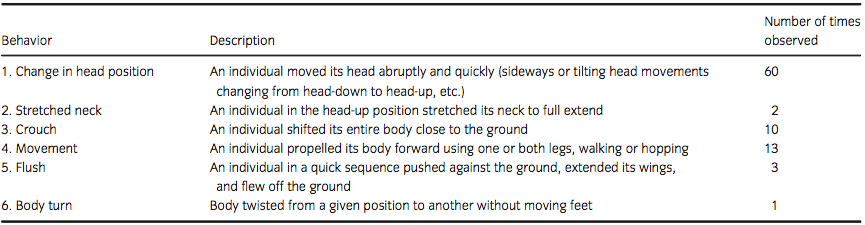
Randolet et al. (2014) studied the antipredator behavior of the dark-eyed junco, a small American sparrow, which uses alarm calls as an auditory signal and flushing, or fleeing, as a visual cue to warn flock mates of an approaching predator. The researchers predicted that alarm calling and flushing were redundant stimuli, and would therefore elicit the same behavioral response in the juncos. To test this, robotic birds were created to set up an artificial flock, and number of group mates, alarm calling, and/or flushing behavior was manipulated in the robotic birds to resemble varying degrees of risk. Live birds were exposed to these artificial flocks, and their responses to the different levels of risk of the different stimuli were recorded. Change in head position, stretched neck, crouching, movement, flushing, and body turn were all recorded, as these are typical antipredator behaviors of the juncos.
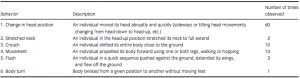
Descriptions of the andipredator behaviors displayed by the juncos.

Descriptions of the andipredator behaviors displayed by the juncos.

The results of the study were contrary to initial predictions, as they showed that multisensory stimuli affect different components of the junco antipredator behavior. In fact, none of the antipredator behaviors performed by the juncos were affected simultaneously by both the alarm calls and flushing behavior, suggesting that these stimuli are non-redundant. Additionally, the degree of alarm of the live birds increased when at least one robot flushed, but reaction times to the robots’ behavior increased, rather than decreased, with at least one alarm call. This suggests possible costs to using each behavior individually, and suggests that, together, these stimuli could facilitate flock cohesion and reduce the occurrence of false alarms to predators.

Although alarm calls and flushing behavior were predicted to be redundant stimuli, it is apparent that there are costs to using each stimulus individually. A flock mate flushing may reflect individuals seeking foraging opportunities, rather than fleeing a predator attack. Thus, if the juncos were to flee the patch each time they witnessed a flock mate flushing, the behavior could waste energy and may result in a loss of foraging opportunities. Additionally, according to the results of the study, alarm calling could actually reduce the benefits of living in a group, by delaying responses to predator attacks. However, it may have been difficult for the researchers in this study to distinguish between alarm calls and low-risk warning calls, which could have caused the results seen.

Randolet et al. (2014) have demonstrated that juncos likely use a non-redundant multisensory system to minimize the occurrence of false alarms using stimuli in different sensory modalities to determine the type of threat. This may ultimately facilitate group cohesion among flocks, allowing for more successful foraging and antipredator behaviors.

Randolet, J., Lucas, J. R., & Fernández‐Juricic, E. (2014). Non‐Redundant Social Information Use in Avian Flocks with Multisensory Stimuli. Ethology

Share
Posted in What's New in Sensory Ecology? | Comments Off on The Use of Multisensory Social Information in Birds to Warn Flock Members of Danger

Oyster Toadfish use stealth signaling to thwart competitors

With stiff competition to find that special someone, sometimes it may be necessary to be a little stealthy to beat out your opponents. Male oyster toadfish know this well, according to recent research by Allen F. Mesinger, which examined the use of grunts by male toadfish in order to interrupt the mating calls of competitors.

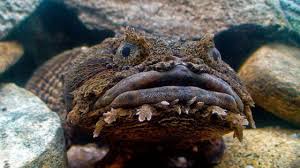
Toadfish

Many types of animals, such as birds and insects, use acoustic signaling to attract mates. In many of these populations, males adjust their timing so as to not overlap calls, but stealthy toadfish do just the opposite, preferring to interfere with the competitors’ mating calls with their own noises, in a process called “jamming”. The researchers tested the duration, frequencies, and timing of the male toadfish signaling, identifying two separate types, the boatwhistle and the grunt. The boatwhistle consists of a brief grunt, followed by a longer period of pulsing, and is used to attract females. Grunts, however, are shorter, and occur very infrequently spontaneously.

The results showed that 88% of the grunts recorded began and ended during the boatwhistle of another individual, indicating that these grunts were more likely to have been timed according to when the boatwhistles occurred, rather than generated randomly. Additionally, the grunts were consistently emitted during the tonal part of the competitor’s whistle whish has been demonstrated in previous research by Edds-Walton et al. to be the part of the call that attracts females most often. When this part of the call is interrupted, and the frequency digresses from the expected of that range of call, the female finds the call less attractive.

Although it is still unclear whether the grunt serves other purposes, this paper provided strong evidence that an important function is to interfere with the mating attempts of competing males, thus improving the chances of the grunt emitter of finding a mate. This provides a strong example of how sensory (!) cues are important factors in selecting for particular behaviors within a population. 

Mesinger, Allen F. Disruptive communication: stealth communication in the oyster toadfish. The Journal of Experimental Biology 217, 344-350

Share
Posted in What's New in Sensory Ecology? | Comments Off on Oyster Toadfish use stealth signaling to thwart competitors