Bronze Age Interactions: The Tin Trade

The Bronze age began 3300 BCE in the eastern Mediterranean and lasted until 1200 BCE when efficient iron smelting brought forth the dawn of the Iron Age. During this period copper and tin were smelted together to create bronze, an alloy stronger than its components and easier to create than refining iron. However, there is an unresolved question. Tin is not native in large quantities to eastern Mediterranean. Therefore, where was the tin mined?
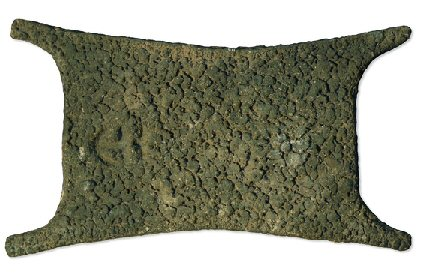
An ancient tin ingot to be used in the creation of bronze.

With the advent of trace-element analysis, in which artifacts are sampled for specific rare elements, archaeologists are able to cross-reference the trace elements found in artifacts with naturally occurring concentrations across the world. For example, at shipwreck near Haifa, present-day Israel,  numerous tin ingots, with Minoan symbols indicating ingots are from the bronze age, had trace elements of cobalt. Archaeologists must now find a source of tin with similar traces of Cobalt to determine the origin. Yet, they have failed to find an exact match, the closest being Cornwall, present-day England, which has concentrations of cobalt and germanium.

In addition to trace-element analysis, written sources can help narrow the tin’s possible origin. The famed Greek historian Herodotus speaks of tin originating in “the tin isles” which is thought to be the English Isles. This tin would be exported to Minoan Crete for processing into bronze. Although his claim does strengthen the possibility of a source of tin in northern Europe, Herodotus wrote his theory of the origin of tin almost a five hundred years since its primary use and admitted that he lacked an eyewitness account. Only until the Roman empire conquered the Isles did both written sources and trace-element analysis provide concrete evidence that northern tin was used in bronze production.

Ultimately, a spatial distribution of assemblages containing tin would provide the most concrete answer. Both tin and amber are commonly found in north-western Europe, but very rare in Mediterranean. Excavations in Minoan Crete and Cyprus
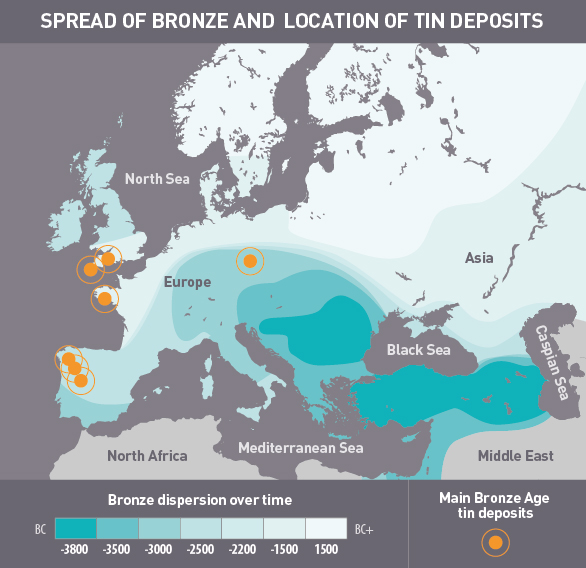
A map showing major tin deposits in Europe.

found jewelry made of tin and amber beads revealing a trade network between the two locations. A fall-off analysis, an analysis which shows how the quantities of traded goods decline as distance to the source increases, indicates that a down-the-line exchange system carried the tin south through present day France before Minoan merchants brought the tin across the Mediterranean to Crete. Therefore, it is probable that a route did from northern Europe did supply at least the Minoans with a source of tin.


Bibliography:

Maddin, Robert, Stech Wheeler, Tamara, Muhly, James. “Tin in the Ancient Near East Old Questions and New Finds.” Penn Museum, Vol. 15, no. 2, 1977. 35-47. http://www.penn.museum/sites/expedition/?p=3921. Web. 29 September, 2017.

Harms, William. “Bronze Age Source of Tin Discovered.” The University of Chicago Chronicle, vol. 13, no. 9, 1994. http://chronicle.uchicago.edu/940106/tin.shtml. Web. 29 September, 2017.

Muhly, James. “Tin Trade Routes of the Bronze Age.” Sigma Xi, vol. 61, no. 4, 1973, 404-413.  http://www.jstor.org/stable/27843879. Web. 29 September, 2017.

Renfrew, Colin, and Paul Bahn. Archaeology Essentials: Theories, Methods, Practice. 3rd ed., Thames & Hudson, 2015.

Further Readings:

Monna, Fabrice & Jebrane, Ahmed & Gabillot, M & Laffont, Rémi & Specht, Marie & Bohard, Benjamin & Camizuli, Estelle & Petit, Christophe & Chateau, Carmela & Paul, Alibert. (2013). Morphometry of Middle Bronze Age palstaves. Part II – spatial distribution of shapes in two typological groups, implications for production and exportation. Journal of Archaeological Science. 40. 507-516. 10.1016/j.jas.2012.06.029.

Bernard Knapp. “Thalassocracies in Bronze Age Eastern Mediterranean Trade: Making and Breaking a Myth.” World Archaeology, vol. 24, no. 3, 1993, pp. 332–347. JSTOR, JSTOR, www.jstor.org/stable/124712.

Image Citations

M. Otte (2007) Vers la Préhistoire, de Boeck, Bruxelles. M. Benvenuti et al. (2003), “The “Etruscan tin”: a preliminary contribution from researches at Monte Valerio and Baratti-Populonia (Southern Tuscany, Italy)”, in A. Giumlia-Mair et al, The Problem of Early Tin, Oxford: Archaeopress. R.G. Valera & P.G. Valera, P.G. (2003), “Tin in the Mediterranean area: history and geology”, in A. Giumlia-Mair & F. Lo Schiavo, The Problem of Early Tin, Oxford: Archaeopress.

Gikeson, Mark. “Copper and Mudd.” Summer 2015, Harvey Mudd College Magazine, 9 Nov. 2015, magazine.hmc.edu/summer-2015/copper-and-mudd/.
Link to original post in Reall Archaeology

What Bog Bodies Can Tell Us About Our Past

While what usually comes to mind at the term “mummies” are any of the Great Pyramid Pharaohs, there exist lesser known and better preserved ancient humans. Bog bodies, or “peat mummies,” are extremely well-preserved human remains found usually in Northern Europe. These bodies, located in a wetland that accumulates peat, are exposed to an extremely acidic yet stable environment for long periods of time. In addition to this acidity, the bogs possess low oxygen levels, low temperature, and low water levels. The presence of these conditions allows the remains to be well-preserved, the organs, skin, and hair often intact. However, prolonged exposure to such high acidic levels eventually dissolves the calcium in the bones, a feature which distinguishes bog bodies from other type of mummy.

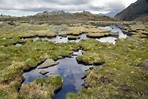
An example of a bog where the bodies are commonly found.

Although bog bodies can be dated from B.C.E to as late at World War II, the bulk of bog bodies found falls within the time period of the Iron Age. The Iron Age, beginning in Europe around 300 B.C.E., is characterized by the widespread use of iron as the dominant tool making material. However, in Northern Europe this period was also characterized by extremely violent practices. Many of the bog bodies recovered from the iron age how signs of strangulation, bludgeoning, stabbing, disembowelment, asphyxiation, and poisoning. The bogs, it seemed, were reserved as dumping grounds for those who had either been brutally murdered or offered as a human sacrifice to the gods. While the demise of those in the bogs is often tragic, they leave behind many clues indicating how their people lived, what they worshiped, and how they died.

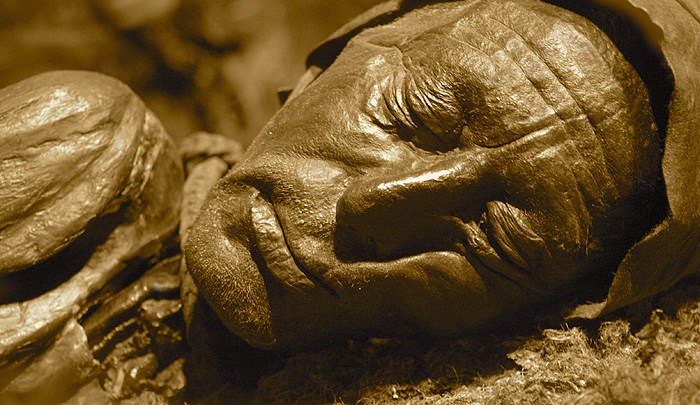
The Tollund Man, one of the most well-known bog bodies, was found in a peat bog close to Bjældskovdal, Denmark. Approximately 30-40 years old, he lived during the beginning of the Iron Age in Europe. While most of his entire body was free from decay, the degree of preservation in his face and facial features is remarkable. The expression the Tollund Man had at the time of his death is still visible- an expression that is eerily peaceful due to the violent nature of his death. Among the Tollund Man’s belongings was a cord tied around his neck, which indicateds he was most likely a victim of hanging. While the body itself is telling, much can be learned about how he lived from studying the “larger picture.” From excavating the area in and around where the Tollund man was found, many artifacts were recovered that outlined how people from ancient Europe functioned as a society. For example, an elaborate leather cap was found, boasting both a conical shape and a braided loop fastener. This cap indicates that his people were skilled artisans, capable of producing complex and robust items of clothing. In addition, by excavating the surrounding areas, it can be concluded that the Tollund man  was most likely a human sacrifice, due to similar nature of the deaths of nearby bog bodies and the absence of funeral urns- urns that were usually used for burying the dead during the iron age. This strongly indicates that his civilization possessed an element of religion. Finally, grain was found in his stomach, revealing that his people were semi-sedentary agriculturalists who lived off of a diet of cereal grains.

A view of the Tollund Man’s well preserved facial features.

By studying the Tollund man and other bog bodies, we are able to see how they once lived. However, we must be careful not to make assumptions based on our own experience of what it is to be “human” in order to fully understand ways of life other than our own. While the life of bog bodies like the Tollund man may seem barbaric, upon closer inspection their societies possessed many elements similar to our own ways of life today. The major difference between our civilization and the bog bodies’ civilizations is mainly the time in which they occurred.

Sources:

Barclay, Shelly. “Bog Bodies Of Europe: The Most Famous Of The Peatland Mummies.” Historic Mysteries. N.p., 2017. Web. 25 Sept. 2017.

“Bog Bodies – Bog People – Crystalinks.” Crystalinks.com. N.p., 2017. Web. 25 Sept. 2017.

“The Tollund Man – Death.” Tollundman.dk. N.p., 2017. Web. 25 Sept. 2017.

Further Reading:

http://www.pbs.org/wgbh/nova/bog/iron-nf.html

https://www.thoughtco.com/bog-bodies-burials-170238

Image Sources:

http://imgarcade.com/bogs.html

15 Legendary Mummified Bodies & How They Got There


Link to original post in Reall Archaeology

What Archaeology Can Tell Us About Modern Climate Change

A common misconception about archaeology is that it is relevant only to the past. In reality, archaeological research can have a profound effect on modern life, and even on the future. One example of this is the archaeological study of climate change. Climate change is often referred to as one single apocalyptic event that will end all human life, and it will certainly alter human life, but climate change is natural and cyclical. It is happening at a faster and more alarming rate due to human activity, but climate change in itself is inevitable. In order to survive climate change of the future, it is important to understand how it was dealt with in the past.

An interesting glimpse into the impacts of past climate change is the case study of northern Cuba conducted by Jago Cooper and Matthew Peros. Unfortunately, an exact timeline for past climate change is very difficult to obtain. Michael Calway notes in his article regarding past South American droughts that some methods such as ice or sediment cores, while useful, are unreliable in this case and do not create particularly accurate timelines. Luckily, Peros and Cooper were able to access written records of past climate events. In their research, Cooper and Peros discovered not only a cycle of hurricanes and rising sea levels in Cuban history, but also techniques the ancient Cubans used to deal with these problems. One such technique is evident in their architecture. Most houses in the case study area were away from the coast on low, flat ground. They also incorporated a stilted design to allow water from storm surges to flow under the house rather than batter its walls. Another important aspect of the early Cubans’ adaptations is their methods of gathering food. The diet of these societies consisted primarily of things taken from shallow, intertidal marine environments. During a storm, however, these environments could be drastically altered, so the Cubans diversified their diet to include food collected from deeper marine areas. This allowed them to continue to find food even when sea levels were high.

A modern Cuban stilted house

These methods for survival are directly applicable to the current situation in the world. One recent example is the devastation caused by hurricane Irma of the southern coastal states. Modern societies could learn things from ancient ones, like not building too close to the water in hurricane-prone areas. Another example could be to diversify food sources so that no one is cut off in the event of extreme flooding.

Hurricane Irma’s devestation in Northeast Florida.

Unfortunately, when it comes to climate change, hurricanes are not the only problem to be faced. Future humans will also have to deal with higher average temperatures, polluted air/water, and other types of storms. It is unlikely that human intervention will drastically slow climate change, but with any luck, people will be able to look to the past to find ways to survive.

Sources

Calaway, Michael J. “Ice-Cores, Sediments and Civilisation Collapse: A Cautionary Tale from Lake Titicaca.” Antiquity, vol. 79, no. 306, 2005, pp. 778-790.

Jago Cooper, Matthew Peros, The archaeology of climate change in the Caribbean, InJournal of Archaeological Science, Volume 37, Issue 6, 2010, Pages 1226-1232, ISSN 0305-4403,  https://doi.org/10.1016/j.jas.2009.12.022.

Renfrew, Colin, and Paul Bahn. Archaeology Essentials: Theories, Methods, Practice. Thames & Hudson, 2015.

Image Sources

McCullough, Gary Lloyd. “Hurricane Irma – Ponta Vedra Beach”. Orlando Sentinel, 11.       Sept. 2017. http://www.orlandosentinel.com/weather/hurricane/os-hurricane-irma-damage-in-jacksonville-and-northeast-florida-pictures-20170912-photogallery.html

http://www.alamy.com/stock-photo/thatched-house-cuba.html

Further Reading

https://phys.org/news/2016-07-archaeology-link-climate-early-human.html

https://news.ncsu.edu/2016/02/gingerich-climate-past-2016/


Link to original post in Reall Archaeology

What Our Food Provides Us: How the Human Diet Progresses Archaeological Analysis

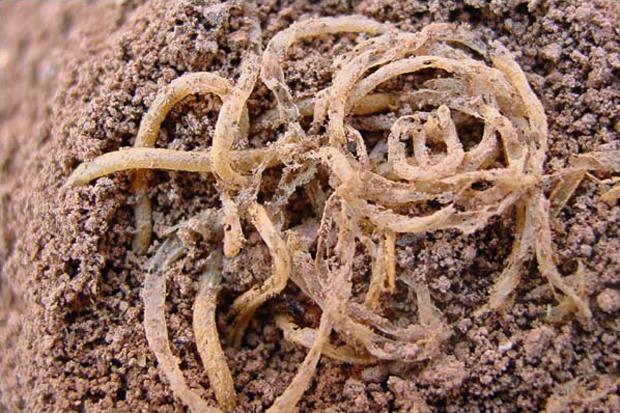
Food, as a necessity for human survival, has always been the basis of any society. Archaeology that focuses on the human diet illuminates interactions between society and nature, and therefore explores their subsequent functionality. Diet is so expansive, that an array of findings can provide archaeologists with the tools for analysis. For example, earthenware found at the Lajia site in northwestern China preserved the earliest record of noodle preparation. The bowl was stuck in a floodplain of clay sediment, and radiocarbon dating suggests that these noodles were from four thousand years ago.

The millet noodles appear to be almost paper thin, with a diameter of 0.3 centimeters. They were around 50 centimeters long, with a yellow tint. They reflect many of today’s modern Chinese noodle dishes.

After analysing and attempting to determine the taxa of the noodles, archaeologists found that grass plants – specifically millet – were the basis of Chinese ingredients, and these noodles in particular. The Lajia site, found in the Loess Plateau region of China, was a semi-arid region, which is an efficient climate for millet to grow, solidifying the idea that millet was used to make noodles and other cuisine around this time period.


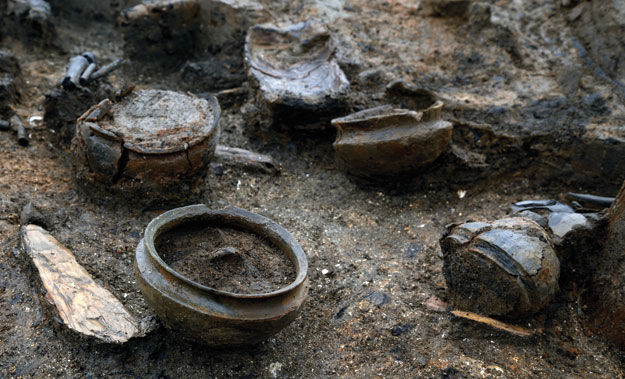
With the millet noodles we see how a relatively small artifact can be used to specify how the environment was utilized by the people inhabiting it. In contrast, we can also look at how a larger archaeological dig site, containing a multitude of plant matter, can shine a light on past practices. The Bronze Age Farm at Black Patch in southern England provided archaeologists with over fifty pounds of wheat, barley, and other plants. The plants were preserved through the charring of the storage pit, prompting many to dub the site as “England’s Pompeii”. 

Along with pounds of edible plants, rich textiles, bronze, wooden, and ceramic artifacts were excavated at the Black Patch Farm site. The findings were uniquely preserved with a combination of waterlogging and charring.

The findings showed an increase importance of wheat, which provides insight into the progression of farming techniques, specifically the newfound reliance on winter-sown crops. Some archaeologists have also speculated that the charring of these storage pits represent the tradition of burning the deceased, and their home, after death.

It’s important to note, however, that these findings are not representative of a wide ranged understanding. In fact, both of these instances are only reflective of a specific, single period in time. The most efficient form of archaeological diet analysis is the study of food traces in the stomach, and fecal matter. Unfortunately, it’s apparent that popular science outlets tend to portray the more glamorous discoveries (like the world’s oldest noodle!) than the discoveries that provide the most accurate and relevant information on diet. Understanding bias in our sources of information – and understanding that the two examples discussed here are only a small piece in a larger puzzle – will allow us to garner a more accurate picture of our past. 

Additional Reading

Swaminathan, N. (2014, August 11). Meadowcroft Rockshelter. Archaeology. Retrieved from https://www.archaeology.org/issues/150-features/americans/2369-peopling-the-americas-meadowcroft-rockshelter

Schaeffer, C. (1978). THE BISON DRIVE OF THE BLACKFEET INDIANS. Plains Anthropologist, 23(82), 243-248. Retrieved from http://www.jstor.org/stable/25667511


Image Sources

[Noodles]. (n.d.) Retrieved from http://images.mentalfloss.com/sites/default/files/styles/insert_main_wide_image/public/noodles_0.jpg

[Black Patch Farm]. (n.d.) Retrieved from https://www.archaeology.co.uk/wp-content/uploads/2016/08/mustfarmfeatured.jpg


Sources

Renfrew, Colin and Paul Bahn (2015) Archaeology Essentials. 3rd edition. Thames & Hudson, New York.

Lu, H., Yang, X., Ye, M., Liu, K., Xia, Z., Ren, X., . . . Tung-Sheng, L. (13 October 2005). Culinary archaeology: Millet noodles in Late Neolithic China. Nature, 437, 967-968. doi: 10.1038/437967a

Cunliffe, B. (2006). Iron Age Communities in Britain: An Account of England, Scotland and Wales from the Seventh Century BC until the Roman Conquest. Retrieved from https://books.google.com/books?id=v1Zkio7jluAC&pg=PA35&lpg=PA35&dq=bronze+age+farm+at+black+patch+England+wheat&source=bl&ots=iB5vgxi32M&sig=yjFdWZNAvUXX6lhY–kStS3fnwk&hl=en&sa=X&ved=0ahUKEwiB76nKlbnWAhVD04MKHUzmDUIQ6AEIZzAN#v=onepage&q=bronze%20age%20farm%20at%20black%20patch%20England%20wheat&f=false

Bruck, J. (2002). Bronze Age Landscapes: Tradition and Transformation. Retrieved from https://books.google.com/books?id=_IwgDgAAQBAJ&pg=PT315&lpg=PT315&dq=bronze+age+black+patch+farm&source=bl&ots=2uxexgp-Pw&sig=i_TBht5poZgiR5c3-cbroI1Lchk&hl=en&sa=X&ved=0ahUKEwia1d-7nrnWAhVI6YMKHTrtDIYQ6AEINzAF#v=onepage&q=black%20patch&f=false

Keys, D. (2016, July 13). Discovery of vast treasure trove of fine textiles shows importance of fashion to Bronze Age Britons. Independent. Retrieved from http://www.independent.co.uk/news/science/archaeology/vast-treasure-trove-of-fine-textiles-shows-importance-of-fashion-to-bronze-age-britons-a7135786.html

Link to original post in Reall Archaeology

No Interest in War: The Harappan Civilization

Some ancient civilizations were renowned for their warfare techniques—the Chinese’s scale being evident with the discovery of the Terra Cotta Army, the Persians emerging as a military power under Cyrus the Great, and the Romans being famed for their discipline and innovation on the battle field. One civilization, however, might not have engaged in warfare at all, archaeologists speculate.

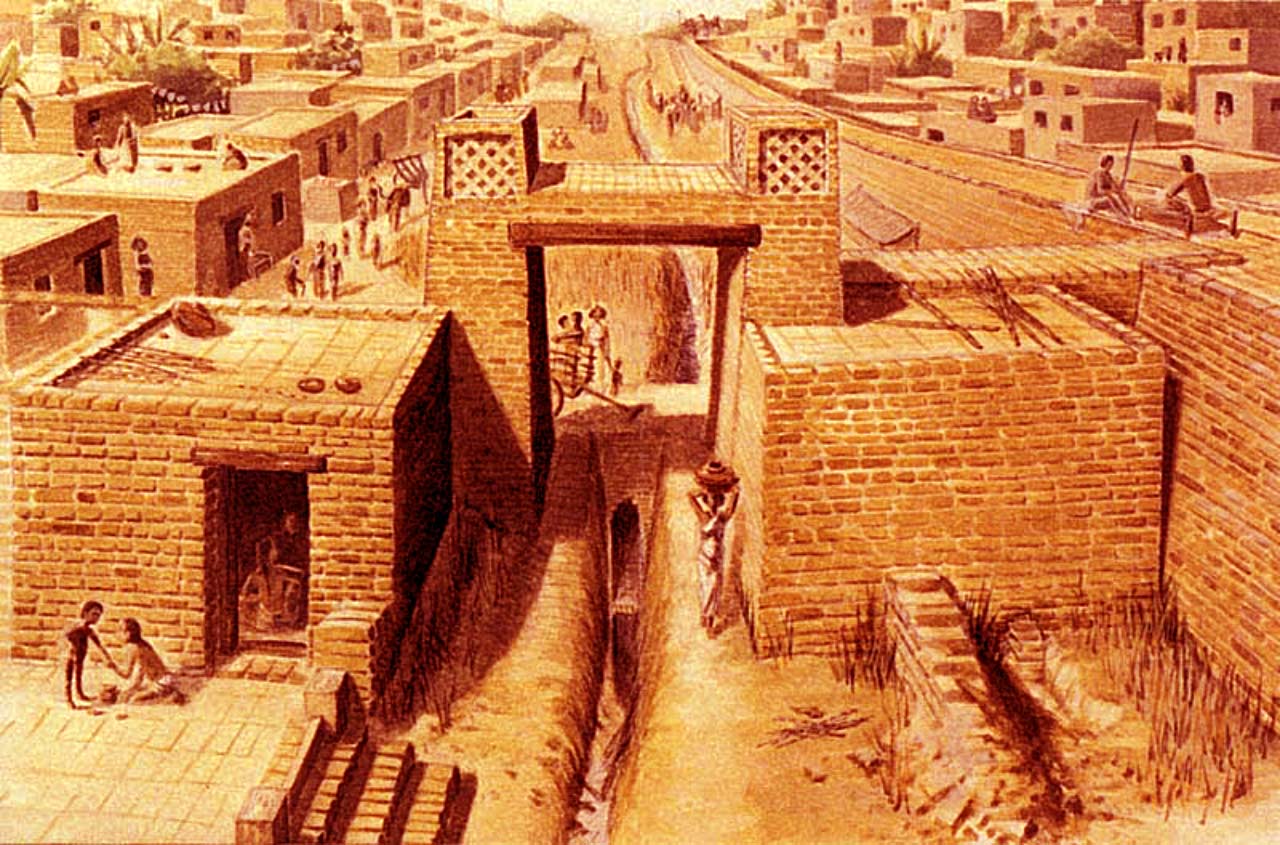
Depiction of the Harappan civilization, located in the Indus River Valley

This is the Harappan civilization that inhabited the Indus River valley some 5,000 years ago. Surviving for about two millennia, it is believed that this society survived without any major wars or conflicts, and is known to be one of the only ancient cities to do so. Archaeologists have never uncovered any signs of ash (indicating whether the city had ever been burned), weaponry, or even of an army itself.

What makes this especially profound is the prominence of army monuments in civilizations surrounding the Indus River Valley, such as those found in Mesopotamia. However, the fact that the Harappan society shows no traces of an army might be contingent on the fact that these were fairly migrant people. Through the analyzation of teeth found in burial grounds in Mohenjo-Daro (the largest city of the Harappan people), archaeologists discovered that many drank water from a source other than the immediate region, suggesting many people came and went from the city often.

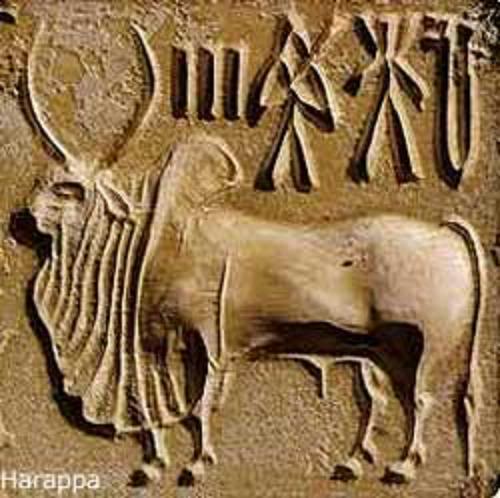
Then what were the Harappan people so focused on besides warfare? Artifacts show that these people were very involved in the art of writing and even science. Markings on pottery show the transition from crude inscriptions to an extensive alphabet, and Harappan cities showcase a firm understanding of engineering, with urban areas built along strict grids and the standardization of bricks essential in the building of their structures.

Signs of character usage on a Harappan seal

So what was the Harappan’s demise, then, if it didn’t engage itself in warfare? Many speculate that rather than a quintessential “fall” within the society, it simply turned into a more nomadic group. This could have been caused by the arrival of the Aryan people in the area. Others suggest that the Harappan people simply shifted away from an urban, mercantile society, and instead adopted a more agricultural lifestyle, eventually merging with the Vedic culture of South Asia.

Whether or not this society was actually void of warfare is not entirely for certain, but through the use of culture history, more truths are slowly being discovered.

Additional reading:

http://archaeologyonline.net/artifacts/harappa-mohenjodaro

https://www.harappa.com/har/indus-saraswati.html

Sources:

https://io9.gizmodo.com/a-civilization-without-war-1595540812

https://www.britannica.com/topic/Indus-civilization

http://thediplomat.com/2015/04/exploring-the-indus-valleys-secrets/

Pictures:

http://cdn.sci-news.com/images/enlarge/image_1705_1e-Harappa.jpg

http://transmissionsmedia.com/wp-content/uploads/2012/11/marsn-6.jpg

Link to original post in Reall Archaeology