GTA (Grand Theft Ants): Social Parasitism Within Ants

When anyone mentions ants, you probably think of the small insects that make colonies within those little hills. Although it is true that many ants are social organisms, there are some ants that are social parasites. Unlike most ants and … Continue reading

Share
More Galleries | Comments Off on GTA (Grand Theft Ants): Social Parasitism Within Ants

A Second Look at Fiddler Crabs Hooded Burrows

This gallery contains 2 photos.

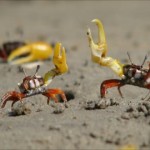
Meet our friend Uca terpsichores, known commonly as a type of fiddler crab. Fiddler crabs are a group of small crabs that may be found in shallow waters of oceans, swamps, mangrove, and lagoons. They are known for the funny, … Continue reading

Share
More Galleries | Comments Off on A Second Look at Fiddler Crabs Hooded Burrows

Why the early bird should miss their flight

http://live.drjays.com/wp-content/uploads/2011/08/0620854-e1314346924912.jpg

(http://live.drjays.com/wp-content/uploads/2011/08/0620854-e1314346924912.jpg)

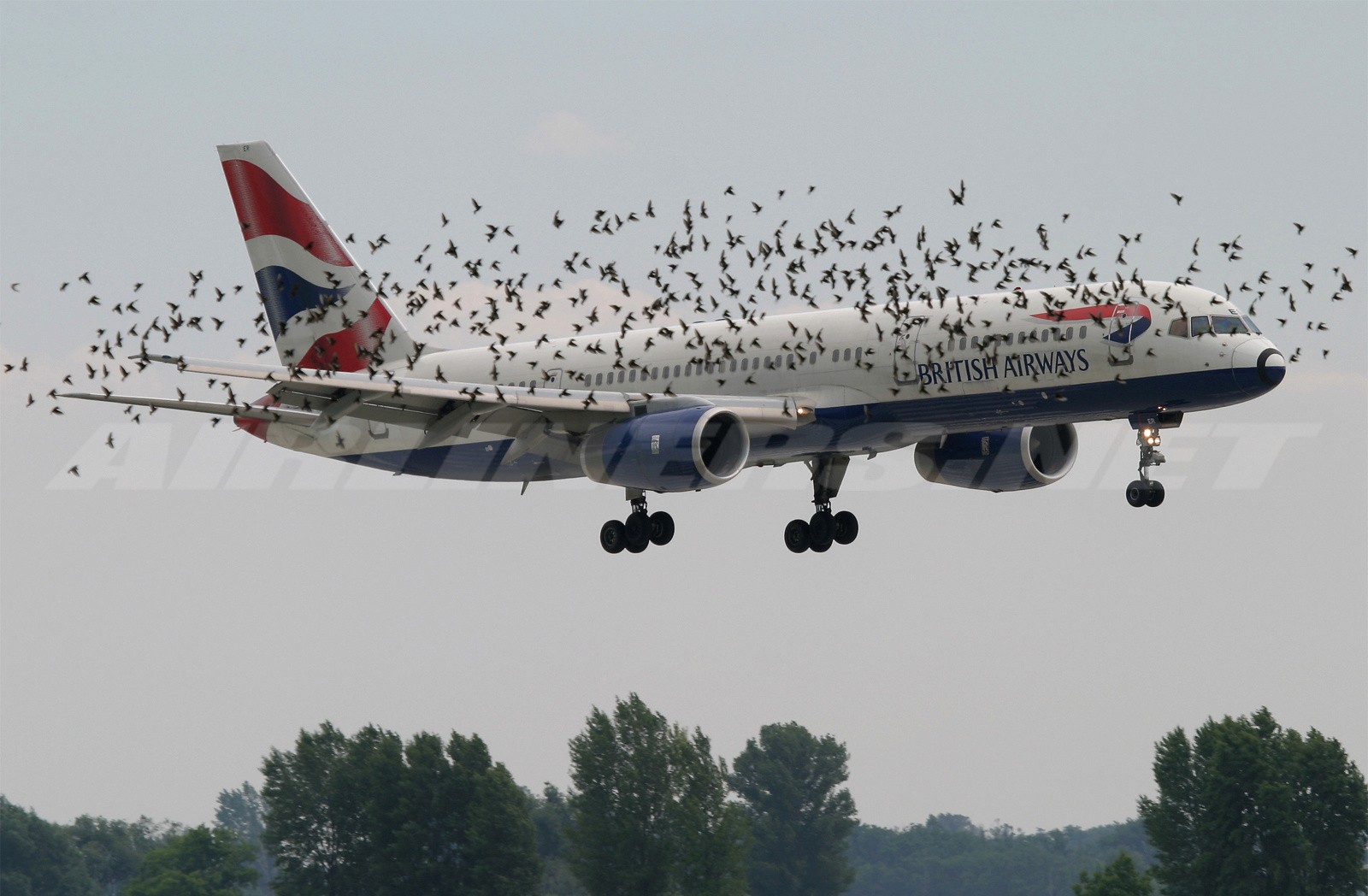
       Have you ever considered how any noise you make is affecting the environment? More specifically, how does noise or pollution affect how animals live and communicate with one another? Previous studies have looked at the effect of anthropogenic (human-made) noise on birds and their communication. These studies have been conducted in urban areas where traffic may be heavy, as well as suburban areas near ecological preserves that may also be polluted by noise to a lesser extent. Research has shown that birds have been calling at either higher frequency to avoid being masked by lower frequency background or simply calling louder and thus naturally increasing their baseline frequency.

            A more recent study has investigated how birds have adapted to deafening sounds that completely mask their calls. Gil et al. observed a trend at locations near airports throughout Europe showing a general advancement in dawn singing time. One hypothesis is that the birds are calling earlier in order to reduce the amount of overlap with periods of intense aircraft noise. They also noticed that this modification in morning call initiation was stronger in species whose normal singing time was relatively late. This data was collected by recording the sounds of ten major bird species before and during early morning aircraft traffic in three different zones: 1) next to the airport, 2) near the airport, and 3) control zone several miles from the airport.

Although several factors may have caused the differences in initiation of call times, they were able to rule out some. Species diversity between the three zones was not significantly different so the abundance of one type of bird did not affect the data. The amount of light that hit the regions was also not significantly different. Thus the authors felt safe to say that the noise coming from the airports was causing a significant impact on the advancements in dawn singing times.

So what does this mean for birds living near airports or heavy noise pollution? Behavioral plasticity may allow for the survival of avian populations in areas of high noise pollution. However, such deviation likely involves departing from optimal singing times, leading to higher energetic costs. If a bird has to call for 20 extra minutes everyday, they may need to compensate by increasing energy intake. Without more food, this could have adverse physiological or circadian side effects. In addition to this, there are evolutionary implications that involve the speciation of two populations that live in close proximity that exhibit different behaviors. If one population is singing and finding potential mates at an earlier time than another, this pre-mating barrier may cause the population to become genetically isolated because the two populations will no longer share mating call times.

Share
Posted in What's New in Sensory Ecology? | Comments Off on Why the early bird should miss their flight

The effects of predation on the visually-based mating signals of the male brown anole (Anolis sagrei)

This gallery contains 2 photos.

Communication is vital to the survival of many species as it facilitates various critical aspects of social interaction, including territorial establishment and reproduction. Attention is a significant facet of communication as an individual receiving the signal, or information, must be … Continue reading

Share
More Galleries | Comments Off on The effects of predation on the visually-based mating signals of the male brown anole (Anolis sagrei)

The Singing Life of the Snowy Owl (Bubo Scandiacus)

The most prominent sources of information on the Snowy Owl comes mostly from the work done by scientists such as A. Watson, G. M. Sutton and D. F. Parmelee during the 1930’s thru the late 1950’s and then in the … Continue reading

Share
More Galleries | 1 Comment

American Robin blog post #2

This gallery contains 2 photos.

American Robins (Turdus migratorious) belong to the suborder oscines, a large suborder of passerine birds that encompasses most songbirds. They are open-ended song learners: they continue to learn new songs throughout their lives. Nestlings first acquire calls which they use … Continue reading

Share
More Galleries | 1 Comment

General Information on the Eastern Bluebird (Sialias sialia)

This gallery contains 3 photos.

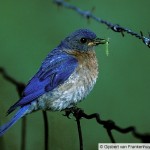
Appearance: The Eastern Bluebird, scientifically known as Sialia sialis, gets its name from its blue appearance.  The male has bright blue upper parts, a red/orange throat, breast and flanks, a white lower belly and undertail-coverts, a red/orange or white chin, … Continue reading

Share
More Galleries | 1 Comment

The Northern Cardinal(Cardinalis cardinalis) Song

This gallery contains 4 photos.

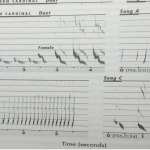
Types of songs and Calls The song of the Northern Cardinal is 2-3 seconds long and consist of a string of slurred whistles usually getting faster and turning into a trill. The Northern Cardinal has 16 distinct calls. The most … Continue reading

Share
More Galleries | 2 Comments

The Singing Behavior of the Eastern Bluebird (Sialia sialis)

This gallery contains 3 photos.

The Eastern bluebird is most commonly known for its unmistakable, vibrant coloration. However, the bluebird’s brilliant plumage is certainly not its only unique feature; its frequently overlooked capacity for vocalization is perhaps even more remarkable. Ertelt, C.A. Eastern Bluebird Singing. Retrieved December … Continue reading

Share
More Galleries | 1 Comment

Biology of the Barred Owl – Strix Varia

The Barred Owl (species name Strix Varia) also goes by the names Hoot Owl, Eight Hooter, Rain Owl, Wood Owl, and Striped Owl. They are often mistaken for Spotted Owls, which are visually quite similar. This mixing up of the two species is not limited to amateur birders; hybridization is occurring between the species as the Barred Owl moves into Conifer forests that were once occupied solely by Spotted Owls.

Spotted Owl Left Barred Owl Right

Spotted Owl (left) Barred Owl (right)

Barred Owls are overall mottled brown and white, with their undersides being mostly white with vertical brown bars. The upper breast has horizontal brown bars.  Unlike many other species of owls, that do not have ear tufts on their round heads. A fairly large bird, Barred Owls have a wingspan of 96cm to 125cm and may weight 500 to 1050 grams with the females typically about 1/3 larger than the males.  The eyes are large and dark with a face that is a relatively light pale brown color. The beak and feet are yellow with dark black talons.

Habitat of the Barred Owl

If you are looking for a Barred Owl, you will do well to search high in the trees of an old growth forest. They prefer large deciduous, evergreen, and sometimes coniferous trees for nesting and roosting. Their taste for fish means that they often live near streams or swamps. They have also been found in the suburbs, Vassar Farm, and Hyde Park.  Luckily for you, they don’t migrate, so you will find them in the same general areas year round.
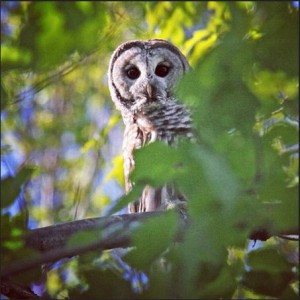
Barred Owl peeking between the trees at Vassar Farm

Barred Owl peeking between the trees at Vassar Farm

They are nocturnal, and so they will usually be hiding in dense foliage when the sun is out. At night, or when it is rather cloudy, they will be active, hunting voles, mice, squirrels and many other small mammals. These ground foragers will also eat amphibians, reptiles, smaller birds, and invertebrates, such as worms. They will wait atop a perch until prey is spotted before swooping down to grab and eat the creature in the same place it was captured. If the prey is rather large, the Barred Owl will carry it back up to a roosting branch and eat up where it is safe. Occasionally they will wade in water to catch fish or frogs, but you’re much more likely to find them in branches up above the water. Don’t count on hearing them when they do decide to strike; they are nearly silent flyers thanks to specially designed feathers.
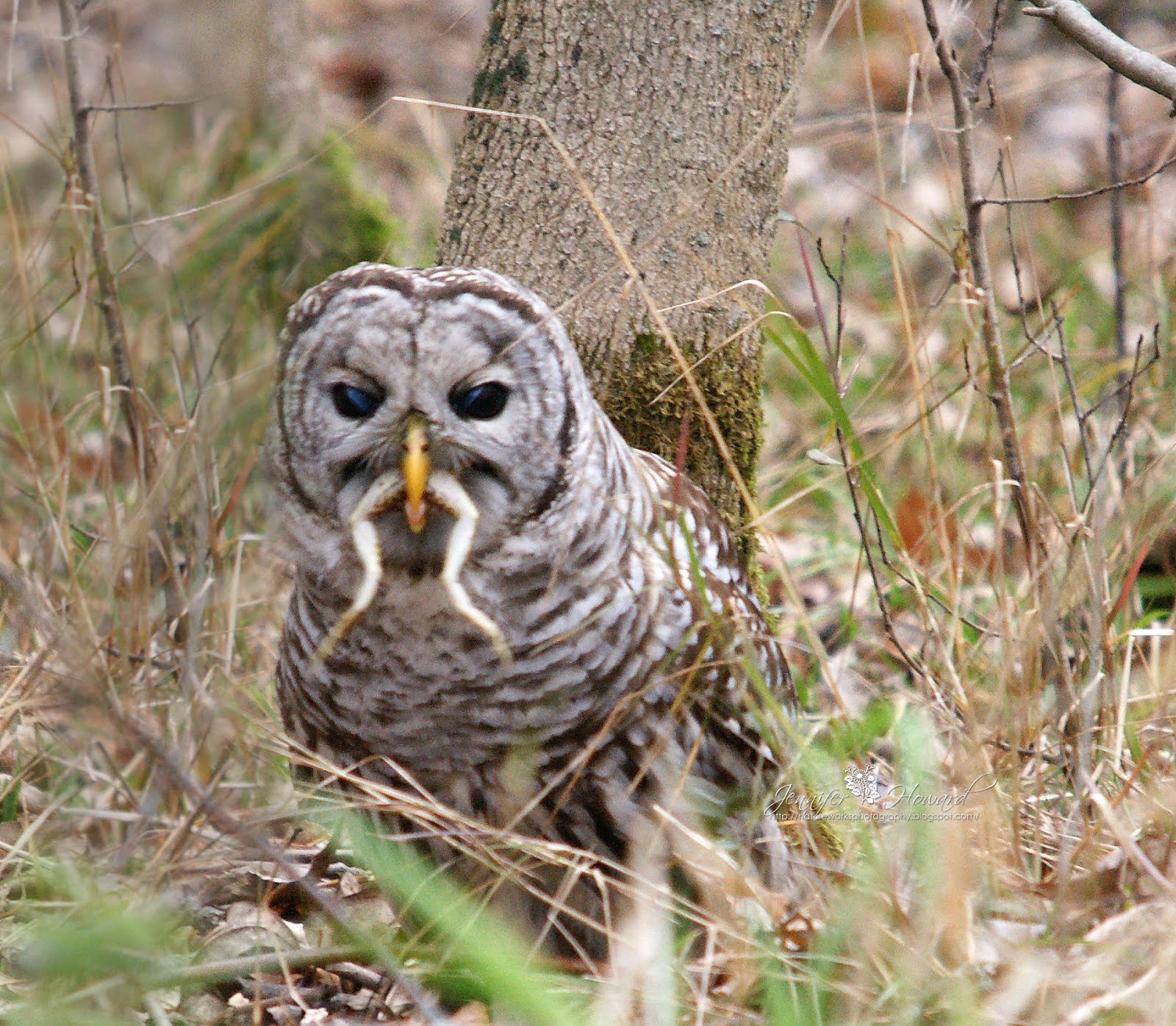
Barred Owl munching on a frog

Most of the year, Barred Owls are very solitary and will defend their territories fiercely. As breeding season approaches in late winter, however, they will begin searching for their mate. There is evidence to suggest that Barred Owls return to the same mate every year, but that doesn’t mean the courtship displays stop after the first year a pair couples up. Females will perform a caterwauling solicitation call and males will call back with their own hooting response. After this, a male may dance for the female by nodding, bowing, spreading the wings, and slowly slipping along a branch. These call and response displays will occur up until March, when breeding begins. Breeding season spans from March until August.

A pair of Barred Owls roosting

The nests will be prepared high up, 20 to 40ft, in dead tree cavities, but Barred Owls aren’t picky; they will often take abandoned bird and squirrel nests, augmenting them with a bit of lichen, sprigs, or feathers. They may have 1 to 5 eggs that incubate for about 1 month. It is suspected the the females tend to be larger than the males so that they have enough internal resources to incubate for this lengthy period of time. She is reliant on the male to bring her food when nesting, but the female’s extra energy deposits are certainly useful when he comes up short.
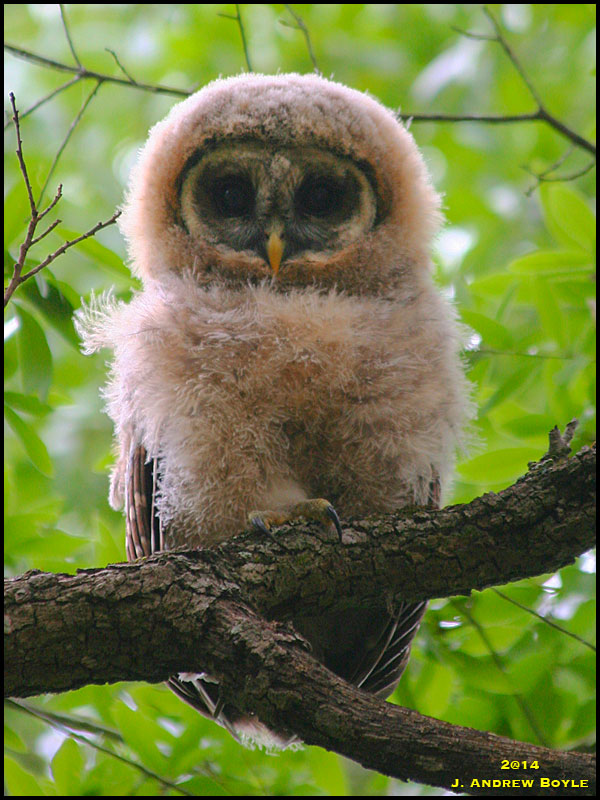
Barred Owl chick with all its down feathers

Those 1 to 5 eggs are typically the only brood the pair will have for the season, but if the eggs are not successful, they will take advantage of the long breeding season and have some more. Once hatched, the male will help bring food to the female that she can tear up and feed the chicks. After 4 weeks, the hatched offspring will crawl out of the nest and roost in nearby branches, where the parents continue to watch out for them for 4 months or more, a very long period of time compared to most owls. Overall, Barred Owls are fascinating creatures that are a joy to observe.

A Barred Owl spotted on the Vassar Farm


Audubon. “Barred Owl Strix varia.” Accessed December 1, 2014. http://birds.audubon.org/birds/barred-owl.

Cornell Lab of Ornithology.  “Barred Owl Identification.” Accessed December 1, 2014. http://www.allaboutbirds.org/guide/barred_owl/id.

Cornell Lab of Ornithology.  “Barred Owl Life History.” Accessed December 1, 2014. http://www.allaboutbirds.org/guide/barred_owl/lifehistory.

DeOrsey, Stan and  Butler, A. Barbara. The Birds of Dutchess County, New York Today and Yesterday A survey of current status with historical changes since 1870. Poughkeepsie, New York: The Ralph T. Waterman Bird Club, Inc., 2014.

Lewis, Deana. “Barred Owl – Strix varia.” Last updated July 23, 2013. http://www.owlpages.com/owls.php?genus=Strix&species=varia.


Photographs (in order):

Greenberg, Joel. “Birds with Hooked Beaks.” Accessed December 1, 2014. http://www.birdzilla.com/bird-identification/which-bird-did-you-see/search-by-body-shape/hooked-bills.html

Cornell Lab of Ornithology. “Spotted Owl Identification” Accessed December 1, 2014. http://www.allaboutbirds.org/guide/Spotted_Owl/id.

Cornell Lab of Ornithology.  “Barred Owl Identification.” Accessed December 1, 2014. http://www.allaboutbirds.org/guide/barred_owl/id.

Cornell Lab of Ornithology.  “Barred Owl Identification: Range Map” Accessed December 1, 2014. http://www.allaboutbirds.org/guide/barred_owl/id.

Eidam, Derrick. “Barred Owl. Taken at Vassar Farm.” Accessed December 1, 2014. https://www.flickr.com/photos/eidamphotography/8112597629/.

Owlguy. “Mr & Mrs Barred Owl – Frog Leggs.” Accessed December 1, 2014. http://owlguyy.blogspot.com/2013/01/frog-leggs.html.

“Barred Owl Pair.” Accessed December 1, 2014. http://s49.photobucket.com/user/Rstrick2/media/Owls/barred-owl-pair.jpg.html.

Drew’s Birds. “Momma and Baby Barred Owl.” Last updated April 20, 2014. http://drewsbirds.blogspot.com/2014/04/momma-and-baby-barred-owl.html.

Eidam, Derrick. “Wildlife Photos from 03/03/13 – Vassar Farm.” Last Updated March 7, 2013. http://deidam.wordpress.com/2013/03/07/wildlife-photos-from-030313-vassar-farm.
Share
Posted in Dutchess County Birds | 1 Comment