It was a pleasant Thursday morning. We packed up the car and set off to our new site, in hopes of doing a quick dig and finding some cool things to add to our collection.
The Dull Ubiquity of Placeless Music Festivals
Some questions for investigations here, presented in the form of a rant. As part of my research in musical urbanism, I consume a fair amount of music coverage in print and online. Jesus Christ, all I seem to find these days is “writing” about generic touring festivals headlined by Coldplay/Metallica/Fiona Apple/Beach House/you name it. News about new music festivals. News about cancelled music festivals. News about how the concert industry, which has put so much of its eggs in the festival basket, now outpaces the recording industry. And the evergreen question, what’s the line-up for Coachella 2013?

Look, I fully support the right of youth to indulge in the mass communion of bad sightlines, expensive food, sunburns and portapotty stench for the romantic pursuit of sex, drugs and [insert any pop genre here]. I’ve indulged in that myself. Coachella, Glastonbury, Sasquatch, Werchter et al—by all means, let them be the gateway drug to a rich life as a music listener. But it’s interesting and, frankly, discouraging that the generic, touring festival seems to be the end game for live music these days, with generally no thought being put to how live music might be presented more imaginatively and meaningfully for listeners and musicians alike. And, conversely, little attention is given to those more imaginative and meaningful festivals.
Place is an especially important concern here. While geography is what ostensibly differentiates one Live Nation mega-event from the next, inside the venues the performers, the lineups, the layout, the vendors etc. are generally undistinguishable and internchangeable across the events. They’re carefully themed spaces that are paradoxically placeless, at least beyond the conceits of the event. The rise of generic touring festivals don’t yet make me worry for the fate of cities, urban economies, or local music scenes. But I sometimes wonder if the dull ubiquity of big-money touring festivals makes younger audiences eager for the theming of their everday spaces: the commodification of colleges and universities, the insularity of the hipster neighborhood, and so on.It’s understandable why ‘independent’ music, which at one pre-ironic point in cultural history was opposed to such commodification, increasingly hitches its wagon to corporate music festivals today. Although touring the music-festival circuit can be a draining, exhausting slog, the promotional opportunity can’t be beat, at least when these events are all any music publication or blog wants to write about. I suspect it also helps that “indie rock” is now mainly the purview of 20- and 30-somethings without dependents to tend to.This is something that the EDM industry has especially figured out. The facts that this music thrives in nightclubs and other smaller venues, and that rock music has long dominated the festival circuit, make me think there’s nothing intrinsically “rave” to the big-field setting for EDM festivals today. EDM has more likely thrived because the barriers to entry for performers are low. Bringing along a laptop or (for the old-school purist) a crate of records is all it takes for most DJs to hit the stage—no long load-ins or soundchecks necessary. Perhaps this infrastructural advantage is the real basis for the recurring rockist insult that “no talent is required to play electronic dance music.”At least those are my hypotheses. Here are a few more.
1. The context for this state of affairs isn’t live music itself. Obviously, this is what happens after the recording industry loses its profit model. Live music is what David Harvey would call a spatial fix—a secondary circuit of accumulation that capital taps into when profits in the primary industrial circuit dry up. We’re simply seeing the next iteration out from the recording industry’s abandonment of artist development and its short-sighted embrace of the quick-profit singles market.
The above means let’s not celebrate the initiative and entrepreneurialism of the “concert industry” just yet, since the high rate of event cancellations suggests they’re still largely throwing business models against the wall to see what sticks. An important question for further investigation is, Just how distinct in name/experience/profile are the players and financial backers in the “concert industry” from the rest of the “music industry”?
2. If we might expect the bovine migration of the corporate sector to the music-festival sector, I’m more disheartened by the failure of imagination on the part of the music media to write about anything else. Their rote, uncritical coverage isn’t limited to summertime, when festivals generally overshadow the release of noteworthy albums and (another dismaying phenomenon) the TV season for Idol, The Voice, etc. How many freakin’ tweets have I read about Coachella: the bands, the fashions, the line-up for next year, the threat of its cancellation, yada yada yada? And South By Southwest… thank god for the SXSW tweet-blocker. I think at least three factors could be culprits:
a) the collapse of the publishing industry, which has shrunk staff, dried up money for original reporting (i.e., news that isn’t “researched” via Twitter or a YouTube livestream), and made it hard for remaining music/arts & culture reporters—particularly at weekly alternative newspapers, still the source for the best local music coverage—to keep their ears to the local ground and make a living;
b) the tail-wags-dog rationale of bigger publications covering “what younger readers want.” So Spin Magazine calls its July/August edition the “Outside Issue,” etc. Implicitly, this further yields the album market to older/occasional listeners who (it will be assumed) want “the next Adele.”
c) the convergence of culture reporting and business reporting that has been encouraged by the dominance of Richard Florida’s creative-city paradigm. While the shrewd promoters will spin a line about how their event borrows from the SXSW model, city papers can now rationalize their arts coverage as a means to a more ‘legitimate’ end.
3. What’s perhaps most surprising is the absence of traditional urban business community involvement in the music-festival sector. Why is this? The rare “post-rave growth coalition” notwithstanding, I suspect the players in most urban growth machines rarely overlap with the world of festival promoting. This may be because many of these events are held in big, exurban fields, which suggests that large-scale property owners will be the main node of connection. But so far I don’t see much active participation (as opposed to passive profit-making) in festivals that happen in city environments either, short of a few notable exceptions—Austin, Berlin, etc.Traditionally, being an urban booster on the chamber of commerce has been the antithesis of hip. Historically, this has been the basis for criticism of its philistine Babbitry. In these ironic, hipster-saturated times, it’s a rare source of integrity for the urban business community. I happened upon a rare music event organized by a urban business improvement district recently: the Downtown Albany Blues Music Competition. Evidently the Chamber of Commerce even got to select the line-up of performing. How “hip” is that?
Urban farming in Cuba
Click here to view the embedded video.
.
Listening to Home, Encountering the Other: Book Review of “Migrating Music” (Jayson Toynbee and Byron Dueck, eds.)
The settlement of foreign-born ethnic migrants has to be the oldest source of urban vitality. It’s also a wellspring of musical innovation. Might the latter connection offer insights into the modern city? That’s always my hope when I read books likeMigrating Music (Routledge, 2012). Edited by Jayson Toynbee and Byron Dueck, this volume addresses the cultural dynamics and social consequences of music that travels across borders. The most common scenario described within the volume is the diasporic one in which ethnic groups move to new countries and bring or rediscover their ‘homeland’ music. In other chapters, music migrates independently of a ‘native’ constituency. Hip hop takes hold of youth in countries with no basis in the African diaspora, this volume documents, while jazz performers and Brazilian genres might migrate at the behest of music industries and institutions.
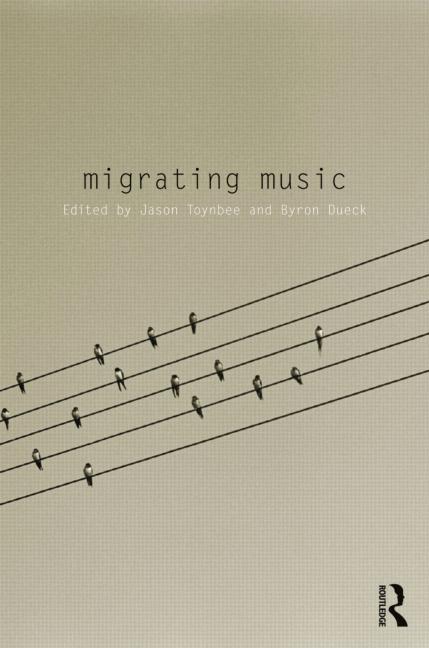
I’ve written recently about the prohibitive costs associated with recent edited volumes of musical scholarship. Although this was an issue when Routledge originally published Migrating Music in 2011, the book has now been released at a (comparatively) more affordable paperback price. The writings here grew out of a 2009 conference sponsored by the University of London’s School of Oriental and African Studies, and its contributors are predominantly based in European institutions. Accordingly, with a few exceptions the research gathered here was conducted in European settings, although the diasporic circuits that this volume charts extend into Africa, Asia and the Middle East. The omission of research on diasporic music in the Americas might irk readers looking for the latest thinking onbanda or reggaeton, yet as Toynbee and Dueck point out, “more than one-third of migration in recent years has been to Europe, making it the most important region of destination for migrants around the world” (pg. 13).
The book is organized into four sections. “Migrants” and “Translations” give respective emphasis to the listeners and forms/transformations of migrating music, while “Media” and “Cities” suggest the importance of material contexts for, respectively, disseminating and producing migrating music. As these edited volumes often go, Migrating Music is a bit of a mixed bag across the chapters. This is true perhaps more so in terms of its sections, which are otherwise well served by the various introductions prepared by the editors. While conceptually the importance of media and cities to the question of migrating music is inarguable, and (separately) the chapters within each section are generally quite interesting, these concepts’ development in the context of the volume’s organization isn’t as consistently up to snuff as the first two sections on “Migrants” and “Translations.”
Despite the title’s promise of entering new terrains, Migrating Music pays almost no attention to the digitally-circulated, club-focused fusions that sometimes get called World Music 2.0. (If this phenomenon doesn’t ring a bell, listen to music made by MIA, Diplo and Moombahton, or check out the writings of Wayne Marshall andLarissa Mann.) So, Pitchfork readers may find very little here to make their hearts skip a beat. A possible exception is Helen Kim’s chapter, “‘Keepin’ It Real’: Bombay Bronx, cultural producers and the Asian scene,” which examines the London Asian urban music scene in which a “post bhangra” sound incorporates fusions with hip hop, dancehall and R&B. However, her concerns in this chapter aren’t musicological but instead more reflective of a cultural studies agenda, e.g., how generic distinctions (here vis-à-vis the tasteful, drum-n-bass-flavored “Asian Underground” associated with Talvin Singh and Nitin Sawhney) reflect contested ideas about British Asian youth identity.
The opinion that the Asian Underground was not for Asians is a loud declaration that not all Asians are alike. It furthermore reclaims ‘Asian’ for a decidedly less highbrow audience, construing the Asian Underground not only as ‘middle-class’, but additionally as inauthentic insofar as it colludes with white middle-class tastes. By defining themselves in opposition to the Asian Underground, cultural producers [at London’s Bombay Bronx] assert that they are countering white, middle-class, hegemonic space (pg. 22).
This example highlights two defining features of Migrating Music. First, the intellectual undertaking here is typically rooted in the anthropology and cultural studies traditions. I confess a little disappointment that there’s almost no musicological analysis (much less music criticism) in Migrating Music, if only because as a sociologist I’m most familiar with the social scientific approaches. Who knows, maybe the musicologists and critics will find these approaches a valuable corrective to the scholarship they’re used to. But as cultural studies is especially prone to do, these approaches support a narrative that eventually abstracts out of the particularities of their subject matter—the historic/geographic contexts, collective dynamics, and cultural artifacts including the music itself—to arrive at a recurring set of social functions: the collective negotiation of identity, the restoration of community, national/ethnic reaction to change from without, etc.
Social science writing shouldn’t have to be a poetry contest, of course. At one level, the predictability of these scholarly ‘punchlines’ reminds us of the stability and durability in the organization of the social world, without which the social sciences would be lost. But it would be nice to hear these general facts of the social world within the music, wouldn’t it? In this regard, the most notable chapter is “Un Voyage via Barquinho: Global Circulation, Musical Hybridization, and Adult Modernity, 1961-9″ by Keir Keightley. Reviewing the ‘migration’ (really, the diffusion by key composers, filmmakers, and media gatekeepers) of the Brazilian bossa nova via the Roberto Menescal/Rondaldo Bôscoli composition “O Barquinho,” Keightley describes the emergence of a very particular, indeed now quite retro, structure of musical feeling: that sense of pre-rock “adult modernity” associated with early-1960s signifiers of James Bond-cool and the jet-setting journey into the “now.” (Later groups like Stereolab, Portishead, and Broadcast mined this specific musical vein quite well.) Keightley’s critical analysis of a key track (from Francis Lai’s soundtrack to the the 1967 film “Live for Life”) makes the reader want to listen closely:
Consuming the adult good life, whether via jet or wine, appears as the imperative of a new sensibility; why else would the injunction “live for life” be necessary? The chord progression’s half-step drop occur and reoccur, creating an effect suggestive of lingering in one place and thn moving onto another. Presenting a montage of moments at both the lyrical and musical levels, the song’s harmonic instability and pleasurable pausing remind us of the restless mobility that characterizes the global consumption at issue (pg. 119).
In a second defining feature, Migrating Music isn’t especially preoccupied with the ‘newest and most exciting’ musical forms if the latter are understood to be whatever excites young people in diasporic communities (or popular music scholarship). To its credit, the volume is even-handed in covering music that resonates across the generations. It’s enlightening to learn of what older Afghanis who have fled their wartorn country are tuning into—the subject of “Music, Migration and War: the BBC’s Interactive Music Broadcasting to Afghanistan and the Afghan Diaspora,” a fascinating chapter by John Baily. It’s important to examine the circumstances by which young migrants find new relevance in ‘old-fashioned’ music from their homeland (as Carolyn Landau recounts for one Moroccan Londoner in “‘My Own Little Morocco at Home’: A Biographical Account of Migration, Mediation and Music Consumption”). An ethnographically rich chapter by Laura Steils, “‘Realness’: Authenticity, Innovation and Prestige among Young Danseurs Afros in Paris,” documents the unexpected appropriation of ‘old world’ Congolese/Ivoirian styles of music, dance, fashion, speech and display by French-African youth caught up in themusique afro movement of the last decade.
This attention to the ‘old-fashioned’ extends to the “Media” section. While elsewhere the book establishes the importance of the Internet and social media to disseminating music across borders, all four chapters in this section primarily address radio. Even more curiously, half of these chapters pertain specifically toBritish broadcasters. In “Migrating Music and Good-Enough Cosmoplitanism,” Kevin Roberts interviews Robin Denselow and Charlie Gillett, the latter a storied music writer whose work as a radio DJ exposed untold numbers of British music fans to “world music” (a generic designation that has been partly attributed to Gillett). In “Ports of Call: An Ethnographic Analysis of Music Programmes about the Migration of People, Musicians, Genres and Instruments, BBC World Service, 1994-5,” Jan Fairley recalls her programming work on the titular show, which was recorded in English for global broadcast. (I’ll not count Baily’s chapter in this category, as the two Afghani radio programs for the BBC World Service he describes were broadcast in the Pashto language.)
If the rationale (never made explicit) behind operationally defining ‘media’ as radio include the fact that the latter remains the chief medium of musical distribution around the world, for native-born residents and transnational migrants alike, then the point is well taken. So too is the editors’ reminder that radio is indeed interactive (increasingly via real-time telephone calls and e-mails with listeners) and can now be heard on a variety of Internet-ready devices. Still, the Roberts and Fairley chapters address quite Anglo-centric topics, and in a breezy, analytically undeveloped manner no less, which gives off an unfortunate whiff of academic laziness. In principle their British views into “world music” is interesting, insofar as they hail from a classic setting of the colonial gaze that these authors wrestle with —well, at least Robins does—from a contemporary context. But I also noted that the contributors to the “Media” section were among the most senior and august scholars in this volume (e.g., Fairley is a past International Chairperson of the IASPM). Did these selections originate as informal “conversations” in the 2009 conference? Do they merit inclusion in Migrating Music alongside the empirical research of the other chapters?
To return to a familiar point of reference for most readers, let me address the issue of youth-based pop culture once again. Were the assembled authors given a vote, I think it’s likely they would nominate hip hop as the most widely practiced lingua franca among youth cultures around the world. In all its artistic (and contested) diversity, hip hop is central to Laudan Nooshin’s chapter on “Hip-Hop Tehran: Migrating Styles, Musical Meanings, Marginalized Voices”) and Antti-Ville Kärjä’s chapter, “Ridiculing Rap, Funlandizing Finns? Humour and Parody as Strategies of Securing the Ethnic Other in Popular Music.” Elsewhere, hip hop gets alchemized along R&B and dancehall in Helen Kim’s chapter on London’s “Bombay Bronx” club, while the danseurs afros in Laura Steils’ chapter reject hip hop’s earlier grip on Afro-French youth to embrace Congolese and Ivoirian flavors.
This spectrum of local responses to the global spread of hip hop highlights Toynbee and Dueck’s chief theoretical contribution to the scholarship on migrating music, which elaborates anthropologist Michael Taussig’s ideas of mimesis and alterity (also the title of his 1993 book). Taussig’s concepts offer a different, more relativistic framework for understanding the encounter with a dominant culture’s influences than simplistic ideas of “Westernization” or “cultural homogenization.” Mimesis (or imitation, what the assimilation of outside influences evidently results in) can occur when two cultures encounter each other, as a way of containing their misunderstood or threatening cultural differences (or alterity). Taussig asserts that this process is rarely unidirectional, as both cultures are transformed in some significant way when appropriating the other’s elements; in this way, homogenization isn’t a foregone conclusion of mimesis. But the editors point out that Taussig’s framework still supposes the binary of the colonial encounter, whereas migrating music can reveal responses to more local, less hierarchicalized orders.
None of the assembled authors in Migrating Music takes up Taussig’s framework or the editors’ elaboration explicitly, but the eclipse of hip-hop by musique afro among the Afro-French youth Steils studies offers a good illustration of what Toynbee and Dueck are getting at. Whereas hip hop was assimilated as a means of addressing the racism of French whites, it became less relevant once assimilation of Congolese/Ivoirian influences gave Afro-French youth a way to renegotiate more subcultural (e.g., banlieue-specific) meanings of “realness.” This is a potentially productive framework, I think, for understanding the often complex semiotic innovations of diasporic cultural production. Certainly it’s an alternative to “glocalization,” an unlovely piece of academic jargon that the all the authors thankfully neglect. More to the point, mimesis and alterity highlight the signifying politics at work in diasporic cultural production, far more than the broad, ambiguous notion of glocalization does. However, the latter evokes a spatial framework that is intuitively salient to urbanists. The absence of such a spatial framework in this book underscores the limits of Migrating Music‘s contributions to cultural urban studies, as well as the insights that a more active urbanist reading of this volume can yield.
Throughout the book, “cities” are on the whole conceptualized narrowly as material sites for cultural production. In Kristin McGee’s chapter “‘New York Comes to Grongingen’: Jazz Star Circuits in the Netherlands,” Grongingen is the location for a musical academy whose jazz program derives international repute from its connections to NYC. In Helen Kim’s chapter on Bombay Bronx, London is the site of a particularly influential weekly nightclub. In Sara Cohen’s chapter, “Cavern Journeys: Music, Migration and Urban Space,” Liverpool is the site of the Cavern Club, a performance venue that sustains musical communities as well as (in the neoliberal era, with tragic historical oversights) supports urban brands. This focus on cultural production means the city qua community—of ethnic/migrant groups, neighborhoods, music fans or otherwise—is largely undeveloped in Migrating Music.
However, elsewhere the volume highlights diasporic ‘publics’ that are constituted by migrating music. As various chapters show, these publics may have urban foundations, although the analysis typically emphasizes publics’ manifest content—e.g., the imagining of cross-border diasporic nations and ethnicities—over their geographic milieu. (As a reader from urban sociology, I was puzzled how frequently some authors downplayed the physical location of their human subjects, at least in comparison to the imaginary locations evoked by the music.) The volume’s relative neglect of urban milieux for diasporic publics, and of the prospect that settlement in concrete places can in fact transform and differentiate the scattered members of diasporic publics, puts it at odds with the thrust of much scholarship in urban studies. Then again, the latter might benefit from this volume’s insights into the signifying work that goes into imagining publics, a work that involves considerable agency on the parts of audiences and contingency in the materials available to construct publics. Just think of how the concept of publics might retorque the critical scholarship on urban branding and hipster enclaves, to name two recent topics in urban studies.
The migration of music and people also supports another feature of cities: cosmopolitanism. Indeed, Byron Dueck questions the conventional association of cosmopolitanism with cities: “Unacknowledged comopolitanisms are hidden everywhere, all the more easily ignored when they seem to be manifestations of the traditional, the rural or the sacred” (pg. 199). This is a valid way to understand what’s at stake when (as John Baily’s chapter describes) women from Afghanistan call into the BBC World Service program Zamzama and share their zamzama—Pashto for everyday humming and singing:
AMINA: Salaam. Where are you speaking from, Farahnaz Jan?
FARAHNAZ: I’m from—in the north…
AMINA: And are you married?
FARAHNAZ: Yes, I’m married.
AMINA: Farahnaz Jan, do you listen to music?
FARAHNAZ: Yes, I listen to music, especially to the BBC. When I go to the kitchen I take my radio [mobile telephone] with me and listen every minute I’m in there. This is the song I want to sing.
[Farahnaz sings]
AMINA: Farahnaz Jan, thank you very much. I thought I could hear someone in the background while you were singing. Is there anyone else with you who would like to sing?
FARAHNAZ: No, there’s no one around because my husband’s very strict. That’s why I came to the kitchen as soon as my phone rang.
AMINA: I hope your husband is not too strict.
FARAHNAZ: Because of the situation in this country and because we’re in a village, people feel they have to be strict, they’re so nervous about upsetting someone.
AMINA: Your husband won’t be upset if he hears you singing on the BBC?
FARAHNAZ: He doesn’t know my [singing] voice that well!
AMINA: Thank you very much (pp. 189-90).
Ultimately, I think it goes too far to suggest that such mass-mediated musical exchanges occur outside the auspices of urbanism (as social condition). My view on this isssue may be more philosophical than empirical, but it seems that what Georg Simmel and Max Weber would recognize as the techno-rational media for modernity—in this case its structured encounter with the ‘other,’ the abstract reflection such encounters facilitate, and (ideally) the civilizing effect that results—emerged in fundamental respects out of the historic cauldron of city life. To acknowledge that modernity has since escaped its original setting hardly means that indicated urbanism has lost its significance. On the contrary, giving a nod to Louis Wirth, urbanism is now a portable way of life. In this way, perhaps new encounters with urbanism are among the best of what migrating music offers its listeners.
Weird Scenes from the 5 and the TCH: Metropolitan Structure and Rock in Canada
It was November 1977, and it was the first time any of us had traversed our home and native land. We soon found out what a big-ass country Canada is. The ground in Saskatchewan was covered with snow, and it was so fucking flat that you could see a grain elevator miles away. It looked like the earth had been run over by a giant bulldozer! Let’s just say the beauty of the heartland is an acquired taste. The road was like a skating rink through eastern Manitoba. I drove through a flotilla of cop cars and tow trucks, my knuckles white from grippin’ the wheel.
– Joey Keithley, I, Shithead: A Life in Punk (pg. 39).
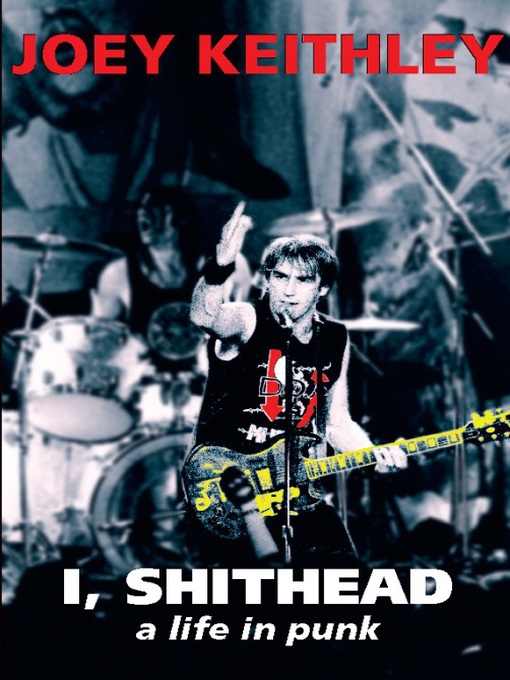
This passage from the autobiography of D.O.A. frontman and Canadian punk pioneer Joey Keithley, a.k.a. Joey Shithead, conveys a fact of life known to all Canadians: theirs is a huge country with a fairly small population. Consider this: in 2011, Canada had a population of 33,476,688 residents within its 3,855,103 square miles (9,984,670 square kilometers). That gives the country a population density of 8.7 people/square miles (3.4 people/square kilometers). By contrast, in 2010 the U.S. had a population density of 83.0 people/square miles (32.1 people/square kilometers), while the U.K. had the respective figures of 661.8 people/square miles (225.5 people/square kilometers).
Of course, most of Canada is undeveloped or inhospitable by “modern” standards (scare quotes to give the country’s indigenous First Nations inhabitants their due). Thus, its population is geographically concentrated within a relative handful of cities close to the U.S. border. Canada’s statistics office reports that in 2006, 80.2 percent of its national population lived in “urban areas.” (I couldn’t find the most recent 2011 figures for urban population.) The census metropolitan areas for Canada’s three biggest cities alone — Toronto, Montreal, Vancouver — account for 42.3 percent of this urban population, or 34.4 percent of the entire population. As a point of comparison, you would have to sum up the 17 largest metropolitan statistical areas in the U.S., from NYC to San Diego, before you reached a comparable proportion of the national population.
It might seem that Canadians with an inkling to visit the big cities would have an easy time of it, considering how few of these major metropoles their country has to offer, but the vast distances separating the three cities can raise a significant obstacle. This point was illustrated to me when I met up recently with a recent graduate from Vassar College who hailed from Victoria, a charming little coastal British Columbian city some 70 miles (114 km) and a ferry ride away from Vancouver. A bright, intellectually curious student, this individual is very much what I’d call an urbanist by disposition. Just last summer, she bicycled across the U.S. with a team raising funds for Habitats for Humanity. And yet… she had never visited Toronto or Montreal, Canada’s two biggest cities.
Although I have no idea how typical her experience is for Canadians living on the West Coast, I’ll bet it isn’t all that out of the ordinary. U.S. citizens wouldn’t necessarily expect all Seattleites to have visited Chicago or New York City. Why should we expect Canadians living just across the border to have spanned similar distances? Well, speaking from an American point of view, we do it because Canadians have so few big cities in Canada to choose from than we do. Essentially, if you’re looking for the cosmopolitanism, diversity, amenities and cultural developments (including architecture) that we associate with ‘great cities’, there’s really only three places in Canada to choose from. Why wouldn’t a self-conscious urbanist take the time to visit these places?
Perhaps the construct of national borders blinds us to the more relevant metropolitan structure. To return to my example, this individual did have a repertoire of cities that she was intimately familiar with growing up in Victoria. They were situated along the Pacific West Coast and U.S. Interstate 5 (“the 5,” in regional parlance): Vancouver, Seattle, Portland, San Francisco, Los Angeles, San Diego. Indeed, Washington state’s San Juan Islands stared at her and other Victorians any time they took the ferry, while her story of the family roadtrip to Disneyland could be substituted for any U.S. resident’s experience, except for the added element of passports.
These features of Canada’s metropolitan structure, particularly the vast distance separating Vancouver from the country’s bigger cities along and off the Trans-Canada Highway, have exerted an overlooked influenced on the development of pop music — in Canada, the rest of North America, maybe even further. Here now, three vignettes from the North America’s highway vector, along the 5 and the TCH.
The Collectors
I recently watched “Shakin’ All Over: Canadian Pop Music in the 1960s,” a CBC documentary from 2006 based on Nicholas Jennings’ book Before the Gold Rush: Peace, Love, and the Dawn of the Canadian Sound. The doc moves quickly through the usual suspects (Neil Young, Joni Mitchell) to focus on the national groups whohad hits and played gigs within Canada. As for the ascent of bona fide 60s rock played by and for countercultural freaks is concerned, the doc assigns Vancouver a key role in the story (at about 14:00 into this clip).
The Canadian music scene continues to thrive locally in the mid-1960s, but without any national music infrastructure. There is no cross-country radio airplay or touring circuits, so West Coast musicians look south to the psychedelic sounds of California. Like San Francisco’s Haight Ashbury, Vancouver’s music scene is based in incense-filled clubs like the Afterthought and the Retinal Circus. Dozens of adventurous bands spring up with their own mind-expanding lightshows and groovy poster art.
The first significant group in this story is the Collectors, flower-punk pioneers from Vancouver who morphs into a Haight Ashbury folk-rock group, Chilliwack. Tapping into the West Coast connection wasn’t merely a matter of musical influences for the Collectors; it was also a matter of career practicality.
It was easier for us to travel 1500 miles to L.A., and there was a great center of music there, than it was for us to go 3000 to Toronto or New York.
– Bill Henderson, The Collectors
In turn, the geographical shift of countercultural musical energy to the West Coast between 1967-69, the key years for the Collectors, gave Vancouver groups special access to the central influences, markets and industry feeding the baby boom rock generation. This was a not-inconsiderable advantage that groups from Toronto and Montreal would be hard pressed to match.
The Deviants
The West Coast urban chain is also the setting for the final burnout of London’s late-60s underground legends the Deviants. Led by Mick Farren, a writer for the underground publication International Times, the Deviants recorded three albums between 1967 and 69 that never quite met the musical standards set by their inspiration, Frank Zappa’s Mothers of Invention, but nonetheless capture the anger and anarchy of the freak community residing in London’s Landbroke Grove neigborhood. By the third album, the group took on Vancouver guitarist Paul Rudolph, whose hometown connections lay the basis for a brief Autumn 1969 sojourn to Vancouver. Deviants manager Jamie Mendelkau explained the idea in Rich Deakin’s Keep it Together! Cosmic Boogies with the Deviants and the Pink Fairies:
In simplest terms, the gig was arranged via Paul Rudolph and his pal who owned the Colonial, and it was seen as a great way to reopen the place. I don’t know if he had ever listened to any Deviants albums at this time. Paul Rudolph was well known enough in Vancouver music circles to pull a crowd (pp. 132-3).
These gigs at the Colonial were disastrous. Few people showed up at first, and when they finally did, they received an abusive earful from Farren:
THIS IS BRITISH AMPHETAMINE PSYCHOSIS MUSIC AND IF YOU DON’T LIKE IT, YOU CAN FUCK OFF AND LISTEN TO YOUR IRON BUTTERFLY ALBUMS!
Farren’s aggravated state (“They were actually seeing a human being in neural disintegration, right onstage, without hesitation and shame,” he recalled) burned the final bridge to his bandmates. Rudolph, bassist Duncan Sanderson, and drummer Russell Hunter sacked Farren from his own band and, stranded in the U.S. without return airfare, obtained a week-long residency at Seattle’s Trolley Club opening for… the Collectors.
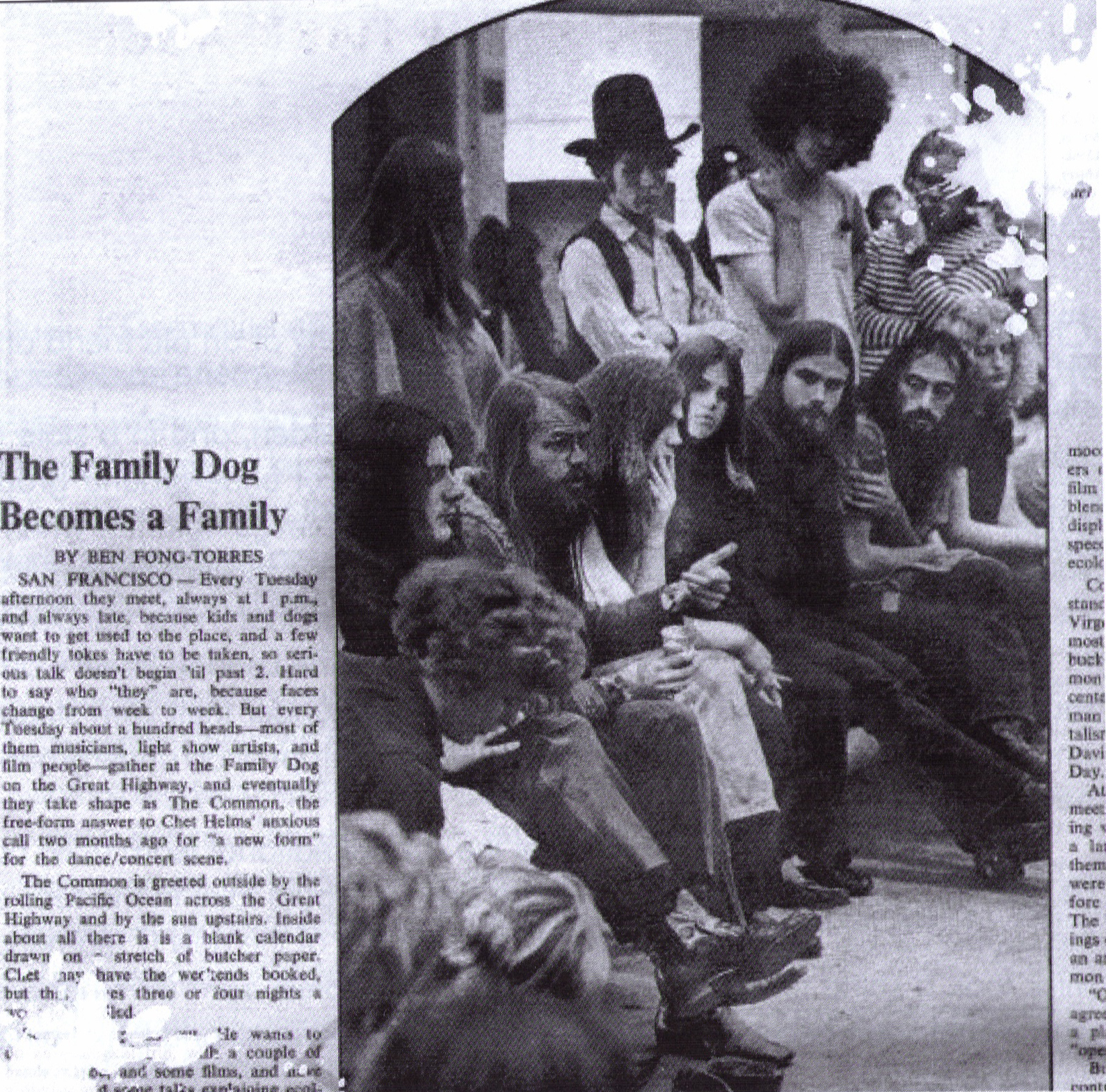
From their they made a pilgramage to San Francisco, where they played a few poorly attended shows, crashed at various communes (including Chet Helms’ Family Dog; see the photo below, with Rudolph sitting to the left of a pontificating Helms), and caught gigs by the Grateful Dead, Jeferson Airplane, Steve Miller, It’s a Beautiful Day, as well as touring performances by the Velvet Underground and Crosby Stills & Nash. Rudolph and Deviants Roadie Boss Goodman even made it to Altamont; in exchange for help setting up the stage, they had backstage view to “loads of little magic moments” and “some of the most atrocious sights you’d ever seen” (in Goodman’s words; pp. 148-9).
Perhaps most importantly, it was in the music room of an Oak Street commune belonging to one “weird hippy religous sect” that the three remaining Deviants put together a new set of material, including an epic new jam, “Uncle Harry’s Last Freakout.” After a final sojourn into Canada for a series of gigs at Montreal’s McGill University, the band finally made it back to England. By the end of 1969, the three Deviants convened with psychedelic musician Twink — ex-Tomorrow, ex-Pretty Things, and creator of the Farren-produced/Deviants-supported solo album Think Pink — to form the Pink Fairies.
DIY in the age of CanCon
In 1971, the Canadian Parliament legislated the recommendations of the Canadian Radio-Television and Telecommunications Commission that radio and TV begin broadcasting a fixed minimum percentage of content that is in some way written, produced, presented, or otherwise contributed to by Canadian citizens. Known as the CanCon requirements, the law responded to longstanding concerns about the Americanization of content broadcast on Canadian airwaves. CanCon’s impact on creating awareness among Canadians of their own popular culture is immeasurable. Furthermore, as intended, CanCon gave a massive boost to the economic sectors associated with Canadian television and music. In the case of music, Canadian bands now could expect that national record labels might give them a serious lookover — at least in the aggregate.
(Famously, Canadian rockers Rush was totally ignored by Canadian labels, and they had to independently release their self-titled 1974 debut album. It took the surprise breakout of the album’s single “Working Man” from a Cleveland rock radio station to get them signed by a major label: the U.S. wing of Mercury Records. The whole situation was “pretty pathetic when you think about us being the biggest band Canada has produced,” Neil Peart told Sounds in 1980. “It makes you a little bit cynical about the [Canadian music industry].”)
Still, Canadian radio formats remained wed to the generic designations promoted U.S. radio consultants (see Line Grenier’s 1990 article, “Radio Broadcasting in Canada: The Case of ‘Transformat’ Radio,” published in the academic journalPopular Music). A punk-rock band in Canada could no more make headway into mainstream radio or the bars venues booking pop and rock acts than it could in the U.S. at this time. Thus the predicament facing Joey Shithead and other punks: they would have to do it themselves. As described in the opening quotation of this essay, Shithead took his first band the Skulls east to Toronto, where a lively punk scene had emerged in 1977. Still, it was fairly tough going at this time, as he recalls in his autobiography:
In one sense Toronto was like Vancouver: there were very few places to play. We had heard about the Crash’n’Burn, a place the Diodes had helped make famous, but it was closed by the time we arrived. We did go to to a couple of parties the Diodes threw, but they came across as art school posers to me.
Perhaps one incentive for the Skulls to make the daunting drive east (during a cold Canadian November no less) was that the trip was always meant to be one-way; after making a name for themselves in Toronto, the Skulls had aspirations to move to London. After their ignominous failure in Toronto broke up the band, Shithead returned to Vancouver and formed D.O.A. Significantly, this band found like-minded groups and made a name for itself largely via travels across the border and along the 5. Jello Biafra was a particular champion after D.O.A. shared several bills with the Dead Kennedys; he included the D.O.A. track “The Prisoner” on the seminal hardcore compilation Let Them Eat Jellybeans! (1981), and his Alternative Tentacles label would periodically release subsequent D.O.A. recordings. Through such support, the band went on to become legends of hardcore punk, opening up smaller cities and towns throughout North America to the punk-rock circuit that in turn laid the foundation for “alternative music’s” hegemony by the 1990s.
Another hardcore band that was committed during this period to playing “secondary and tertiary markets” (as Henry Rollins sarcastically calls these overlooked places, above) was Hüsker Dü from Minneapolis. “D.O.A. and Dead Kennedys were the two bands that were the most instrumental in getting Hüsker Dü to the West Coast,” Bob Mould writes in his autobiography See a Little Light (pg. 48). In turn, Hüsker Dü laid important ground for punk rock along the Trans-Canada Highway. Mould describes the inaugural dates of Hüsker Dü’s first North American tour (1981) in Calgary at the Calgarian Hotel (“a flophouse with a bar and lounge on the ground floor”). A real baptism by fire for the band, the event also provides a view onto the conditions for punk rock in Calgary, then a city of 591,857 people.
I’d sat next to bleeding unconscious people in bus terminals, I’d watched Johnny Thunders shoot up, and I’d watched drunk women attempt to vandalize our musical equipment; I’d experienced sketchy before. But this was a whole new level of sketchy. One woman who was a regular at the Calgarian was stabbed on Monday night, and then stabbed again that Wednesday. It was that kind of place.
Early in the week, we were playing our first set while a handful of local Native Americans were getting drunk. During the second set, some ranchers started showing up. Then the two groups started going back and forth at each other. A fair amount of fighting happened around the pool table between the cowboys and the Indians — those are crass stereotypes, but it was the reality. We would fire the music back up, and they would stop what they were doing and say, “What the fuck is this punk rock? This band sucks!” So now the cowboys and Indians were putting their beef on hold and uniting against the punk rock; not ony against us, but also the punks in the audience. Of the fifty or so people in the bar, there would be a dozen cowboys and a handful of Indians, but the majority were the punks. You might that that ratio would have discouraged the cowboys and Indians, but it didn’t. We’d finish a set, get off the stage, leave the drums and amps behind, run upstairs, go back to the rooms they gave us for free, and just sit there and say to one another, “We have to go back down there?” Fights were pouring out into the street, and since our room was in the front of the hotel, we saw everything. It was like a barroom brawl straight out of an old western movie.
This continued for six straight days. By the end of the week, we’d not only managed to keep ourselves out of harm, trouble, and jail, but we’d also become acquainted with several folks in the Calgary punk rock community. It was a hell of a way to start a tour (pg. 50).
As this passage suggests, there was already a small punk rock community in Calgary whose flames Hüsker Dü only had to fan. One wonders if the band didn’t have a special affinity, coming from the U.S. nothern midwest themselves, for punk rockers stranded in the Canadian plains, hundreds of miles away from the next outpost of good music.