Bring Back the Artifacts: Artifacts Returned to Peru from U.S. Museum

For four years, the Burke Museum of Natural History worked with the Peruvian government to identify objects such as human remains, ceramic vessels and bowls, a collection of dolls, necklaces, and textiles. On November 5, the Peruvian Consul General attended a gathering for the final exhibition of the items; and the following week, the items were packed up and transported to Peru. Those items were identified for repatriation under a UNESCO Convention on the Means of Prohibiting and Preventing the Illicit Import, Export, and Transfer of Ownership of Cultural Property. The convention permits government to designate meaningful objects of cultural heritage and protect them from leaving the country from which they originated. This repatriation shows that the museum is fulfilling the ethical responsibilities that come with having excavated artifacts. The UNESCO convention supports the idea that the identity of people is linked to the past, which people learn about from artifacts. Thus, the countries that use the UNESCO convention to repatriate artifacts can reclaim information from their past.
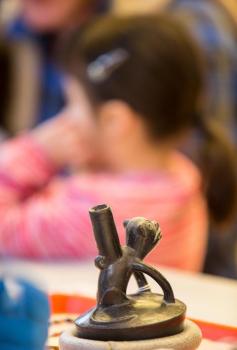
Figure 1- A ceramic vessel collected from Mochica, Peru, is one of the objects returned to the Peruvian government.

Figure 1- A ceramic vessel collected from Mochica, Peru, is one of the objects returned to the Peruvian government.

Dr. Peter Lape, associate director of research and curator of archaeology at the Burke Museum, said, “We are glad to help send these collections to Peru.” The artifacts were flown by the United States Air Force to the Peruvian Air Force base in Lima, Peru. Two officers from the Peruvian Ministry of Foreign Relations took the objects and transferred them to the Ministry of Culture for further preservation. The positive attitude from Dr. Lape and the level of involvement for transportation indicate the importance of repatriation and the power that the UNESCO convention holds.
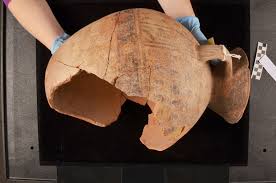
This pot, given to the Burke by a Seattle woman in 2007, was returned to Peru.

This pot, given to the Burke by a Seattle woman in 2007, was returned to Peru.

The museum was prompted to examine their Peruvian collections by a different ruling concerning the handling of Native American cultural items for federal agencies or institutions that receive federal funding. The ruling led the museum to re-inventory all of their human remains and they found three sets of Peruvian remains. Laura Phillip, the museum’s archaeology collections manager, said, “So, it’s sort of in the spirit of that law [Native American Graves Protection and Repatriation Act of 1990], we talked to the Peruvian government and said ‘Would you be interested in these individuals?’ And they said yes.” So, the legislation regarding archaeology and artifacts has the potential to stimulate further discussion of repatriation. Existing legislation combined with ethical standards of archaeologists and museums foster a system for dealing with artifacts that is respectful to the people who consider the artifacts as parts of their past.

Sources:

http://www.archaeology.org/news/2699-141111-peru-artifacts-returned

http://dailyuw.com/archive/2014/11/09/news/burke-museum-return-artifacts-peruvian-government#.VGldNFYvTwJ

Sabloff, Jeremy A. “Chapter Five: Why Cities?” Archaeology Matters: Action Archaeology in the Modern World. Walnut Creek, CA: Left Coast, 2008. 71-72. Print.

Figure 1: http://www.archaeology.org/news/2699-141111-peru-artifacts-returned

Figure 2: http://dailyuw.com/archive/2014/11/09/news/burke-museum-return-artifacts-peruvian-government#.VGldNFYvTwJ

Further Reading:

http://www.burkemuseum.org/info/press_browse/peruvian_collections_going_home

http://www.peruthisweek.com/news-peruvian-artifacts-to-be-returned-from-seattle-w-museum-104450

Link to original post in Reall Archaeology

Archaeology and Sustainability in the Amazonian Basin

As global population grows at a startling rate, global emissions of greenhouse gasses and demand for more reliable sources of food grow in parallel. These issues are slowly becoming ones that urgently need to be addressed. Gradually, more and more individuals are trying innovate new ways curb anthropogenic greenhouse emissions and cope with the growing global demand of food. Engineers are developing cleaner sources of energy and international politicians are trying to implement legislation that limits emissions. More recently however, archaeologists concerned with preservation and sustainability are rediscovering land management techniques used by ancient civilizations that could be replicated in a modern fashion with enormous payoff.

During her work in deep within the Amazonian rainforest, Crystal McMichael, an archaeologist/paleoecologist at the Florida Institute of Technology, mapped a large collection of soil deposits classified as terra preta or “black earth”. These deposits of darker soil are drastically different than the soil surrounding it. Typically, Amazonian soil is of rather poor quality because the biodiversity of the rainforest promptly extracts any extra nutrients. It would be almost impossible to maintain a civilization on this type of soil. However, the terra preta found in many sites had a considerably larger nutrient count and was much more suitable for agriculture. McMichael’s team located several terra preta deposit sites in Amazonia and found that a majority of sites of enriched soil were located in eastern Amazonia on top of bluffs overlooking the Atlantic Ocean. Typically, these bluffs were eroded of the porous Amazonian soil and were practically bare and infertile. However, after the terra preta was introduced, there’s evidence that these bluffs could have sustained huge swaths of agriculture. From a purely archaeological standpoint, this data is useful because it can be a basis in which future archaeologists plan to dig. Because the terra preta soil is a direct cause of human interaction, wherever there are deposits of terra preta, there are likely past developments of human society. Using statistical analysis, this data can be used to predict where other terra preta deposits are, and therefore where other people used to live.

Big picture. A new model of the Amazon predicts that terra preta is more likely to be found along rivers in the eastern part of the rainforest. The letters indicate known archaeological sites.

(Region of McMichael’s study)

While valuable from an archaeological perspective, the discovery of terra preta also could be a major breakthrough in more sustainable agriculture. According to Johnannes Lehmann and his team at Cornell University,

“The knowledge that we can gain from studying the Amazonian dark earths…not only teaches us how to restore degraded soils, triple crop yields and support a wide array of crops in regions with agriculturally poor soils, but can also lead to technologies to sequester carbon in soil and prevent critical changes in world climate”.  (Johannes Lehmann)

Via experimental methods, Johannes deduced that the terra preta was made by slowly burning biomass in a low oxygen environment (also known as biochar). This method of slow charring transforms the biomass into an incredibly useful substrate. The terra preta has an abundance of calcium and phosphate (nutrients that most of the Amazonian soil lacks) and the process of biocharring the organic matter actually sequesters carbon from the atmosphere.

(Biochar use in agriculture)

Archaeology has come a long way from the era of collectors and curiosities. Today, archaeological findings are being used to possibly help ameliorate some of the world community’s most pressing issues.

Cites:

Picture 1: http://news.sciencemag.org/archaeology/2014/01/searching-amazons-hidden-civilizations

Picture 2:http://www.biochar-international.org/biochar/soils

“Searching for the Amazon’s Hidden Civilizations.” Science/AAAS. N.p., n.d. Web. 14 Nov. 2014.

Johannes, Lehmann. Biochar for Mitigating Climate Change: Carbon Sequestration in the Black (n.d.): n. pag. Web.

Terra Preta Soils and Their Archaeological Context in the Caqueta Basin of Southeast Colombia
Michael J. Eden, Warwick Bray, Leonor Herrera and Colin McEwan
American Antiquity, Vol. 49, No. 1 (Jan., 1984), pp. 125-140


Link to original post in Reall Archaeology

Chemical Bonds and Personal Connections

Today’s post comes from Michael Cadenas, class of 2015 and Art Center student docent.
As a part of “The Artful Dodger” series of talks at the Frances Lehman Loeb Art Center, Marianne Begemann, Dean of Strategic Planning and Academic Resources, stepped out to the Sculpture Garden to highlight some of the works on view in her October 31 presentation, “The Experience of Sculpture

Link to original post in Off the Wall

Chemical Bonds and Personal Connections

Today’s post comes from Michael Cadenas, class of 2015 and Art Center student docent.
As a part of “The Artful Dodger” series of talks at the Frances Lehman Loeb Art Center, Marianne Begemann, Dean of Strategic Planning and Academic Resources, stepped out to the Sculpture Garden to highlight some of the works on view in her October 31 presentation, “The Experience of Sculpture

Link to original post in Off the Wall

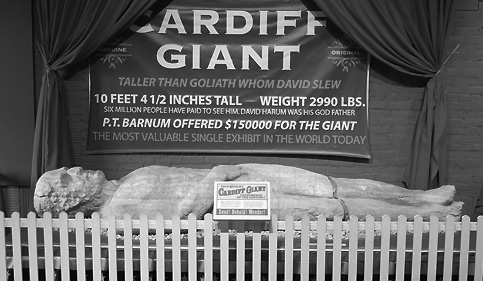
A Giant Hoax in Cardiff

In 1869 in two men digging a well came across at ten foot tall stone man in rural New York. Immediately the find was claimed to be alternately an example of the Biblical giants from Genesis 6:4 or an ancient statue carved by a long gone tribe. In fact it was neither of these it had been created by an atheist tobacconist named George Hull. He was inspired and enraged by a conversation with a biblical literalist reverend he met in Iowa. Hull acquired a 5 ton block of Gypsum and swore multiple people to secrecy along the way as he got the man carved and buried on the farm of William Newell in Cardiff New York.

Newell began to display the artifact now known as the “Cardiff Giant” under a tent on his farm and charging fifty cents for people to come look at it, and he made a killing with this. American’s traveled from across the eastern seaboard to see this remnant of some sort of ancient past. This was the Burned Over District during the Second Great Awakening which meant that the Cardiff Giant was discovered in a time and place there was an immense amount of religious seeking and thus the idea of physical evidence of an ancient Biblical past on American soil was enthusiastically received by the general public. It’s not so different from the beginnings of Mormonism.

The Giant was soon exposed as a hoax and yet people continued to visit it in its new home in Syracuse. And P.T. Barnum even offered to lease it for 3 months for $60,000 and when he could not get it he built his own replica to travel with his circus. The Giant now resides in the Farmer’s Museum in Cooperstown, New York where people still visit it today.

The Cardiff Giant on display at the Farmers Museum in Cooperstown,  NY

The Cardiff Giant on display at the Farmers Museum in Cooperstown, NY


The Cardiff Giant is an example of groups of people building a cultural identity around an “archaeological” find. Fundamentalist Christians wanted to validate their faith and their connection to a Christian past in America to legitimize the colonization of America. And if this giant man was really a petrified body of a biblical giant no one could deny that Christianity and, by the logic, Europeans had a right to be in the Americas.

But even when the truth was revealed and the Cardiff Giant was clearly not an actual archaeological artifact people continued to be fascinated by it, and in this way we can see something about America today. We are interested in how we see our pasts and the Cardiff Giant is now a ridiculous example of how easily people could be hoaxed in the past. We like to think we have e come farther and that we are better at validating our artifacts but fraud in archaeology is still prevalent and it is estimated that over 1200 fake artifacts are on display in major museums, so honestly we cannot say that we have gotten much better as a society at collectively recognizing hoaxes. Or maybe the hoaxers have just gotten better.


Bibliography

“Cardiff Giant, Cooperstown, New York.” RoadsideAmerica.com. Web. 10 Nov. 2014. .

Renfrew, Colin, and Paul Bahn. Archaeology Essentials. 2nd ed. London: Thames & Hudson, 2010. Print.

“The Cardiff Giant.” The Farmers’ Museum. Web. 10 Nov. 2014. .

“The Littlest Literary Hoax.” Museum of Hoaxes. Web. 10 Nov. 2014.

Link to original post in Reall Archaeology