
Today’s post comes from Matthew McCardwell, class of 2017 and Art Center Summer Archival Intern
“Concept is now.” This was the opening sentence and kinetic mantra of the spring 1969 exhibition, Concept, at the Vassar Art Gallery—the predecessor to the Frances Lehman Loeb Art Center
Category Archives: Site Feed
What Exactly is Punk Archaeology and is it Worthwhile?
I do think that Punk Archaeology does succeed in challenging established modes of thought. First, let’s define Punk Archaeology since it’s a very different way of studying archaeology. It is a technique that urges one to approach the familiar understandings of archaeology in new/unfamiliar ways. This type of archaeology supports conventional archaeology, which provides a distance for understanding objects from the past, but in most cases these objects are already unfamiliar to the modern viewer. Maybe I need to emphasize how punk archaeology makes the familiar and everyday unfamiliar. Punk archaeology began between archaeologists Kostis Kourelis and Bill Caraher who while studying archaeology listened to punk rock music. Punk Archaeology follows certain elements of punk philosophy through the study of archaeology. Archaeologists demolish the very object that they seek to study, and Punk Archaeology grasps chaos as a creative force. Its spontaneity gives off a creative destruction of the objects they are seeking to study.
The archaeologists who dug up the Atari game in the trash dump in New Mexico validated the theory of Punk Archaeologists is an established mode of thought. Filmmakers were also part of the crew of archeologists. Their initial response was motivated by interest in archaeology science and video game history. These punk archaeologists reversed the value of a culture that valued the past and things that are old and unique for searching for games that were not rare, but ordinary. The most interesting thing about this was that the scientists dug up the old Atari game, which represented a look at corporate history and the “end-of-lifecycle” for products. Thus their work helped people better understand Atari’s corporate decision making and how they tried to advertise the game. This dig answered the question where old, returned or overproduced products went to die out. Did they just vanish? Punk Archaeology showed where these old products went. Thirty years later, these old video games became material record of the past. The most favored game was E.T. The Extra -Terrestrial, and E.T. finally came home. The archeologists were part of turning these old games into museum artifacts from target of consumer wishes. The archaeologists also wanted to see the concrete and the line between product and trash as well as the games. Atari had concealed the unsold and/or undesirable games under concrete.
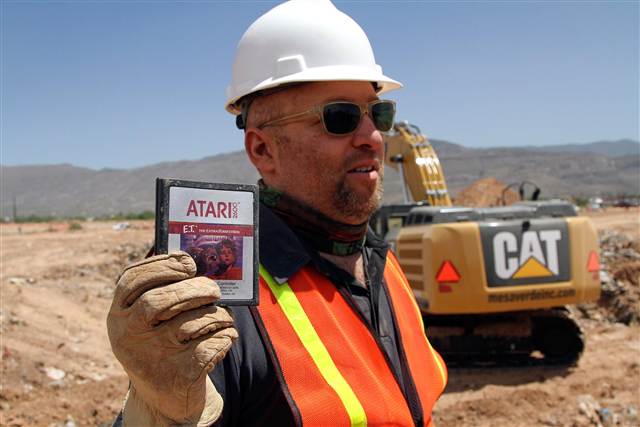
Film director Zak Penn holds up Atari E.T. the Extra-Terrestrial game at the dumpsite
After the media blitz, the archaeologists were overlooked in the papers and the news focused more on the filmmakers who documented it. The filmmakers knew that the excavation gave the archeologists, anthropologists and historians a chance to look into a modern landfill while digging up the recent past, while people responded to this modern find. Even though some believe they were overlooked, I believe this excavation showed that Punk Archaeology did succeed in challenging established modes of thought to help people better understand our culture.
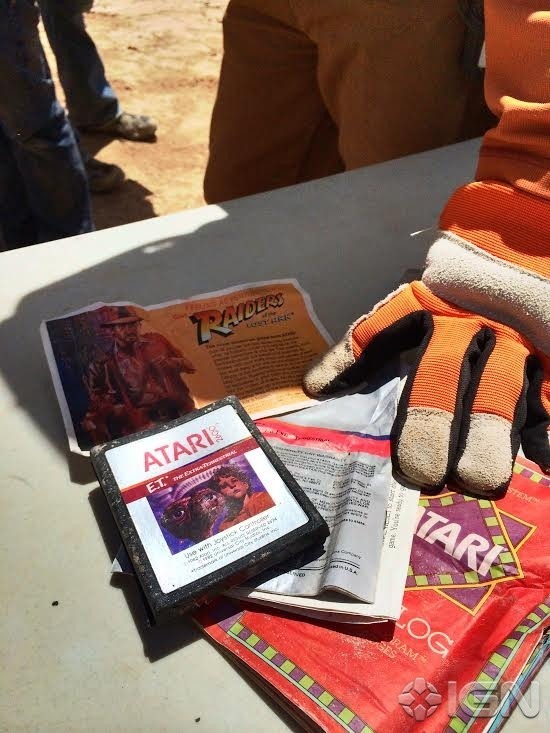
Up close photo of game cover
References:
http://www.theatlantic.com/technology/archive/2014/08/why-we-dug-atari/375702/?single_page=true
http://mediterraneanworld.wordpress.com/category/punk-archaeology/
Image URL/further reading:
http://www.nbcnews.com/news/us-news/diggers-find-hundreds-atari-e-t-video-games-new-mexico-n90491
2nd image:
http://www.ign.com/articles/2014/04/26/the-dig-uncovering-the-atari-et-games-buried-in-new-mexico-desert
Some ideas to re-activate class discussion
At this point in the semester, you might be finding that your class formats are feeling “old.” Maybe you’ve done lots of group discussions, or lots of “pair-share” or lots of lecturing. Time for a list of ideas
Chermaitre in Retrospect: A Student’s Voice
Sarah Oliver is a senior at Vassar College, majoring in Anthropology and pursuing a future career in medicine. In Vassar Haiti Project, Sarah is currently serving as the President of Internal Operations and is an invaluable member of the organization
The Cascajal Block of the Olmec Civilization
Although many people only think of Egyptian hieroglyphics when discussing the origins of written language, there is evidence that written language systems had been developed independently of each other around the world. Artifacts suggests that the earliest forms of written language originated in Mesopotamia, China, and Mesoamerica. A recent find has opened the door for reanalysis and for questioning regarding the early written records of Mesoamerica and their influence in the development of the area’s early languages. In the early 1990s, while building a road, what is now known as the Cascajal Block was found in Veracruz, Mexico, where the Olmec civilization once stood. This stone block was taken care of by cultural authorities and was examined in 1999 and 2006.
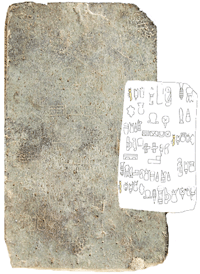
The Cascajal Block
Upon examination, archaeologists Carmen Rodriguez and Ponciano Ortiz revealed that the serpentine block contained sixty two images on one of its surfaces. After investigating the images on the block, they believed that an example of written text had been found. The pictures on the block appear to be arranged in a certain syntax, there are patterns and repeating images suggesting that the images are not just art or pictures but written language. Another interesting observation reveals that the block may have cleared or erased several times indicating possible personal use.
Although most agree that the images on the block are indeed evidence of a writing system, some controversy surrounds the dating of the block. The block was dated to around 900 BCE, this estimate was based on the pot sherds and other artifacts it was found with, so many do not trust that the true context of the artifact is known. If the dating holds true, then the Cascajal Block is the earliest evidence of written language in the Americas. This along with the fact that the images do not seem to connect to any other writing of the area or time period has added to the “mother-sister” debate regarding the Olmec civilization’s influence in Mesoamerica.
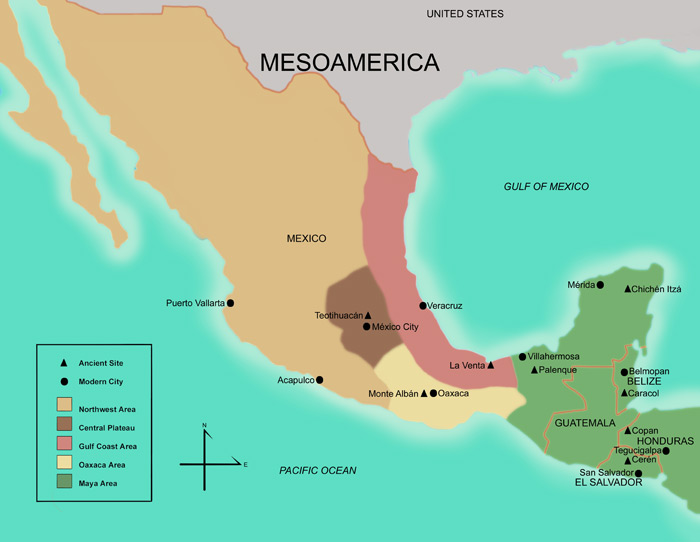
Map of Mesoamerica
The discovery of the Cascajal Block and the debates surrounding it can help us understand how different archaeological approaches and circles of thought can be used to gain a deeper understanding of the artifact and the Olmec civilization. Starting with a functionalists approach the block’s possible purposes may be examined, and here experimental archaeology techniques may be used to understand the functionality of the block as a personal writing tool. From this type of investigation, more questions will arise and can be asked. We can approach these questions from a more structuralist or processual view by looking into the social structures of Olmec civilization and how written language, text, and literacy were affected and affected structures such as gender and class or everyday life. With these ideas in mind, what are the possible implication of the Cascajal Block?
References:
http://www.sciencemag.org/content/313/5793/1551.full
http://archive.archaeology.org/0701/etc/learn.html
http://archaeology.about.com/od/olmeccivilization/a/cascajal_block_3.htm
Photo 1: http://archive.archaeology.org/0701/etc/learn.html
Photo 2: http://www.famsi.org/maps/
Additional Reading:
http://www.sciencemag.org/content/313/5793/1610.full
http://archive.archaeology.org/0601/abstracts/olmec.html