Category Archives: Ford 2025

The Black Studies Sit-In at Vassar and its Aftermath

Mayte Segura, Class of 2028

Over the span of eight weeks, I worked with Debra Bucher and Special Collections to research student activism at Vassar College in the late 1960s and early 1970s, particularly relating to the Black Studies Program (now the Africana Studies Program). This project was created by the Race and Racism in Historical Collections (RRHC) Engaged Pluralism Learning Group with an interest in building a cohesive timeline surrounding the Main Takeover, also known as the 1969 Black Studies Sit-In, using primary documents in Vassar’s collection. The materials reviewed for this project largely come from the Alan Simpson Files held in Vassar College Library’s Special Collections Department, published Alum work, and articles from the Poughkeepsie Journal and the New York Times.

Interest

Throughout this research, I have held a special focus on the forms of student agency showcased during this time; from publishing their own pieces to understanding the administrative meetings students attended. Often when discussing student activism on campus, the narrative begins and ends with the 1969 Black Studies Sit-in. I was interested in learning about and preserving the other smaller forms of resistance, as I knew the fight for change cannot be contained in a single event. There was work that built the community present at the sit-in, and there was work after the demonstration ended to ensure follow-through on promises made. 

Additionally, the history of students of color on campus has been a hazy image during my time at Vassar. Specific landmarks known but not frequently discussed. Daily existence is acknowledged as a byproduct of knowing their attendance but never actually flushed out. I wanted to use this project as an opportunity to show not only myself, but other students of color, that we belong to a larger, less known legacy built through community, determination, and innovation.

Method

Navigating Special Collections: At the beginning of my research, I reviewed a list of folders of interest created by Emma Gronbeck for the RRHC Learning Group. To best ensure efficiency and new discovery, I assessed which items had previously been reviewed on the list. Once left with the unreviewed items, I then selected folders based on their subject.

Annotated copy of Folders of Interest, created by Emma Gronbeck

Refined list of Folders of Interest – does not include the folders I referenced when researching 1968

Contextualizing information: To keep my notes organized, I created a dedicated Google Document for each folder I reviewed; taking notes in the order of the documents I read. When first beginning my research, I created timelines at the top of each document to act as a table of contents and assist me in cleaning up each folder’s chronological order. As the number of documents grew, along with the size of the folders I reviewed, I created a project-wide timeline titled Major Events Timeline in Relation to Black Studies. This document was created in Google Sheets and served as a large-scale chronicle of the events that occurred in the late 60s and early 70s. It contains,

  • The date of the event
  • A description of what occurred (as well as relevant documents attached to the event)
  • A list of students involved
  • The Special Collections folder call number – hyperlinked to its dedicated note document
  • The reference number within the note document containing more in-depth information

Screenshot of Major Events Timeline in Relation to Black Studies

Findings

Annotation of ‘Educational Fraud at Vassar’ by Maybelle Ann Taylor, African American Teacher’s Forum – Alan Simpson Papers, Box 54, Folder 54.26

Carrying the philosophy

Near the end of my research, I discovered an article written by Maybelle Ann Taylor, class of 1970, in box 54, folder 54.26 of the Alan Simpson Papers. The piece is titled “The Educational Fraud at Vassar” and was published in the African American Teachers Forum in their January-February 1970 issue. I found that Taylor perfectly captured the nuance and emotions of the time. I was particularly drawn in by the record this article provided from the student perspective, as most of the documents I reviewed largely stemmed from the administrative point of view. A particular quote that stuck with me was, “Until we have successfully begun to destroy the MAN within us, we cannot begin to educate ourselves to the complexities of this society and its implications for Black people.” (Quote I, pg. 3). In my research, I found Black Studies to be a larger movement focused on carrying the ambition to learn past the classroom. It spoke to a life-long commitment to reflecting on the world around you and how you can positively contribute to it. In carrying out this philosophy, many Vassar students made efforts to find ways to contribute to the community beyond campus, from actions like weekly (and in some cases daily) tutoring sessions for any interested party in the Poughkeepsie community, to speaking at conferences to represent student needs and desire. 

The agency shown off campus embodied the heart of these students’ vision for the Black Studies program as a full-body effort to dissect white supremacy’s influence and learn to build a world centered on Black flourishing, all with an underlying focus on maintaining community. These actions really stuck with me as an Afro Latin student who has attended predominantly white institutions for the last nine years. For nearly a decade, I have had to grapple with the tension that exists between these institutions’ identities, as both business and a place of learning. I have found that these labels often hold a strained relationship with each other. Learning is a messy, unpredictable process of discovery that does not always lend itself to the appeasement of business projections. Learning about these students’ actions to not only call out the tension that has always felt unacknowledged but also fight to ensure the financial need does not outweigh the mission of exploration, has helped connect me to my own membership in the legacy of Black scholars.

What does success look like?

Another quote that has stuck with me is, “We had an integrated Black house with which we were satisfied and pacified, where the true efforts of establishing sisterhood was a sham.” (Quote J, p. 3). This line stood out because throughout my research I had seen glimpses of the betrayal and pain Taylor writes about. Dating back to their earliest demands, the Black students at Vassar College always held strong on their need for Black housing. While they received it, leading to the creation of Kendrick House, there was a caveat requiring white students to live there as well to avoid legal concerns. At the time, it was a commonplace fear that providing Black housing would be deemed a violation of the Civil Rights Act of 1964. Many colleges found that they were able to subvert these worries by not officially declaring dorms as Black only housing, hence the integration at Kendrick House. At the end of the dorm’s inaugural year, two student representatives, Claudia Thomas and Gary Graves, presented the demand to officially make the dorm all Black housing, cosigned by the Black residents of Kendrick House. Their demand was met with hesitation due to legal concerns and the cited fact that there were simply not enough Black students enrolled to fill up the house, making white residents necessary. 

Throughout a lot of my research the question of what constitutes real change kept coming to my mind. Even when establishing a home for Black life on campus, white bodies were still required to be present to legitimize it. I felt like the struggle around Kendrick House reflects the reality of what it means to be Black not only at Vassar but in the US. The battle for housing represents the nuance of reclaiming space. While Blackness does not have to exist in isolation to thrive or legitimize itself, it is expected to make space for the presence and oversight of whiteness to maintain its credibility and existence.

Presentation: Six weeks into my program I led a discussion on my findings, using Taylor’s article as a bridge between artifacts. In preparation, I identified the following themes through colored annotations and a corresponding key given to each attendee (as pictured at the beginning of this section): 

  • Philosophy surrounding Black Studies
  • Student perspective
  • General timeline information
  • State of things in 1970

I selected quotes to connect the topics and anchor my findings. The walk through of the article was followed by a guided discussion in which attendees were able to ask follow up questions and explore their own interests from the article.

Moving Forward

This past summer has helped me grow a lot as a scholar. While I was working independently, I remained mindful of the fact that this project was created to assist the RRHC Learning Group in identifying and contextualizing information; as such, I was intentional about providing clean deliverables that could be used beyond my engagement with the program. With the flexibility I was given, I was able to develop my own methods to approach efficiently recording my findings to best ensure future progress. The opportunity to actively put my academic training to use regarding a topic I deeply care about is an honor I will never forget. 

In looking past this summer, I aim to continue preserving the work and dedication exercised by students of the past by sharing the information I found. I hope to conduct a series of discussions modeled after the one I held this summer with different perspectives targeting diverse groups on campus, such as departments and programs. I believe that this will assist with engaging attendees by honing in on their special interests; highlight and honor the complex scenarios that arose; and offer ample opportunities for those interested to attend as it will not be constrained to a specific date.

Youth Theatre Arts Program for Justice-Involved, At-Risk, and Economically Disadvantaged Youth

Week of 6/2

On Monday and Tuesday, Professor Means and I, along with the other project staff and community members, participated in an intensive run by Kevin Coleman and Dr. Tori Rhoades. The workshop was called “Teaching With Care: Trauma-Informed Pedagogy.” Over the course of those two days we learned strategies and best practices for teaching theater in a therapeutic manner, by participating in exercises, games, performances, and discussions.

On Friday, I attended the Juvenile Justice Counsel at the Poughkeepsie courthouse with CAAD scholars Zander and Taylor, as well as staff member Brian Robinson. Together, we pitched the prototype program to stakeholders, including probation officers, police officers, judges, social workers, and representatives of community organizations.

Week of 6/9

On Monday and Tuesday, I researched and compiled peer reviewed methodologies for similar research projects and experiments in published scholarly articles. I then used what I found to inform and draft an original methodology to be used in our work and future publications.

For the remainder of the week, I drafted the necessary data collection materials to be used in our research. These included intake and exit surveys, intake and exit interviews for students and parents, teacher evaluations, self evaluations, parental consent and minor assent forms. I created these forms based on my previous research into data collection for the parameters the project methodology focuses on, and adapted commonly used questionnaires.

Week of 6/16

Professor Means and I spent this week finalizing the data collection forms. We also wrote and submitted our research proposal to the Institutional Review Board.

On Friday, we attended “Voices of Youth: Educational Justice From Our Youths’ Perspective” at Marist University, which was part of the “Promoting Partnerships to Advance Educational Justice in Poughkeepsie” series. We heard from a panel of seven high school students from Poughkeepsie and Arlington about where they identify needs for students and young people in the community, and their suggestions for improvements. The event affirmed the need for our youth theater program, and further informed the way we plan to run the space.

Week of 6/23

This week, I worked with program administrators Professor Taneisha Means, Brian Robinson, and Tom Pacio, as well as CAAD Scholars Zander and Taylor, to build our program cohort. We received 44 applications and 7 referrals in total. In the end, we built a diverse cohort of 11 students, representing five districts in Dutchess County and a broad array of races, ethnicities, gender identities, and backgrounds.

Additionally, Zander, Taylor, and I spent time working with the program teaching artist Amara James Aja to clarify our respective roles in the rehearsal space and solidify program plans and logistics.

Week of 7/7

After coming back from our Independence Day break, it was time for the program to begin!

As the students ate lunch each day, I administered intake surveys measuring their baseline levels of self esteem, resistance to peer pressure, and mental health. I also conducted one-on-one interviews with each student over Zoom to get to know them better, as well as to qualitatively assess their baseline levels of communication skills, socialization, and self-confidence. Finally, I participated and sat in on programming each day to build trust and connections with the students, as well as to take ethnographic field notes.

On Friday, we took the students to the greenhouse at Vassar, where they had the opportunity to tour the facilities and feed the resident carnivorous plants. We then discussed the college admissions process and our personal experiences with the students, answering any questions they had about their options and giving advice. That evening, we offered an optional field trip to Powerhouse Theater’s performance of The Comedy of Errors. Four students attended, and all enjoyed!

Week of 7/14

During the second week of programming, I continued to attend rehearsals to record field notes. Students started working directly with the text of Romeo and Juliet. They constructed tableaus, performed scenes, and began analyzing themes of power. On the Thursday session, Amara taught a swordfighting lesson (using pool noodles), an exercise I was able to participate in as well. We choreographed fight scenes and practiced safe expressions of violence and nonverbal communication.

On Friday, the students had the opportunity to tour the Loeb and learn more about visual representations scenes through art. They also put their acting skills to use by constructing tableaus to mirror paintings, and were given art supplies to make their own creations. Zander and Taylor then split the students up and held workshops on the performing arts industry and college social life, respectively.

Week of 7/21

In our third week of the program, we saw a lot of major breakthroughs for individual students and the group as a whole! The participants continued to get deeper into scene work and built towards performing a longer scene from Romeo and Juliet. They synthesized what they have been learning about tableaus, power, performing lines, sword choreography, and staging. Their final product was extremely impressive considering the amount of rehearsal time they’d had.

On Tuesday evening, we hosted a dinner for students, their families, donors, and community supporters of the program on the second floor of Gordon Commons. Students were presented with personalized midpoint letters of appreciation from Amara, Zander, Taylor, and myself.

On Friday, the students split into two rotating groups. I took participants down to the Innovation Lab, where they had the opportunity to make buttons, create using the 3D pen and visualizers, and design lithographs and wood burnings. Meanwhile Taylor ran workshops on feelings, needs, empathy, and healthy conflict resolution. At both stations students really got to know one another on a deeper level and found the experience valuable.

Week of 7/28

In our final week of programming, I administered exit surveys to measure changes in their self-esteem and resistance to peer influence from the beginning of the program. I also conducted in person exit interviews with each student to measure changes in their communication skills, socialization, and self-confidence, as well as to hear their thoughts on the program itself as a whole.
Data Analysis for Behavioral Economics

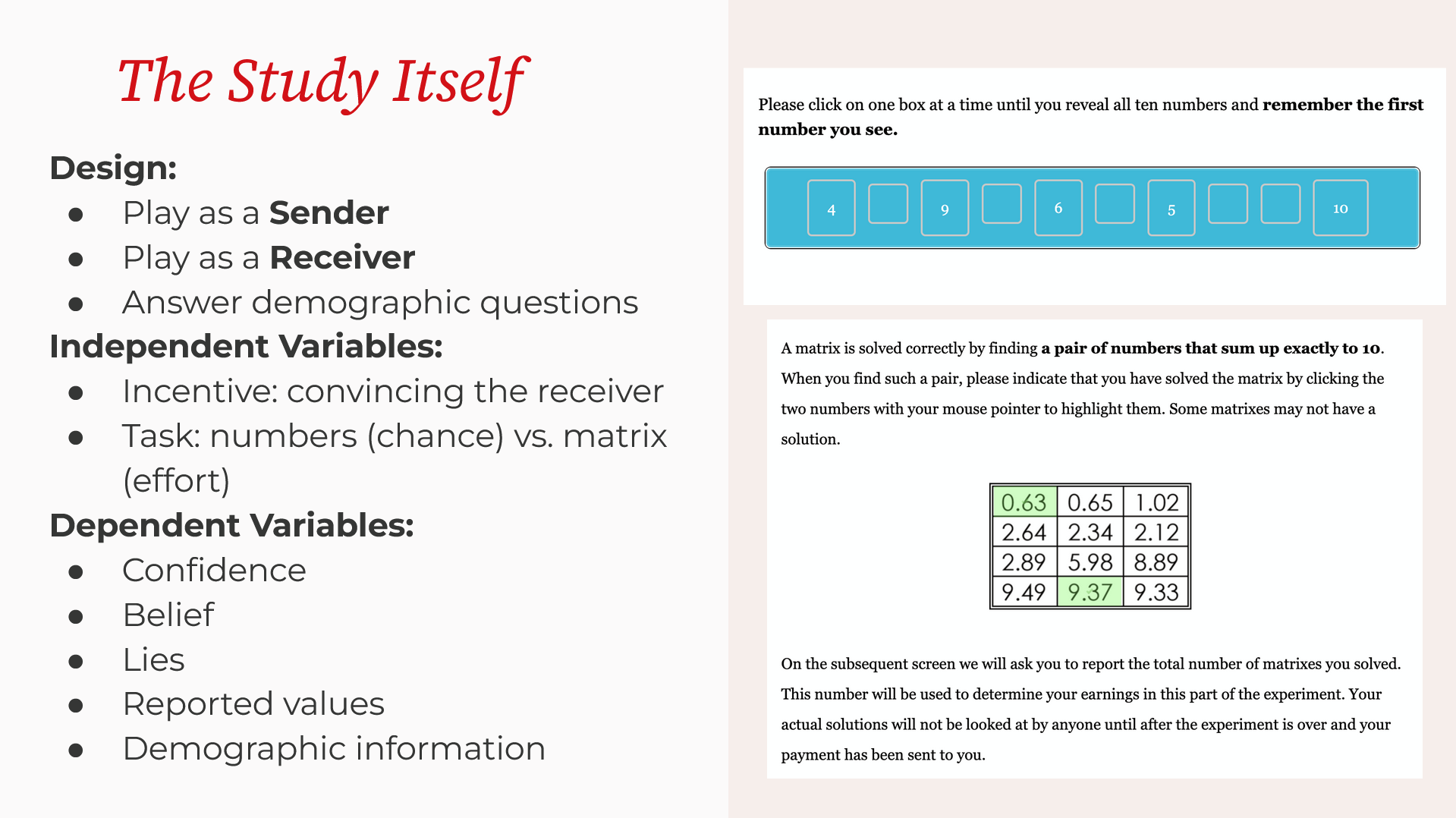
This summer, I worked with Professor Benjamin Ho to conduct data analysis of a dataset from a recent experiment. This experiment and research centered on detecting deception in a simple game that models communication between a “sender” and “receiver”. We explored receivers’ responses to lies as well as senders’ anticipation of how receivers detect deception, particularly when believable lies are incentivized. In a time of constant mass-communication, where there is an incentive for real-life senders to persuade others to believe them, it is imperative to understand how people respond to lies.

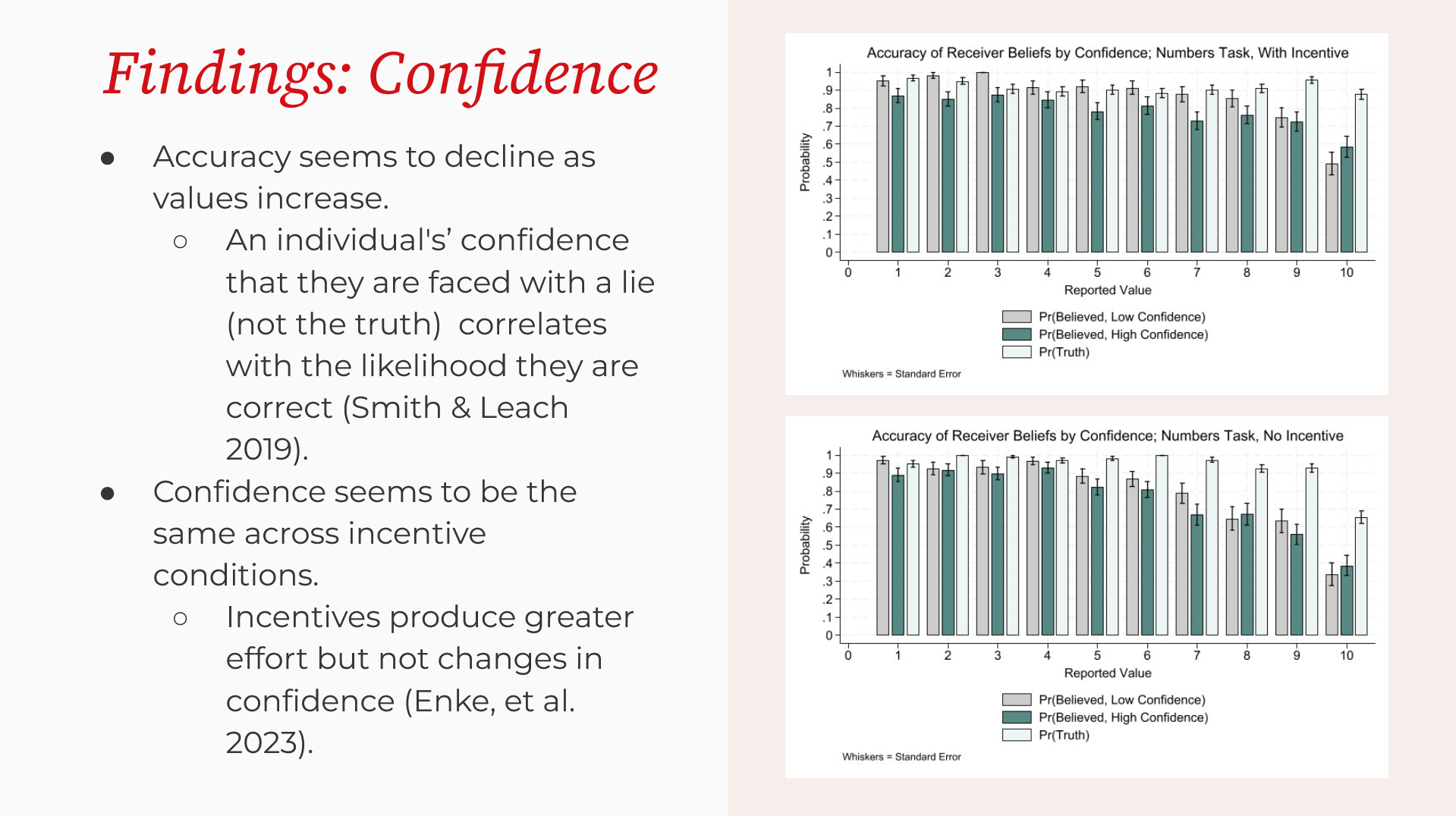
Almost all of our data analysis was conducted using Stata. At first, we focused on senders’ truth-telling and receivers’ trusting behavior between conditions where senders were and were not incentivized to be believed. From there, we began to expand and explore other topics of interest. Items of particular interest were receivers’ confidence in their choices, participants’ perception of their peers, and participants’ earnings from the experiment.

As results were found, we conducted a literature review to explore other studies centered on deception to interpret our results. The information drawn from the literature review, especially relating to confidence, appears to paint a more complex picture of how receivers discern the messages that they receive. During this time, I also assisted with creating a summary statistics table and ran regressions for the probability of senders reporting the truth and the overall size of senders’ reports.

I am honored and thrilled to have been able to participate in this rewarding project. In a world of constant communication, learning about lies are both detected and communicated was poignant to me. For me, this project has allowed me to grow as a researcher and find deeper meaning in how we interpret one another’s messages.

Art, Archives, and the Classroom: Reflections on a Summer in Religion Studies

Kimaya Saijpal Class of 2027

This summer, I worked as a research assistant for Professor Kirsten Wesselhoeft in Vassar’s Religion Department, who is currently developing a book on a surprisingly underexplored topic: a cultural introduction to Ramadan. While there are countless works on the other pillars of Islam, Ramadan has received comparatively little sustained cultural study, and that gap shaped much of my work. I shared the position with another Ford Scholar, Felix, and our collaboration became an important part of the experience. We regularly exchanged ideas, shared readings, and offered suggestions for further inquiries, making the research process all the more generative. I think we often imagine academic work as a solitary pursuit, but this summer reminded me how collaborative it can be. 

My primary focus was twofold. First, I developed an archive of creative works related to Ramadan, including poetry, visual art, music, theater, and architecture. I also identified contemporary Muslim artists whose work could contribute to a 2027 Loeb Art Center exhibition on Ramadan. The envisioned exhibition will be interactive and designed to welcome both the Hudson Valley Muslim community and broader public audiences into a multidimensional exploration of the month. I compiled this research into a detailed exhibition proposal and artist roster for the Loeb’s review.

Second, I worked with Felix on the reading list for Professor Wesselhoeft’s upcoming fall course, Religion, Violence, and Peacebuilding. This involved reviewing a wide range of literature in religious studies and peace studies, assessing both foundational and emerging works, and curating selections that aligned with the course’s pedagogical goals. We often discussed which texts best fit the course objectives and which ones—despite their reputations—were not worth including. I also integrated South Asian perspectives throughout, reflecting my own research interests. As an outcome of this collaboration, I will be teaching a week of the course in the fall on the Bhagavad Gita and Gandhi. I will be responsible for lesson planning, designing activities, and setting learning objectives, which will be an exciting early step into teaching.

Alongside these projects, I conducted more tangential research on pre-modern Ramadan writings, including instructional fasting manuals, mystical interpretations, and culinary texts. I also visited the Schomburg Center to explore the Larry Neal archives for Ramadan-related creative works. While his film treatment Ramadan Lovers unfortunately did not connect directly to my research, the process of looking through his manuscripts revealed other compelling engagements with Muslim themes in Black creative expression.

This summer was a rare chance to move between curatorial planning, archival research, and course design, all in a deeply collaborative setting. It gave me a glimpse of how ideas grow and transform—not just in classrooms or archives, but also in conversations, shared projects, and the spaces where academic work meets the public.

Creating Peace Education Curriculum

Sarah McDonald, Class of 2026

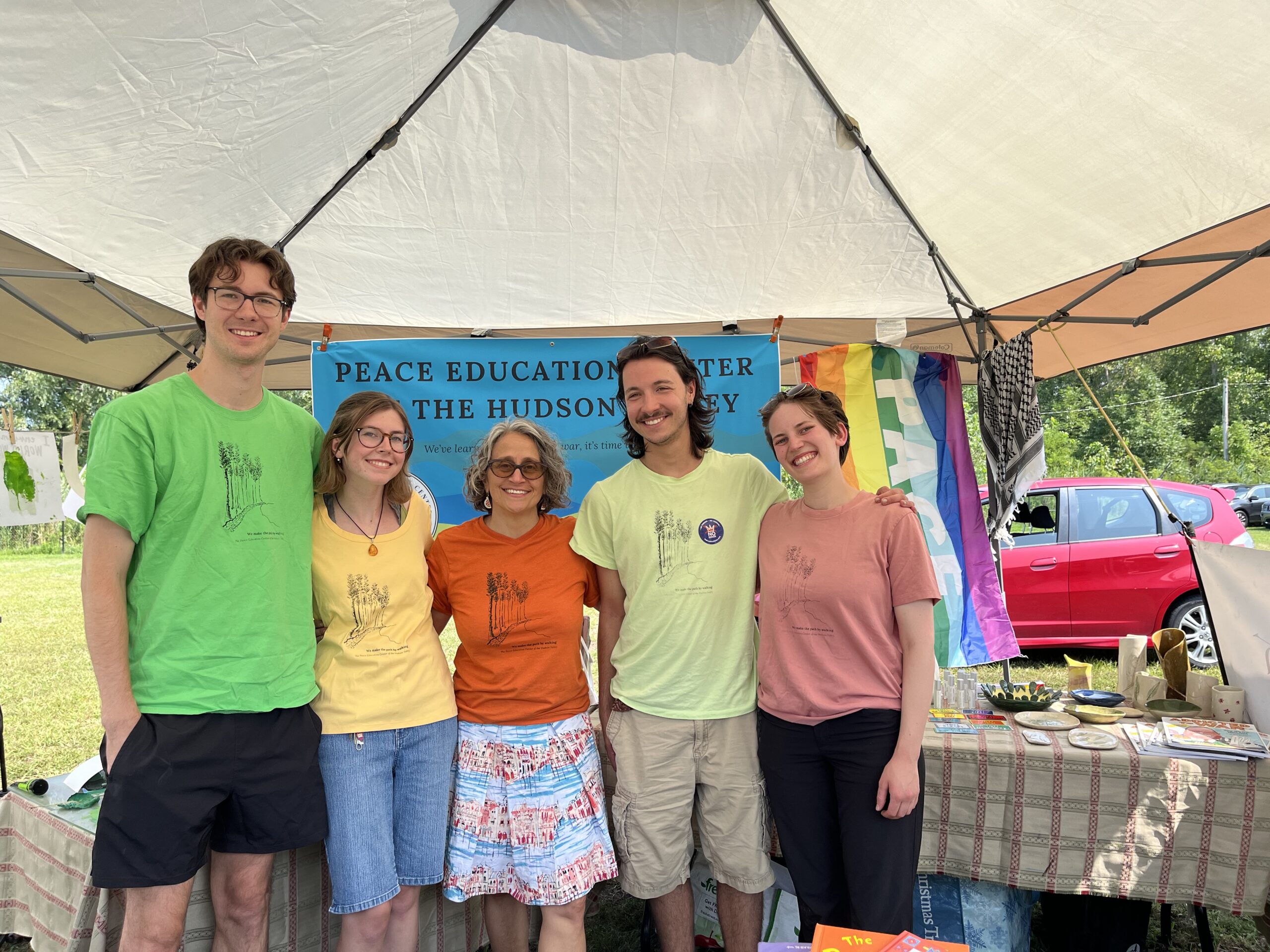
This summer I worked with Professor Leonisa Ardizzone to create a peace education handbook to help educators implement peace education practices and lessons into their classrooms. Professor Ardizzone is the founder of the Peace Education Center of the Hudson Valley (pechv.org) which supports the local community through peace education and programs primarily for students and educators. Peace education actively educates to counteract the war system and various manifestations of violence and promotes peace through the values of relational existence, global consciousness, and holistic earth care. Many people can agree that peace education aligns with what we would like to see more of in our classrooms and society at large, and the goal of our handbook is to make it easier for educators to put peace education into practice. 

I began the summer by analyzing data from a cohort of educators who went through a peace education workshop conducted by Professor Ardizzone last year. I then worked with her and Zak Shearn, another Vassar student working at the PECHV this summer, to create an outline for our handbook which was informed by a variety of peace education texts. It includes an introductory section about the practices of a peace educator as well as a curriculum of nearly 50 lessons divided into the categories of Need and Wants, Human and Planetary Rights, Conflict Resolution, War is Terrible, and Creating a Peaceful Society. Completing the handbook will be an ongoing project with the collaboration of others and all of us are very proud of the progress we made this summer. 

In addition to writing curriculum, I also spent the summer assisting with many other PECHV projects including Zak’s Photovoice research, working with students at the YWCA and YMCA in Kingston, creating videos about peace education, and screen printing upcycled t-shirts to sell at events the PECHV participated at throughout the summer. I had the most amazing experience this summer and I will always be extremely grateful I was given the opportunity to participate in and learn so much from this work.

Reframing Childhood: Images of Children’s Rights and Voices in Times of Conflicts—Exhibition Planning

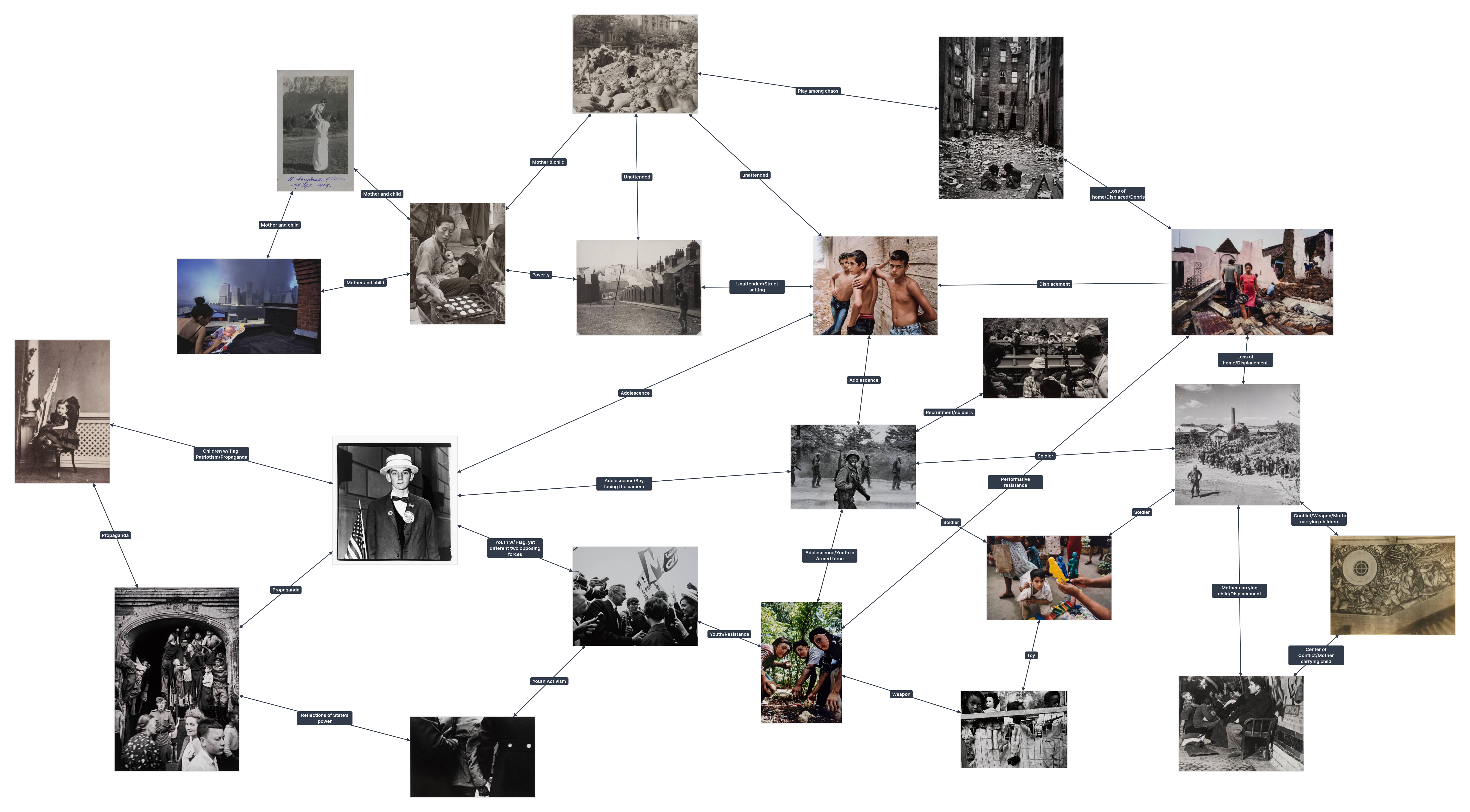
This summer, I worked with Professor Tracey Holland on a proposal for a travelling photography exhibition entitled Reframing Childhood. Featuring around 20 photos from the Frances Lehman Loeb Art Center, this project aims to raise awareness and invite conversations around topics of childhood, children’s rights, and armed conflict. Through various education programs and educational exhibition texts, we hope to inform viewers with the fundamental tools of looking at images–most importantly, the ethical concerns of looking at images of suffering. We also explores non-traditional approaches to curating a photography exhibition, one that incorporates multiple perspectives from different participants including visitors, curators, and student researchers.

Our project received funds from Vassar’s Creative Act Across Disciplines, which shaped the project’s creative curatorial vision. Our interdisciplinary research method not only incorporates materials from different academic disciplines but also professional knowledge. We began with image research by organizing past student writings and readings on topics including children’s rights, photojournalism, and peace education. As we started drafting our proposal, we visited photography exhibitions in the NYC and explored multiple online collections. From conversations with curators and directors at the Loeb we learned more about the logistics planning, public programs, and curatorial strategies. We followed the “making and doing” aspect of curating with the educational goals. We used creative visualization tools including Mindmaps, Vision Boards, Minecraft, and Sketchup to present and develop our ideas. Creating these visual materials deepens our connection with the photos and understanding of the themes.

In the end, our proposal established a framework that organizes our materials into five major thematic sections, conceptual design of the exhibition space and the catalogue, and ways to increase the project’s reach and visibility. As our project transitions to the implementation stage, we will focus on making realistic budget planning and adapting the exhibition designs within the specific venues we hope to present our project at.

Research in Social Psychology: Marketized Mentalities, Prejudice, and Dehumanization

Akshaya Raghavan

This summer, I worked with Professor Jannay Morrow of the Psychological Science Department to conduct research in social psychology. Professor Morrow was also simultaneously working on a few URSI projects with Professor Baird, so we all met as a group and discussed our areas of interest in psychology and helped each other brainstorm regarding our research.

Professor Morrow allowed me to choose the direction of our research, which led me to be even more passionate about the project. I began short-listing certain topics that piqued my interest and reviewed articles published in Social Psychological journals to understand the scope of previous research and look for areas that are under-studied.

The topic I landed on was a sociological concept called “Marketized Mentality,” which we wanted to study in a psychological manner. A Marketized Mentality, or MM, is a value system in which one sees wealth as the ultimate indicator of success and may even resort to crime or unethical behavior to achieve it. One with an MM puts the economy over all other institutions such as family, polity, or education. We were interested in studying the relationship MM had with prejudice, particularly toward supposedly “unprofitable” groups of people like the disabled, homeless, or unemployed. We also were curious to see whether those with a MM dehumanized these groups.

Next, I worked on writing down my predictions for the results of our research and fine-tuning all our questionnaires. It was a lengthy process, but I learnt a lot about creating a study. Once we finalized our design, Professor Morrow launched the study online and we finally began collecting data! Unfortunately, 8 weeks had already passed by then, but I look forward to analyzing the results when I am back at Vassar.

Encountering Texas: White Supremacy and Remembrance in the Lone Star State.

This summer I worked with Professor Hite on a book she is in the process of writing, titled, at the moment, Encountering Texas: White Supremacy and Remembrance in the Lone Star State.

It was an absolutely amazing experience to work with Professor Hite over the summer! Her book focuses on Texan ideas of relational encounters, violent white supremacy, frontier masculinity, trans-racial solidarity, collective political memory, and individual and communal identity, among a plethora of other supporting facets and perspectives.


It was so unique to read books diving into the ontology of seemingly innocuous social identifiers, like the collection of essays, On Whiteness: The Racial Imaginary Institute, in tandem with books like Seeds of Empire, by Andrew Torget, which uncovered Texas memories which implicate and imagine these social identifiers as large players in the formation of the State’s history.

It was a very special experience to grapple with these ideas, ever present in the current political landscape, with Professor Hite, and see how her book has shifted, and will continue to shift bit by bit, with every new article and book she reads. It was empowering and unique to be treated as an equal, in many ways, by Professor Hite as we discussed readings and bounced ideas off of one other. To rant for multiple minutes, spewing all my thoughts about a reading and more at Professor Hite as soon as we sat down to meet, and to watch her sit silently and carefully chew on and consider every word I said, was a very powerful experience. It is easy in a classroom of brilliant peers to shrink into one’s own thoughts, and going into my final year at Vassar, I will be ever grateful to have had this chance to re-orient myself in relation to what, and how, I learn.

Frederic Church’s Sacred Geographies

Ashleigh McDermott, Class of 2026

This summer I worked for John Murphy and Ian Shelley at the Loeb, conducting research and preparing an exhibit for the Frederic Church 200, a celebration which many museums are participating in next year. Church belonged to the Hudson River School, the first national school whose work laid the underpinning for an American imagery or imaginary and also, for the founding collection of our college museum. Painting during the antebellum period when the introduction of western territories meant aggravated separation of interests between the slave economies of the South and the industrial economies of the North, Church found national images through natural formations. 

Most of the summer I took to familiarizing myself with Church’s way of thinking: how were these neutered scenes to be public instruments of manifest destiny? Uncovering his ideology through his fascination with Humboldt’s Cosmos, a publication which detailed the naturalist’s journey through South America in search for god’s interrelation of all through natural observation of minerals, plants, and animals, I unravelled how his replicated journey to Colombia and Ecuador was subsequently a search for god, unification, and truth during a time lacking in harmony. Due to the degradation of North America through deforestation, overcultivation, and exploitation, the unspoiled continental Southern landscapes were to reinstate god as sovereign over the Edenic Americas while still maintaining distance from the nationalistic tensions that came with depicting a scene local to the United States. 

The two paintings I was assigned were Autumn in North America and Summer in South America, where continental differences speak to the complications of representing an American identity. His Autumn, a New England forest interior, references the North-South jockeying for national representation, resolved by his Summer, a divine image of fraternal land that emits American exceptionalism while remaining unspecific to how the land is to be controlled. This is something I found interesting in conjunction with Church’s mentor and founder of the school, Thomas Cole, who critiqued man’s dedication to progress and advocated for a ‘juste milieu,’ a pastoral middle ground between man and nature. By neutrally representing territories while doubly formulating a kaleidoscopic land of god, Church was able to reach a large audience, but most times, failed to procure a unified message or image for the nation. 

The theme of sacred geographies stood out to me during my research as they are the physical arrivals to an ever-receeding immateriality, whether that be a national identity, the American West, or the passage into god’s domain. While in the New World, Church used nature as scientific proof of the divine; however, after Darwin’s theory of evolution and the outbreak of the Civil War, Church’s search for god and unification pulled him backwards to the Old World, particularly the Middle East, where biblical sites, ruins, and temples could materially prove god’s sovereignty. How did the shift from finding god in nature to proving divine existence through architecture affect modern conceptions of national identity and religious justifications of territorial expansion?

Curious about Church’s recession from westward expansion, I found interest in Tanner’s View of Palestine, an elevated view of the sprawling holy land with irrigation features and dotted people in the distance. Known as a biblical scene painter and member of the AME Church, Tanner was one of the first prominent black artists in the Western canon and held a complicated relationship with nationality as he indefinitely left America for Paris in order to gain access to civil rights. With works such as Tanner’s, I want to complicate the ways Church naturalizes manifest destiny and nationalism through uprooting contrasting beliefs and representations among similar practices or subject areas. This fall, I will continue the work of researching objects in the collection, producing labels, and writing a brochure to culminate in an exhibition which will doubly honor the role Church plays in the founding collection while also critiquing his use of the genre to convert public spectators into divine speculators. Thank you John and Ian!

Researching Legislative Responses to Changes in Migration

It was a wonderful summer working with Prof. Sarah Pearlman as her Ford Scholar. Her research explores migration and its influence on voting behavior in the United States. Thus, our project’s focus was to create a comprehensive dataset of U.S. population demographics and state legislatures; using this dataset, we made it our objective to draw correlations between the fluctuations in migration and electoral outcomes across states. 

Collating the master dataset was no simple task, however: it necessitated weeks’ worth of searching for data, coding, and literature review to get to the right sources. The first couple of weeks I spent reading publications from peer-reviewed journals in Economics, think tanks, and legal reports. These sources commented on the most recent trends in immigration and the role of naturalized citizens on electoral outcomes. Moving forward, I began with preliminary cleaning of Census Bureau data (derived mostly from the American Community Survey) to visualize demographic trends of naturalized citizens across the past twenty years. Furthermore, I was able to pull more data and model the voter registration and turnout rates for naturalized citizens and link my findings to federal and state electoral outcomes. Once I gained more exposure to handling large data, I proceeded to work with a dataset containing information on state legislative election returns and their party composition. 

In the end, I successfully created a master dataset and ran several regressions. While some of our findings were inconclusive due to inconsistent availability of most recent data, working on this project was greatly rewarding for me. I am incredibly glad that I got the opportunity to improve several crucial skills such as coding, handling large datasets, and combining literature review with quantitative research. It was truly a transformative experience.