
Throughout the eight weeks, I worked alongside Professor Osman Nemli to study the concept of sovereignty in its contradictions and examine its manifestations in the US government. We each prepared notes on the readings before our weekly discussions.
Sovereignty in Theory
In the first part, we focused on philosophico-historico-theoretical texts, reading two per week in a (somewhat) chronological manner. This generated initial contrasts and connections that we expanded upon each subsequent week. We began with Rousseau’s The Social Contract and Hobbes’ Leviathan, forming a basic foundation of some fundamental ideas and terminologies.
To illustrate some contradictions: Rousseau conceptualizes an indivisible, inalienable sovereignty of the people, in a small direct democracy. Contrastingly, Hobbes locates sovereign authority in the supreme rule of absolute monarchy.

(Week 2)

Law (Week 3)
With sovereignty as the focus, we branched out into related concepts, including theology, states of exception, violence, vulnerability, and the Other.

Waning Sovereignty (Week 4)

and Infinity (Week 5)
Sovereignty in the US Government
The second part focused on the US with theoretical and case-based studies. We covered selections from the Federalist Papers, 2026 executive orders, and contemporary articles on unitary executive theory to analyze the US government as a manifestation of modern sovereignty. In particular, we looked at the executive branch as a representative of modern sovereign power.
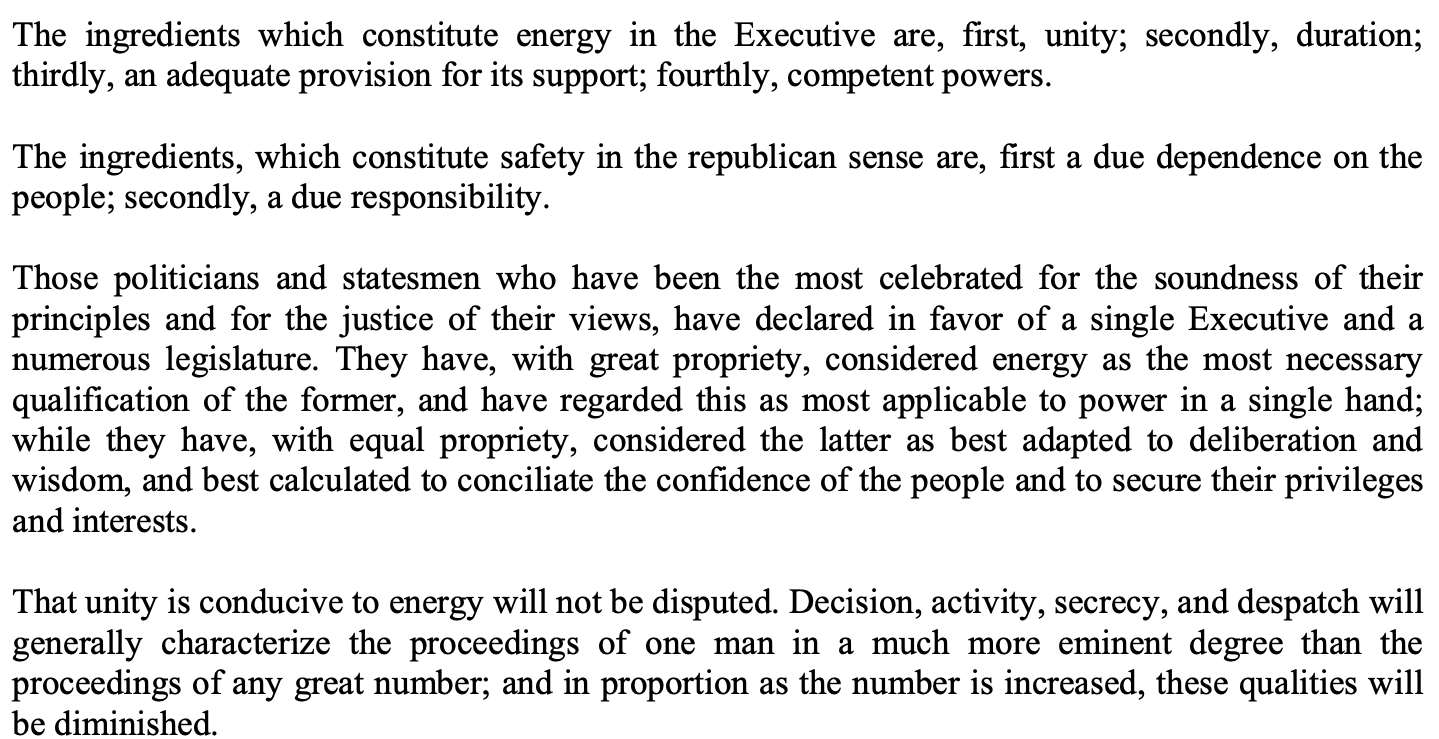

Sovereignty, in the US, appears as a strange, contradictory chimera. It is divided and limited by checks and balances. At the same time, it is sourced in a single entity under the unity of the executive branch. The executive is not quite an absolute authority; but neither is sovereign power shared in an indivisible, inalienable manner. Driesen’s article on unitary executive theory adds additional worries over the possible transition from the executive branch’s centralized head-of-state control into autocracy.

Executive: Past, Present, Future

Theory in Comparative Context
We can see slippages from the Constitution and Federalist Papers into our current-day, carrying potentially devastating consequences to our constitutional republican structure. Despite being an abstract (nonphysical) concept, it is undeniable that sovereignty carries concrete, material consequences in its manifestations.
Future Work
I will continue working out my ideas and questions in a writing sample and in syllabi outlines, intended for implementation in a future course in the Philosophy Department.
Additional Information
Complete Reading List:
1) Rousseau – The Social Contract, Hobbes – The Leviathan
2) Schmitt – Political Theology, Agamben – State of Exception
3) Benjamin – Critique of Violence, Derrida – Force of Law: The Mystical Foundation of Authority
4) Brown – Walled States, Waning Sovereignty, Butler – Endangered/Endangering: Schematic Racism and White Paranoia
5) Levinas – Totality and Infinity, Derrida – The Animal That Therefore I Am.
6) Selections of Federalist Papers
7) Selections of 2026 Executive Orders
8) Driesen – The Unitary Executive Theory in Comparative Context, Sunstein & Vermeule – The Unitary Executive: Past, Present, Future.
Brief Overview of Concepts: sovereign and sovereignty; state of nature; authority/force/power; social contract; general will and particular will; commonwealth/general body/”the people”; language and definitions; secularized theology; states of exception; possibilities of justice; violence of law; forms of violence, i.e. mythic/divine, law-making/law-preserving, police violence; violence of language; deconstruction; the Other; the animal and the human; transnationalism and globalism; political economy; political sovereignty; co-constituency between subjects and state; decline of nation-state sovereignty; borders and walls; containment/boundedness; phantasmic productions; phenomenological and psychoanalytic frameworks; vulnerability and protection; processes of disavowal; forms of government; separation of powers.