
Madeline Hsiao ’27 and Professor Jannay Morrow
This summer, I continued working with Professor Jannay Morrow on psychology research exploring avoidant personality disorder (AvPD) and building on findings from our URSI project last summer. Our research examines the psychological mechanisms underpinning the adverse influence of AvPD on mental health outcomes, particularly psychological well-being and interpersonal relationships.
Our URSI project investigated the role of experiential avoidance (EA) as a possible mediating and/or moderating variable affecting the relationship between elevated AvPD traits, well-being, and interpersonal distress. All mediation pathways in our model were significant, suggesting that EA may partially explain the effects of AvPD on well-being.
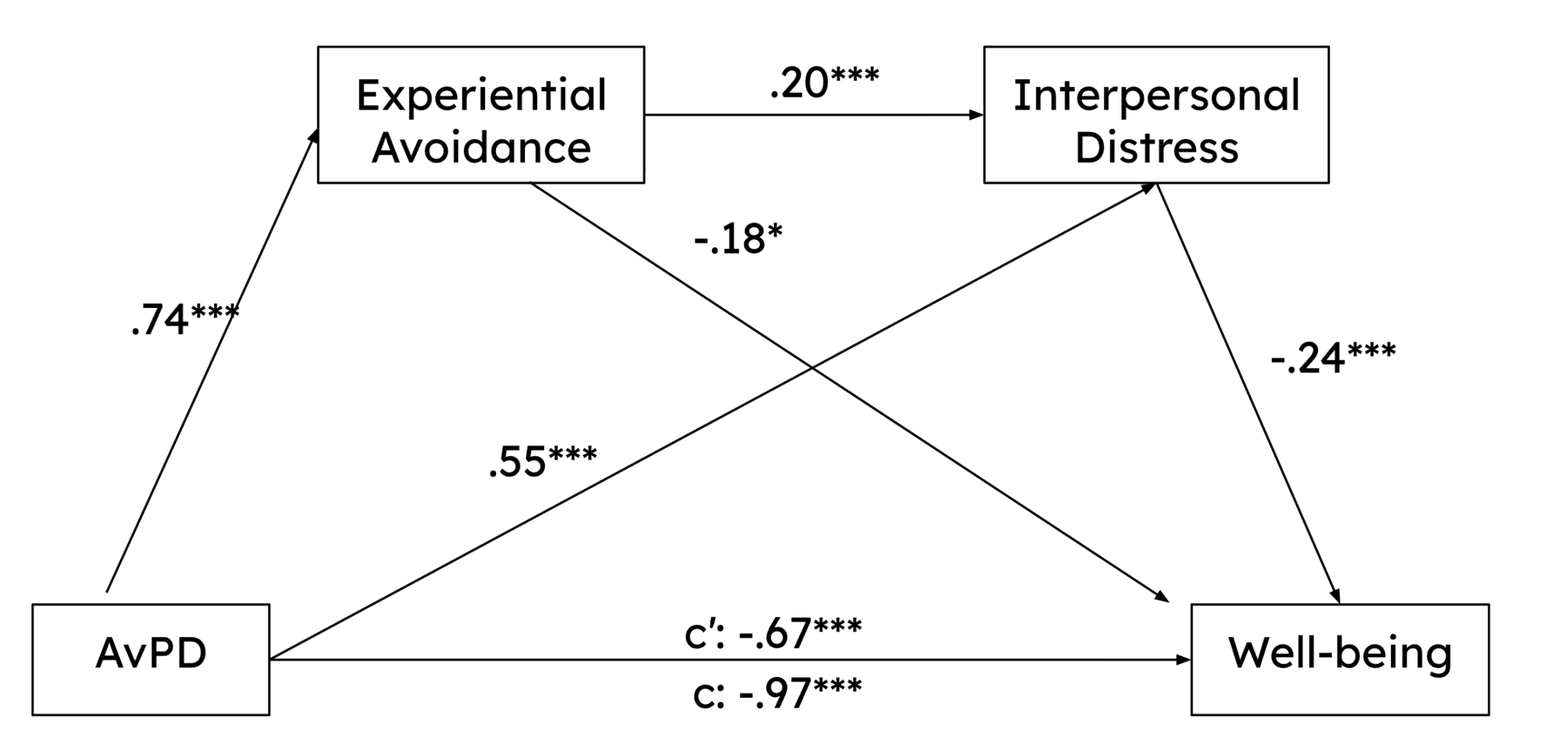
Building on these findings, we designed this year’s Ford Projects to further investigate these mechanisms and identify factors that may reduce the adverse effects of AvPD. Professor Morrow allowed me to conceptually shape the study direction by selecting a variable of interest. I chose self-compassion (SC), leading to the central research question: Does self-compassion buffer the negative effects of elevated AvPD traits and EA on well-being?
Our process began by reviewing literature on AvPD and EA, leading us to consider SC as a possible explanatory factor in their relationship. We examined current evidence on SC, AvPD, EA, and well-being, evaluated measures and self-compassion induction methods, and reviewed statistical approaches used in similar studies, with particular interest in serial mediation models. Simultaneously, we worked on expanding our related URSI project into a full research manuscript for future submission to a peer-reviewed, open-access journal.
We launched an initial correlational, proof of concept study and are currently about to launch a quasi-experimental online study in which participants engage in either a self-compassion writing exercise or a control group. This project will bridge URSI findings with those of the correlational SC project. Afterwards, we will collect and clean the data and begin our statistical analyses.