This summer, I worked with Professor Pier Carlo Tommasi and research assistant Julia Onishi by reading 16th century Japanese warrior diaries to analyze the importance of the diary as a form of self-expression and for understanding cultural practices in the daily lives of samurai warriors. Previous scholarship on Medieval Japanese diaries has either focused on the works of priests and noblemen and neglected those of warriors, or was entirely focused on the politics behind the diaries. For our project, we tried to view them from a different perspective than other scholars, focusing on the identity of each warrior and the intention behind each event they chose to note from both their professional and private lives.
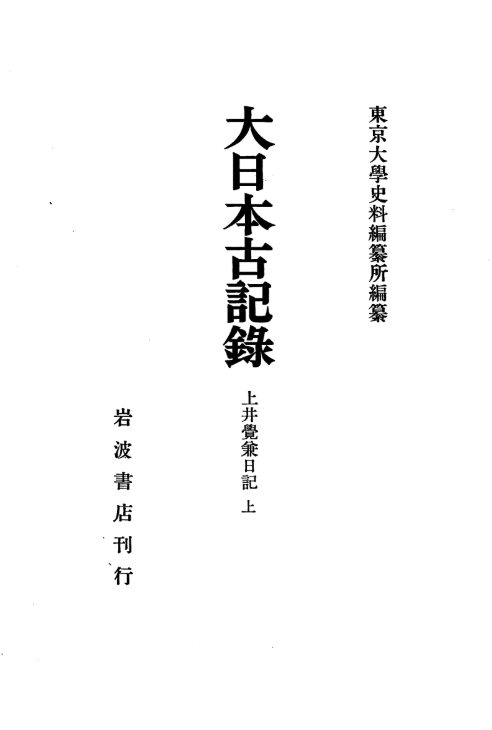
Uwai Kakuken Nikki Original Document, Iwanami Shoten
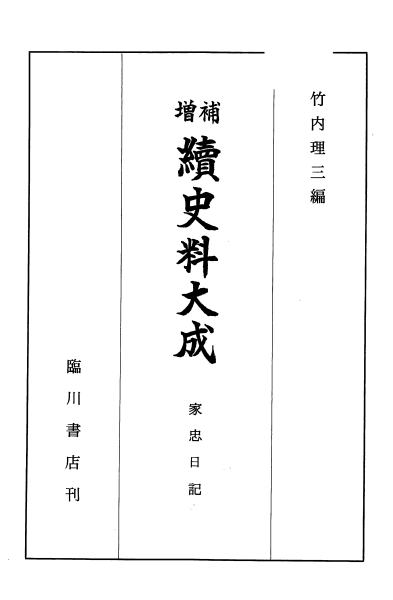
Matsudaira Ietada Nikki Original Document, Rinsen Shoten
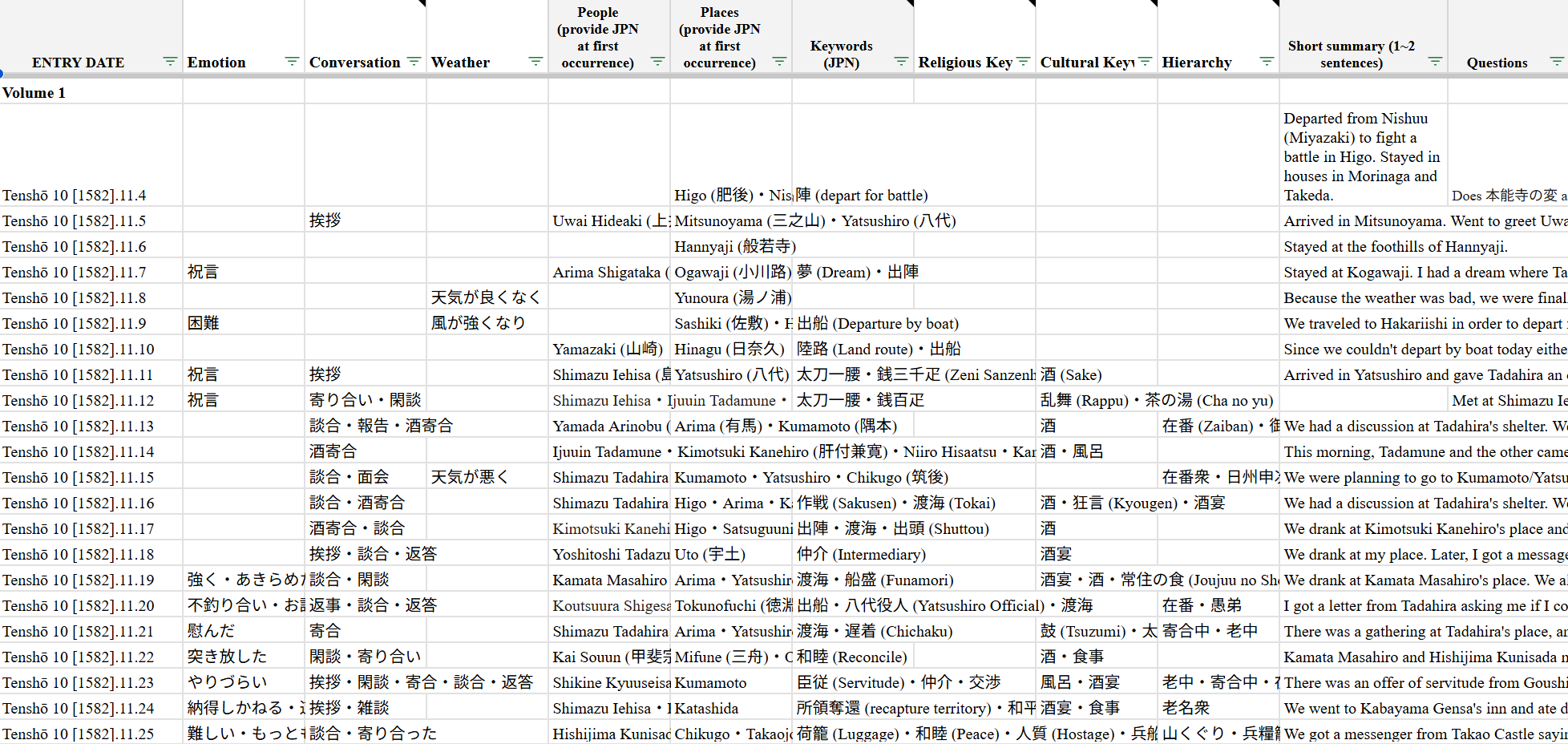
All three of us worked on different warrior diaries. For my portion of the project, I worked on the Uwai Kakuken nikki (上井覚兼日記) and the Matsudaira Ietada nikki (松平家忠日記), written by Uwai Kakuken and Matsudaira Ietada, respectively. The bulk of the summer was spent reading a modern Japanese translation of the diaries, noting any mentions of keywords related to Japanese culture, politics, and social norms. Additionally, I would write a translated summary of each journal entry and organize it in a spreadsheet. I also worked on reading through and annotating secondary scholarship on the diaries to better understand the time period and the opinions of other scholars before forming my own conclusions.
Spreadsheet for data from the Uwai Kakuken Nikki
Uwai Kakuken and Matsudaira Ietada share multiple similarities. Both were mid-rank samurai who presumably started their diaries at a turning point in their lives: Kakuken, when he became the official messenger of the Shimazu clan, and Ietada, when he became the head of the Fukouzu Matsudaira clan after his father’s passing. However, the content and style of their diaries are drastically different. Kakuken’s diary consists of a variety of topics that he writes down with precise details, both in his work and private life. Due to his position as a messenger, he has a large vocabulary when describing interactions with others. The entries vary in length depending on how many messages he received that day, and he is consistent with writing every day. On the other hand, Ietada’s diaries are short, limited in the number of topics discussed, and mainly focus on his work rather than his private life. My current hypothesis is that Kakuken and Ietada had different intentions behind writing their diary; Kakuken simply wrote down everything that happened to him and wanted it to be more personal, while Ietada used it to record work-related events.
This is a long-term project that I’ve been working on since my freshman year, and will continue doing so during the school year. My current goal is to finish gathering data and reading through more secondary sources on the Matsudaira Ietada nikki before switching gears to conduct a more thorough comparison between the two diaries. In the later part of the project, the three of us will share our findings from our respective diaries and work to come to a conclusion on the significance of the Medieval Japanese diary genre as a whole.