
Anni Yu ’27
This summer, I worked with Professor Alicia Atwood examining healthcare adequacy among veterans. Previous research finds that male veterans tend to have better healthcare access. Extensive literature documents persistent gaps in healthcare access and outcomes across racial groups. Yet, the these factors does not standalone; they interact to shape healthcare experiences. Our project builds on existing research and examines this intersection by comparing healthcare access among Black and White veterans with their nonveteran counterparts.
To measure healthcare adequacy, we examined changes in preventative care utilization around age 65, when Medicare eligibility provides near-universal health insurance coverage. We selected preventative care as our outcome variable, as these services are broadly recommended at the same frequency, thus a good proxy for access rather than a reflection of health status. The rationale of our study is that a larger increase in utilization after eligibility indicates limited previous access.
My work began with literature review and replication of adjacent research to establish a foundation for our study, followed by cleaning RAND Health and Retirement Study dataset in Stata and Excel and conducting exploratory visualizations to uncover healthcare utilization trends and identify control variables to inform our empirical analysis decisions.
After that, we spent the majority of our time designing and refining our econometric models. The approaches we selected are regression discontinuity designs, triple-difference models, and fixed effects regressions. The first provides clear visualizations (see below), while the latter two allow us to better isolate the association between Medicare eligibility and healthcare utilization and strengthen causal interpretation.
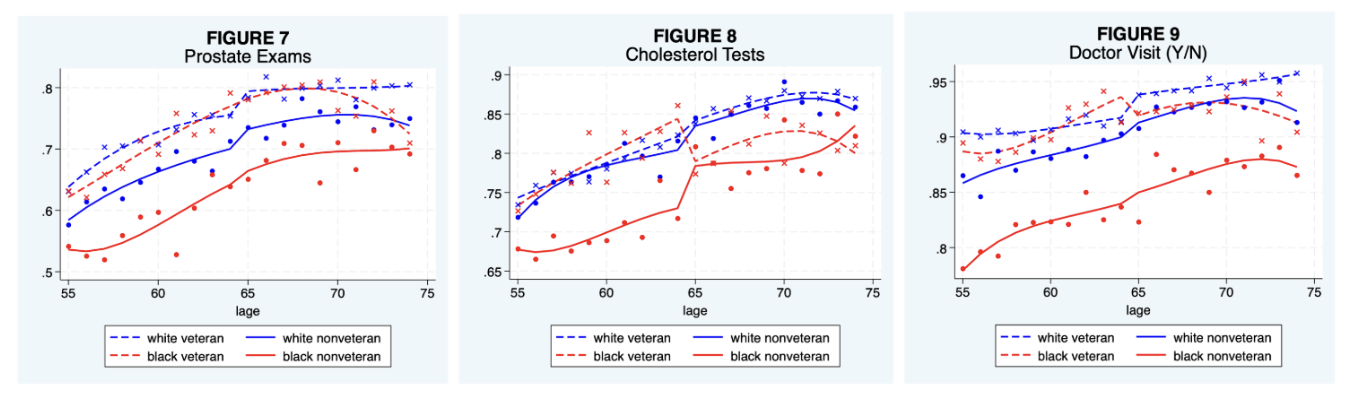
Since access is influenced by various factors, including commonly-known ones such as education, wealth level, and geographic location, as well as more nuanced factors such as veteran cohort, interview year (capturing macroeconomic conditions, healthcare guideline changes, healthcare policy changes, etc.), and demographic interaction terms, we designed numerous alternative control and bandwidth specifications to evaluate the robustness of our findings.
Working on this project has been an invaluable opportunity to apply and strengthen the econometrics and data analysis skills I developed in the classroom to empirical research. I am grateful to Professor Atwood for her guidance and support, and I look forward to continuing our research in the fall by incorporating additional datasets and further contextualizing our findings!