
Mayte Segura, Class of 2028
Over the span of eight weeks, I worked with Debra Bucher and Special Collections to research student activism at Vassar College in the late 1960s and early 1970s, particularly relating to the Black Studies Program (now the Africana Studies Program). This project was created by the Race and Racism in Historical Collections (RRHC) Engaged Pluralism Learning Group with an interest in building a cohesive timeline surrounding the Main Takeover, also known as the 1969 Black Studies Sit-In, using primary documents in Vassar’s collection. The materials reviewed for this project largely come from the Alan Simpson Files held in Vassar College Library’s Special Collections Department, published Alum work, and articles from the Poughkeepsie Journal and the New York Times.
Interest
Throughout this research, I have held a special focus on the forms of student agency showcased during this time; from publishing their own pieces to understanding the administrative meetings students attended. Often when discussing student activism on campus, the narrative begins and ends with the 1969 Black Studies Sit-in. I was interested in learning about and preserving the other smaller forms of resistance, as I knew the fight for change cannot be contained in a single event. There was work that built the community present at the sit-in, and there was work after the demonstration ended to ensure follow-through on promises made.
Additionally, the history of students of color on campus has been a hazy image during my time at Vassar. Specific landmarks known but not frequently discussed. Daily existence is acknowledged as a byproduct of knowing their attendance but never actually flushed out. I wanted to use this project as an opportunity to show not only myself, but other students of color, that we belong to a larger, less known legacy built through community, determination, and innovation.
Method
Navigating Special Collections: At the beginning of my research, I reviewed a list of folders of interest created by Emma Gronbeck for the RRHC Learning Group. To best ensure efficiency and new discovery, I assessed which items had previously been reviewed on the list. Once left with the unreviewed items, I then selected folders based on their subject.
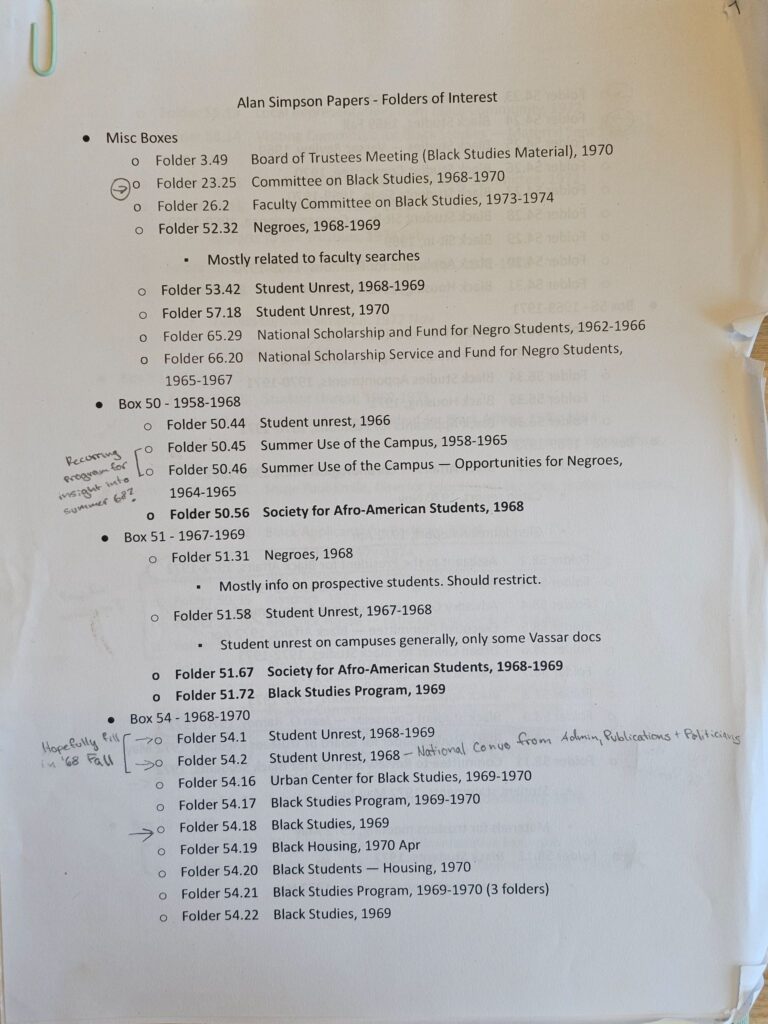
Annotated copy of Folders of Interest, created by Emma Gronbeck
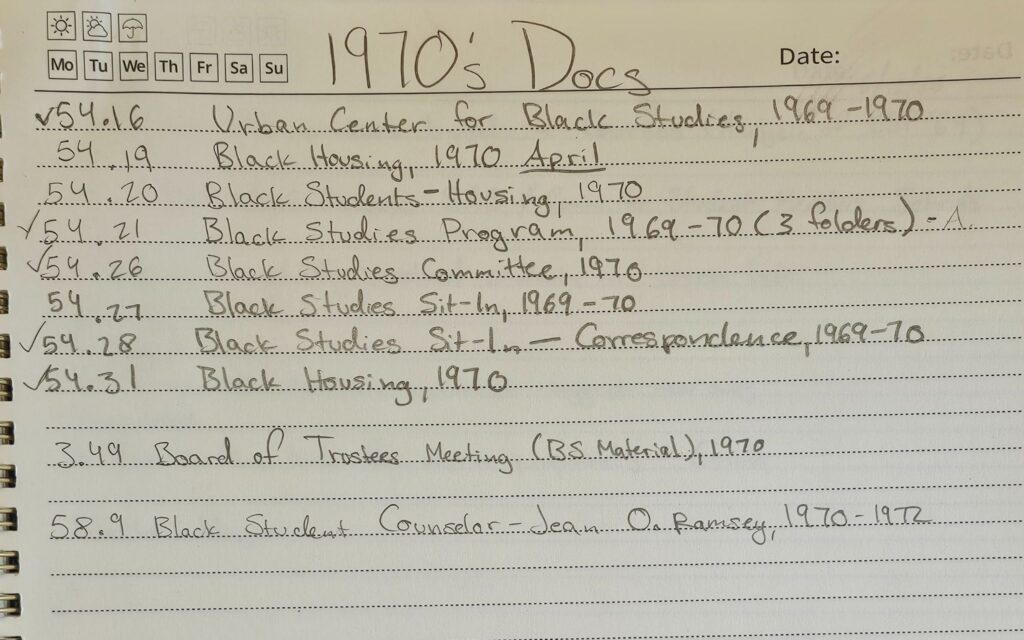
Refined list of Folders of Interest – does not include the folders I referenced when researching 1968
Contextualizing information: To keep my notes organized, I created a dedicated Google Document for each folder I reviewed; taking notes in the order of the documents I read. When first beginning my research, I created timelines at the top of each document to act as a table of contents and assist me in cleaning up each folder’s chronological order. As the number of documents grew, along with the size of the folders I reviewed, I created a project-wide timeline titled Major Events Timeline in Relation to Black Studies. This document was created in Google Sheets and served as a large-scale chronicle of the events that occurred in the late 60s and early 70s. It contains,
- The date of the event
- A description of what occurred (as well as relevant documents attached to the event)
- A list of students involved
- The Special Collections folder call number – hyperlinked to its dedicated note document
- The reference number within the note document containing more in-depth information
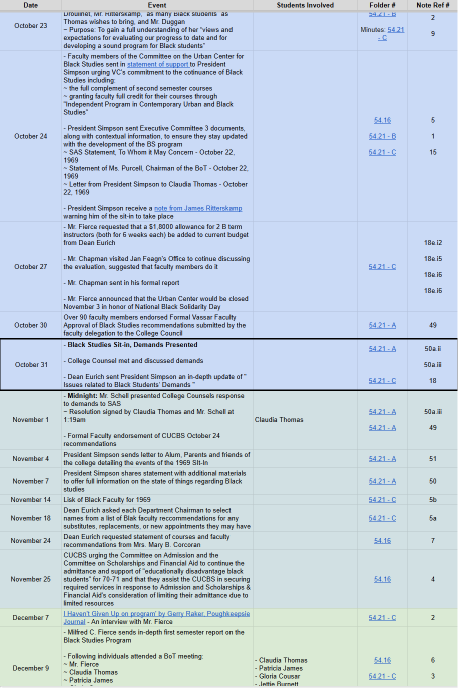
Screenshot of Major Events Timeline in Relation to Black Studies
Findings
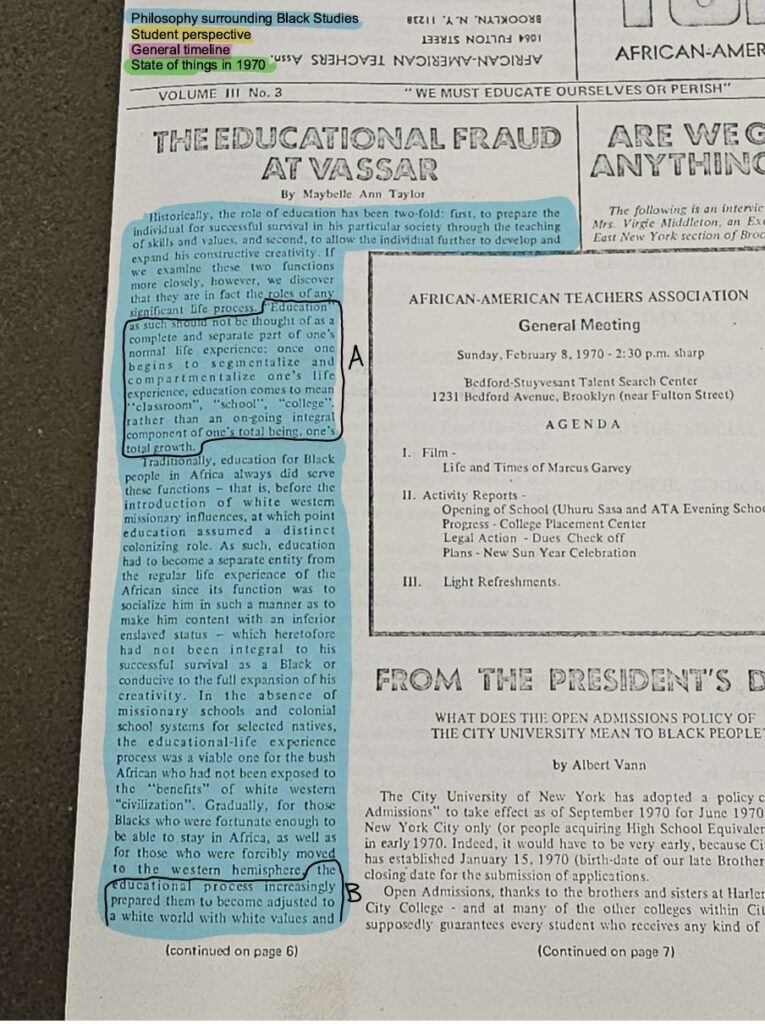
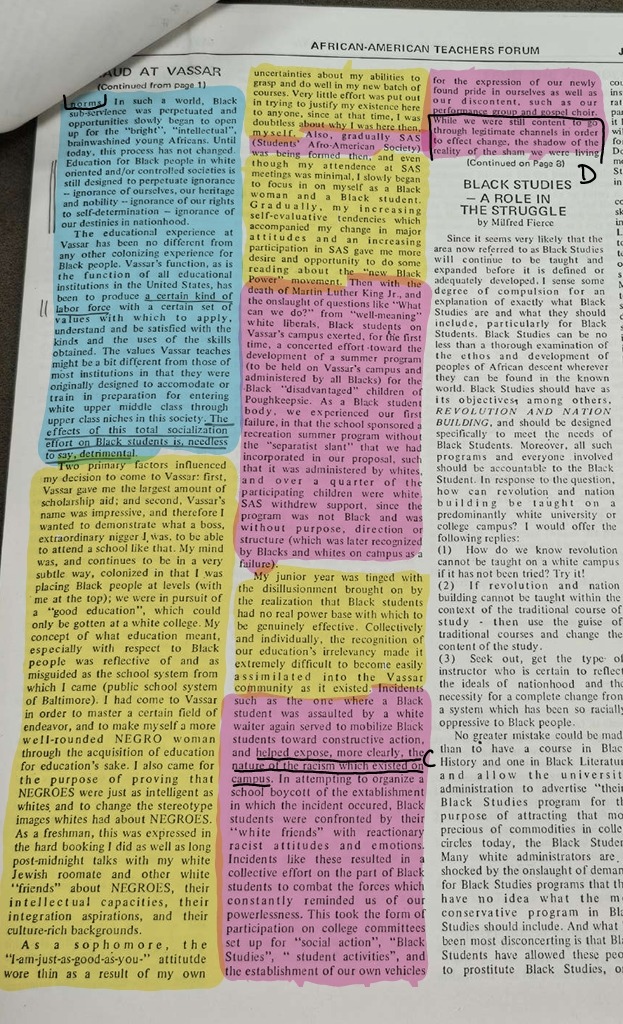
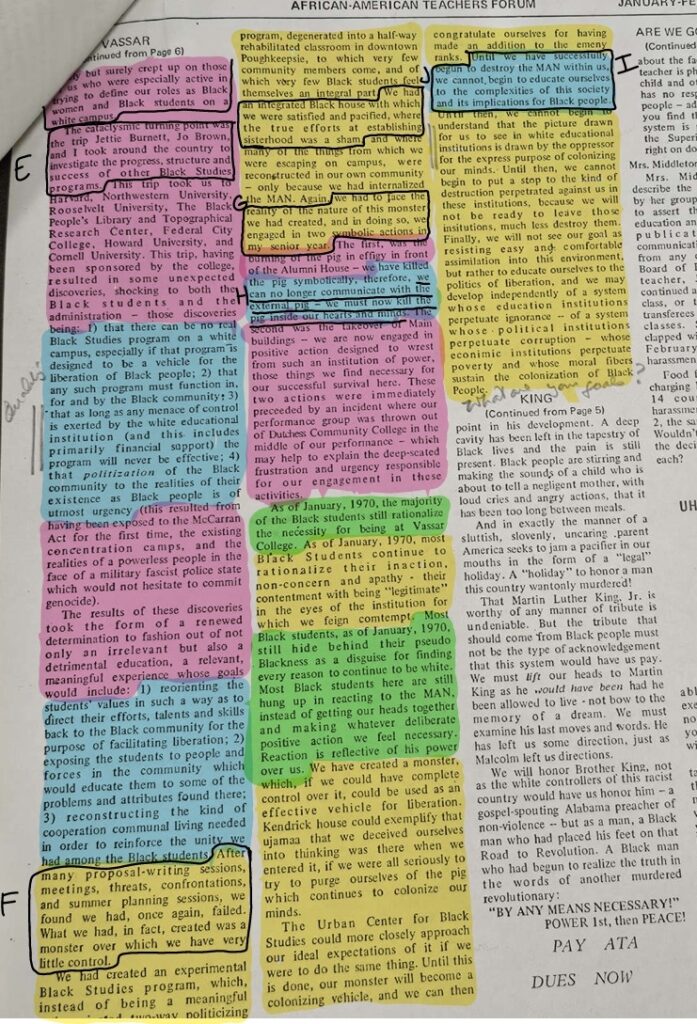
Annotation of ‘Educational Fraud at Vassar’ by Maybelle Ann Taylor, African American Teacher’s Forum – Alan Simpson Papers, Box 54, Folder 54.26
Carrying the philosophy
Near the end of my research, I discovered an article written by Maybelle Ann Taylor, class of 1970, in box 54, folder 54.26 of the Alan Simpson Papers. The piece is titled “The Educational Fraud at Vassar” and was published in the African American Teachers Forum in their January-February 1970 issue. I found that Taylor perfectly captured the nuance and emotions of the time. I was particularly drawn in by the record this article provided from the student perspective, as most of the documents I reviewed largely stemmed from the administrative point of view. A particular quote that stuck with me was, “Until we have successfully begun to destroy the MAN within us, we cannot begin to educate ourselves to the complexities of this society and its implications for Black people.” (Quote I, pg. 3). In my research, I found Black Studies to be a larger movement focused on carrying the ambition to learn past the classroom. It spoke to a life-long commitment to reflecting on the world around you and how you can positively contribute to it. In carrying out this philosophy, many Vassar students made efforts to find ways to contribute to the community beyond campus, from actions like weekly (and in some cases daily) tutoring sessions for any interested party in the Poughkeepsie community, to speaking at conferences to represent student needs and desire.
The agency shown off campus embodied the heart of these students’ vision for the Black Studies program as a full-body effort to dissect white supremacy’s influence and learn to build a world centered on Black flourishing, all with an underlying focus on maintaining community. These actions really stuck with me as an Afro Latin student who has attended predominantly white institutions for the last nine years. For nearly a decade, I have had to grapple with the tension that exists between these institutions’ identities, as both business and a place of learning. I have found that these labels often hold a strained relationship with each other. Learning is a messy, unpredictable process of discovery that does not always lend itself to the appeasement of business projections. Learning about these students’ actions to not only call out the tension that has always felt unacknowledged but also fight to ensure the financial need does not outweigh the mission of exploration, has helped connect me to my own membership in the legacy of Black scholars.
What does success look like?
Another quote that has stuck with me is, “We had an integrated Black house with which we were satisfied and pacified, where the true efforts of establishing sisterhood was a sham.” (Quote J, p. 3). This line stood out because throughout my research I had seen glimpses of the betrayal and pain Taylor writes about. Dating back to their earliest demands, the Black students at Vassar College always held strong on their need for Black housing. While they received it, leading to the creation of Kendrick House, there was a caveat requiring white students to live there as well to avoid legal concerns. At the time, it was a commonplace fear that providing Black housing would be deemed a violation of the Civil Rights Act of 1964. Many colleges found that they were able to subvert these worries by not officially declaring dorms as Black only housing, hence the integration at Kendrick House. At the end of the dorm’s inaugural year, two student representatives, Claudia Thomas and Gary Graves, presented the demand to officially make the dorm all Black housing, cosigned by the Black residents of Kendrick House. Their demand was met with hesitation due to legal concerns and the cited fact that there were simply not enough Black students enrolled to fill up the house, making white residents necessary.
Throughout a lot of my research the question of what constitutes real change kept coming to my mind. Even when establishing a home for Black life on campus, white bodies were still required to be present to legitimize it. I felt like the struggle around Kendrick House reflects the reality of what it means to be Black not only at Vassar but in the US. The battle for housing represents the nuance of reclaiming space. While Blackness does not have to exist in isolation to thrive or legitimize itself, it is expected to make space for the presence and oversight of whiteness to maintain its credibility and existence.
Presentation: Six weeks into my program I led a discussion on my findings, using Taylor’s article as a bridge between artifacts. In preparation, I identified the following themes through colored annotations and a corresponding key given to each attendee (as pictured at the beginning of this section):
- Philosophy surrounding Black Studies
- Student perspective
- General timeline information
- State of things in 1970
I selected quotes to connect the topics and anchor my findings. The walk through of the article was followed by a guided discussion in which attendees were able to ask follow up questions and explore their own interests from the article.
Moving Forward
This past summer has helped me grow a lot as a scholar. While I was working independently, I remained mindful of the fact that this project was created to assist the RRHC Learning Group in identifying and contextualizing information; as such, I was intentional about providing clean deliverables that could be used beyond my engagement with the program. With the flexibility I was given, I was able to develop my own methods to approach efficiently recording my findings to best ensure future progress. The opportunity to actively put my academic training to use regarding a topic I deeply care about is an honor I will never forget.
In looking past this summer, I aim to continue preserving the work and dedication exercised by students of the past by sharing the information I found. I hope to conduct a series of discussions modeled after the one I held this summer with different perspectives targeting diverse groups on campus, such as departments and programs. I believe that this will assist with engaging attendees by honing in on their special interests; highlight and honor the complex scenarios that arose; and offer ample opportunities for those interested to attend as it will not be constrained to a specific date.