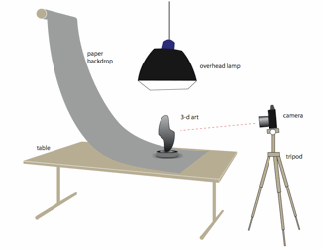
Two-Dimensional Artwork
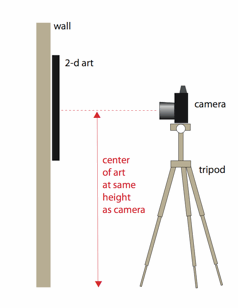
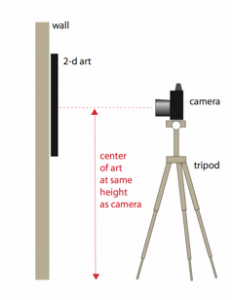 Hang your grey paper with the center approximately at eye level.
- The camera’s distance to the artwork should be determined by your lens’s angle of view. Be sure to fill as much of the image frame as is possible without cropping out any of the artwork.
- Examine the edges and corners of the art through the viewfinder to be sure there is no distortion or keystoning (when one side appears longer than a parallel side).
- To minimize key keystoning, use a fixed focal length, standard lens. A standard lens for a full-frame camera = 50mm. Standard lens for a cropped sensor = ~35mm. Example: a 50mm lens on a camera with a 1.5x crop factor, APS-C sensor, gives a field of view equivalent to a 75mm lens on a full-frame camera. A standard lens on camera with a crop factor of 1.5x is 35mm.
- Set your camera to its highest resolution setting, and to its lowest ISO rating for the highest quality images possible.
Two-Dimensional Artwork – Lighting
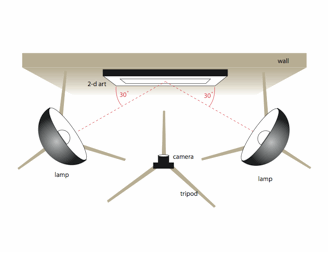
For best results, place lights at an equal distance from your artwork, at approximately 30º – 45º angles, being sure to avoid glare. The height of your lights should be on center with your artwork.
Three-Dimensional Artwork
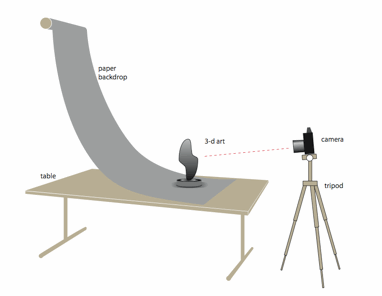 Positioning your art 1. For smaller sculptural work, place your art on a flat surface with a neutral colored background
2. Don’t place your art too close to the background, give it some space. Note: If your art is small enough and you want even diffused light, use a tabletop soft-box.
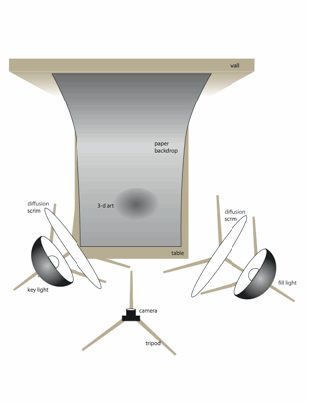
Setting up the Lights
- Set up the stands first, and then add the lighting heads
- Place the umbrellas onto the lighting heads and then face the lights away from the art
- At first place the lights at 45 degree angles from the art, half way between the art and the camera, this will give even, diffused light.
- Then move around one of the lights to start creating shadows, once you have reached a desired shadow leave the light, and start photographing.
- Some pieces of art need three lights to create dimensionality. If needed, add a third light.