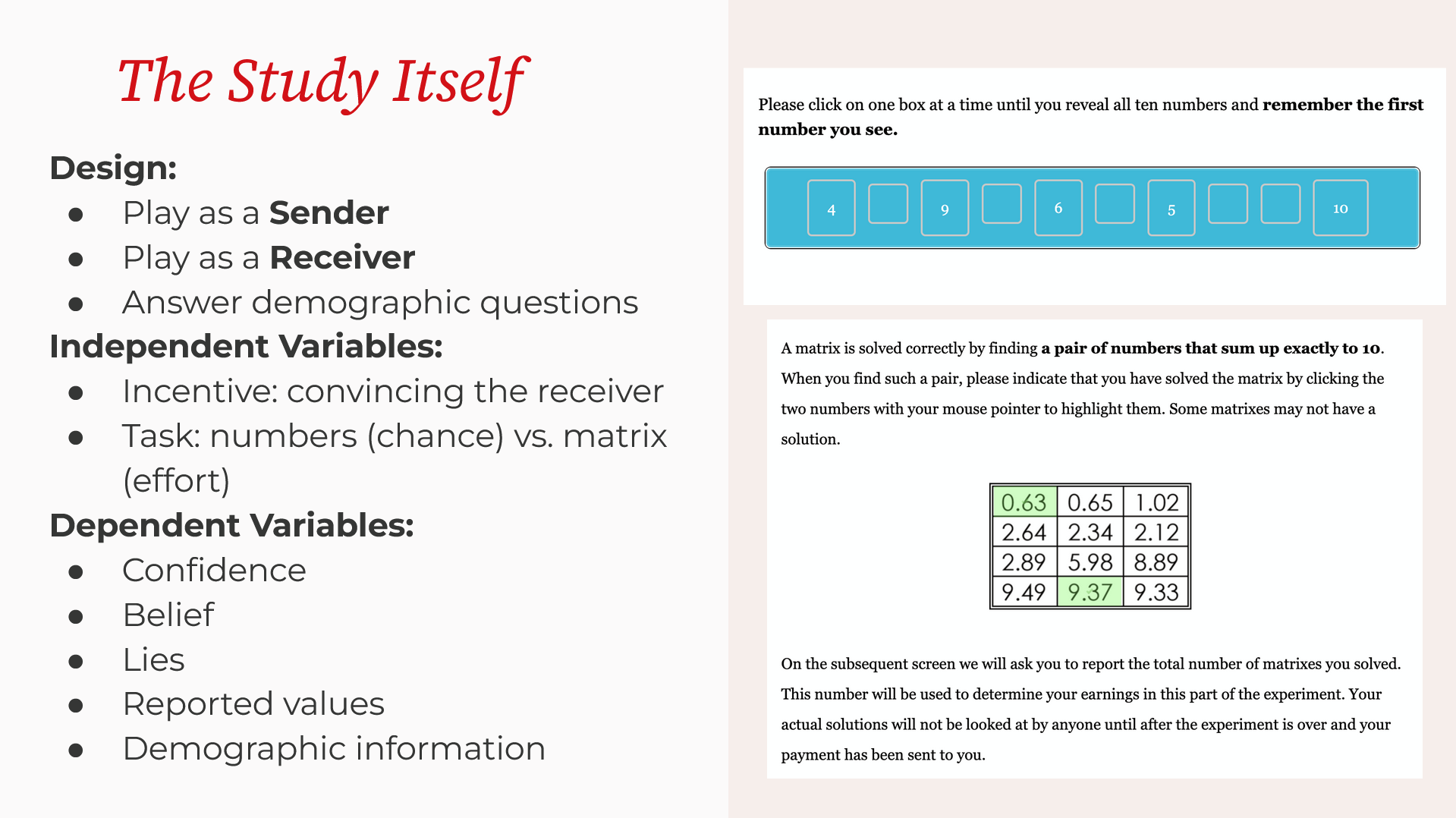
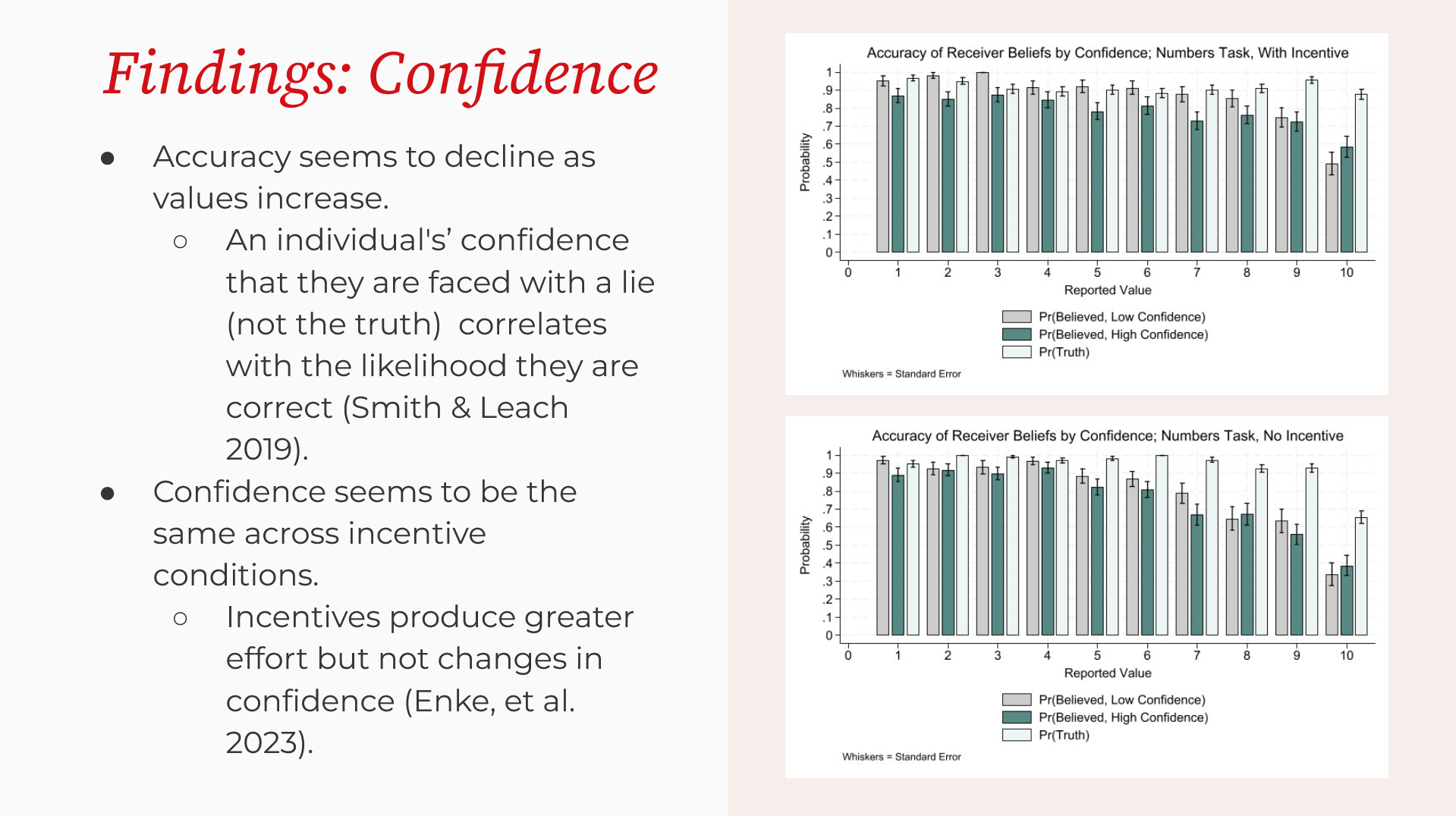
This summer, I worked with Professor Benjamin Ho to conduct data analysis of a dataset from a recent experiment. This experiment and research centered on detecting deception in a simple game that models communication between a “sender” and “receiver”. We explored receivers’ responses to lies as well as senders’ anticipation of how receivers detect deception, particularly when believable lies are incentivized. In a time of constant mass-communication, where there is an incentive for real-life senders to persuade others to believe them, it is imperative to understand how people respond to lies.
Almost all of our data analysis was conducted using Stata. At first, we focused on senders’ truth-telling and receivers’ trusting behavior between conditions where senders were and were not incentivized to be believed. From there, we began to expand and explore other topics of interest. Items of particular interest were receivers’ confidence in their choices, participants’ perception of their peers, and participants’ earnings from the experiment.
As results were found, we conducted a literature review to explore other studies centered on deception to interpret our results. The information drawn from the literature review, especially relating to confidence, appears to paint a more complex picture of how receivers discern the messages that they receive. During this time, I also assisted with creating a summary statistics table and ran regressions for the probability of senders reporting the truth and the overall size of senders’ reports.
I am honored and thrilled to have been able to participate in this rewarding project. In a world of constant communication, learning about lies are both detected and communicated was poignant to me. For me, this project has allowed me to grow as a researcher and find deeper meaning in how we interpret one another’s messages.
This summer, Professor Holland and I have reconceptualised and given a new life to the project that has been in the works for about a year: the study of arms manufacturers’ responsibility towards the protection of children’s rights.
We started with reviewing the various international, regional, and national legal frameworks regulating and restricting arms trade, to analysing the key international agreements, reports, guidelines, and scholarly works on Children’s Rights and protection of children in Armed Conflict. Having gained a robust understanding of the legally binding and non-binding frameworks surrounding arms trade and protection of children’s rights, we have constructed an argument that arms manufacturers not only are able and could benefit from, but also must conduct human rights due diligence independently of the state issuing an export license for an arms transfer. Moreover, we suggest that incorporating child-centric risk assessment policies is crucial to align the risk assessment practices within the arms trade industry with the international legal standard. This argument gained even more strength as we assessed the disproportionate vulnerability of children to illicit dispersion, diversion, and misuse of arms, as well as the increased risks that lack of consideration of children’s safety in arms design, export, and use carries.
Image 1: Presentation Slide about the danger of Explosive Weapons in Populated AreasImage 2: Presentation Slide about Weapons of special concern and highest risk to children
Then, we conducted a literature review and a secondary in-depth analysis of the corporate policies of 5 of the largest 30 arms manufacturers, with 2 based in the USA, 2 based in China, and 1 based in Norway, which, according to our preliminary analysis, represented different levels of commitment to protection of human rights, transparency, and diligence in risk assessment. The review of corporate policies, supported by findings from the literature review, revealed increasing awareness and willingness of the arms manufacturers to respond to the demands of civil society, pressure of shareholders, and to comply with domestic legislation and demands of clients, to avoid legal repercussions, decrease financial losses, and preserve reputation. Our initial findings revealed that although the arms manufacturers largely fail to reference the rights and protection of children in any context but the prevention of child labor in the supply chain, arms manufacturers have responded to global action and outrage regarding conflict minerals, child labor, human trafficking, and even sustainability, by seeking innovative solutions and adopting more robust policies and risk assessment practies.
Image 3: Presentation Slide exemplifying the preliminary analysis and evaluation of the Human Rights Due Diligence Statements of the largest arms manufacturers.
To gain more insight into the inner workings of the arms trade, risk assessment, and protection of children in conflict, we conducted informational interviews with four experts: Patrick Wilcken, an expert in Arms Control, Security & Human Rights at Amnesty International and Forum on the Arms Trade; Saudamini Siegrist, a Senior Advisor on Child Protection in Emergencies at UNICEF; Hugues Laurenge, UNICEF Child Protection Specialist developing and leading the work of the office on mine action and explosive weapons; and Alec Wargo, ex-Senior Child Protection Adviser and member of the human security team at NATO. These conversations have tremendously enriched our understanding of the complexities of arms trade and human rights risk assessment, but have also reassured us of the meaningfulness and importance of our work. The interviews and advice we received supported us in laying the foundation for the development of a tool for child-specific risk assessment as a part of the due diligence process required before arms transfer.
We are currently completing two papers and are carrying the work forward into the semester, hoping to expand and strengthen the project as we continue to refine and test the child-centered risk assessment tool for human rights due diligence processes in arms transfers.
This project has made me grow as a scholar, researcher, interviewer, writer, and critical thinker more than I could have imagined. I have learned of the immense complexities, potential, but also the many limitations and loopholes of the international legal system when it comes to regulating arms trade and human rights, and gained crucial experience in critical analysis of corporate policies. Most importantly, I had a chance to directly engage with an issue that is very close to my heart, and by continuing our work on the project, I hope to contribute to the international effort of protecting children in armed conflict.