
Charlie Townsend ’27, under Professor Kyle Coombs
This summer, I worked alongside Professor Kyle Coombs, examining the interaction between the rise in youth sports, and decline in organized religious participation over recent decades.
This process began by constructing the primary data set, where I toiled with OCR pipelines, built Python cleaners, and used Microsoft Azure to extract state-sport level data from National Federation of State High School Associations (NFHS) records. This provided us a strong measure of youth sports engagement by state and sport from 1969-2009. Alongside this, I built up the religious membership side of the analysis, using Presbyterian Church USA (PCUSA) records spanning 1983-2013, and the Association of Religion Data Archives (ARDA) records, which contained county level membership data for multiple religions across 1980-2010.
Our main focus over the summer was looking at the 1994 World Cup, hosted in the United States, to see if the boom in soccer participation following the tournament created a measurable shift in religious participation. To do so, we compared host stadium states, followed by host counties, to the rest of the country. The different geographical scales required the use of ZIP-to-county and county-to-commuting zone crosswalks, which I handled using VSCode and R.
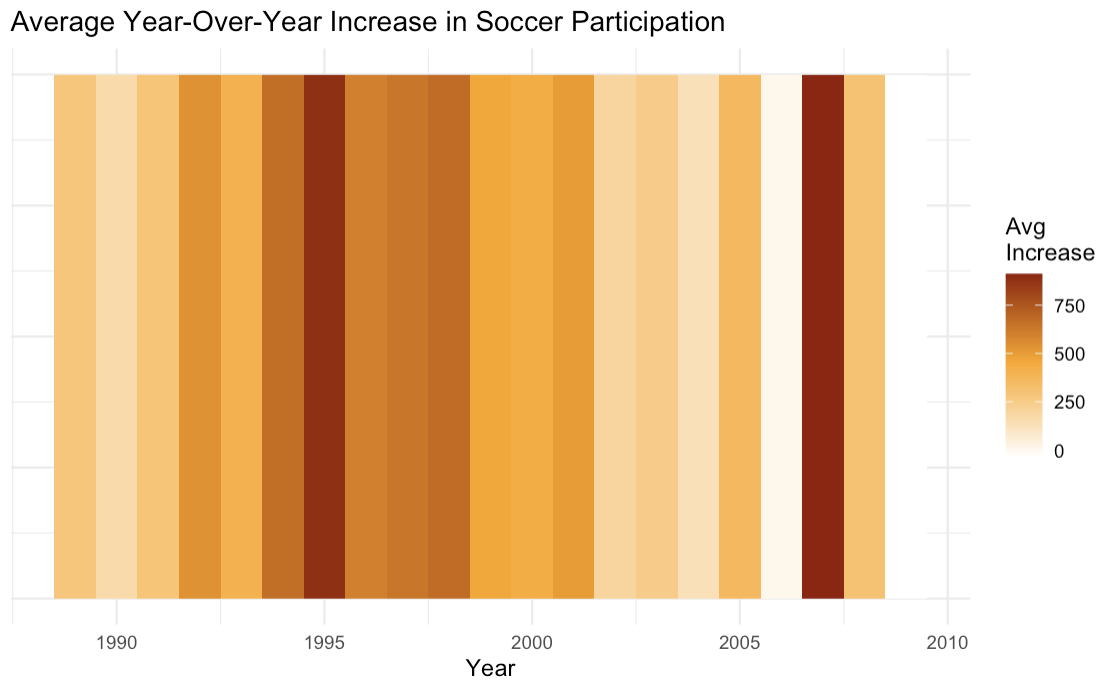
We tested this through multiple different methods, starting at national and state level correlations. From there I looked at fixed effect panel regressions to account for state specific baselines and national trends, and then difference in difference models, comparing host states and counties to non-hosts, using the host state announcement year, 1992, as the treatment year. Across these tests, only a small number of results appeared to be statistically significant, however, were inconsistent with direction.
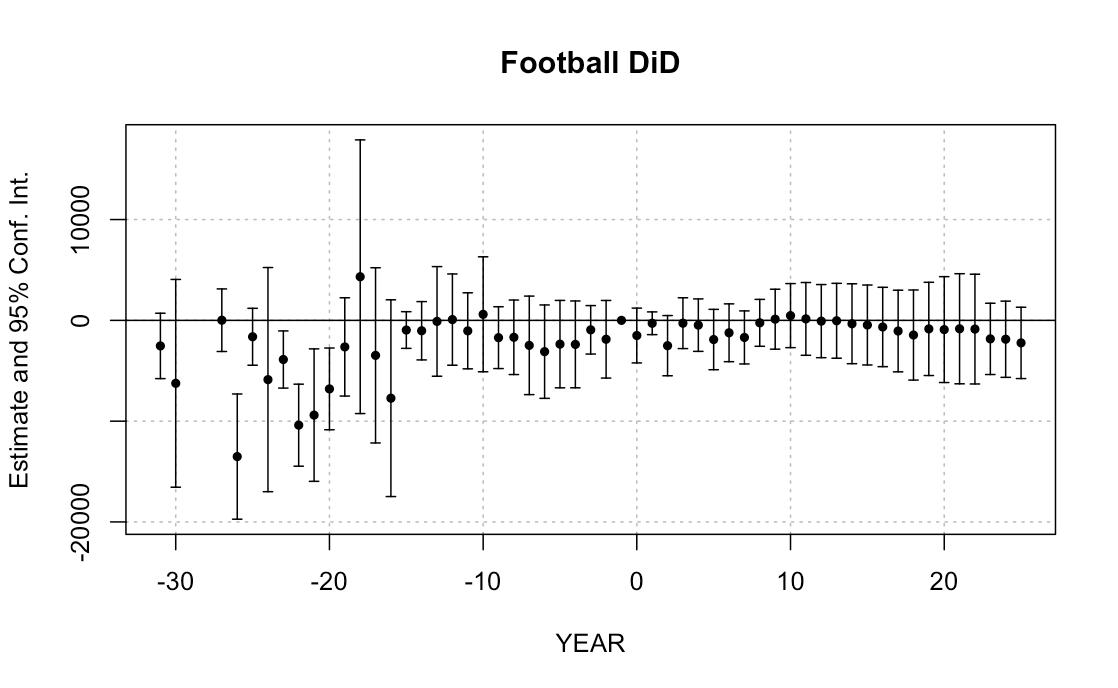
We then applied a similar framework to investigate if state legislation that shifted liability protections from parental volunteers to youth sports organizations had an effect on sports participation. For this, I constructed staggered DiD models, with state specific treatments being the year a bill was passed. This showed no consistent relationship between legislation passing and participation.
Overall, the summer provided an amazing opportunity to understand the workflow and timeline of academic research, as well as a space to grow my technical skills in R, Python, VSCode, Github, and more, outside of the classroom.