
Xiaonuo Zhang ’27, working under Professor Zhengren Zhu
College courses provide students with valuable knowledge and skills, but measuring the types of skills developed through coursework remains challenging. This project explores a data-driven approach to understanding how college syllabi reflect the skills students acquire and how these skills relate to workforce needs.
This project builds upon the Syllabus2ONET framework introduced by Sabet et al. (2024), which uses natural language processing techniques to infer workplace skills taught in university courses by mapping syllabus content to ONET Detailed Work Activities (DWAs).
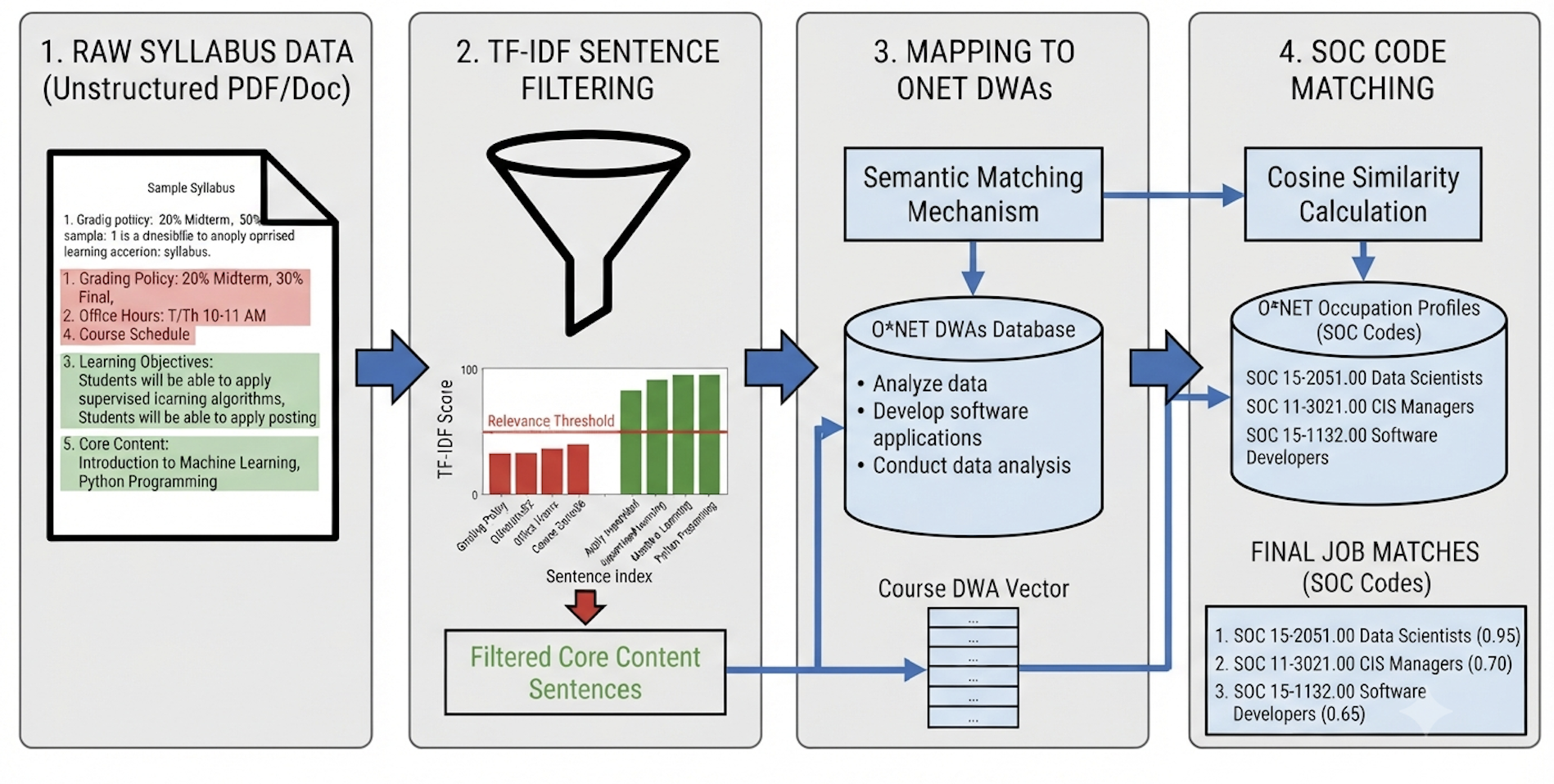
We extend this framework by examining alternative preprocessing and sentence-selection approaches to improve the extraction of course-level skill profiles. A major challenge in this process was that syllabi often contain large amounts of general administrative information, such as grading policies and course procedures, which do not represent actual learning outcomes. To address this challenge, I explored improved text preprocessing methods, including TF-IDF-based sentence selection, to identify more relevant course content before mapping syllabi to skills.
Early trials suggest that these refinement steps are moving in a promising direction, pointing toward cleaner instructional text and more coherent skill profiles. The results show that careful preprocessing plays an important role in extracting meaningful skill patterns from educational materials. The improved pipeline provides a clearer representation of the skills emphasized in different academic subjects and creates opportunities for comparing skill development across fields of study.
This project provides an initial step toward measuring human capital development through educational experiences. Working on this project has been an invaluable opportunity to apply computational text analysis to empirical economic questions, and I am grateful for Professor Zhu’s guidance. Future work will extend this framework by connecting extracted course skills with occupational requirements (SOC-code) and using these measures to better understand differences in skill development across student populations.