
This summer, I worked with Professor Benjamin Ho to conduct data analysis of a dataset from a recent experiment. This experiment and research centered on detecting deception in a simple game that models communication between a “sender” and “receiver”. We explored receivers’ responses to lies as well as senders’ anticipation of how receivers detect deception, particularly when believable lies are incentivized. In a time of constant mass-communication, where there is an incentive for real-life senders to persuade others to believe them, it is imperative to understand how people respond to lies.
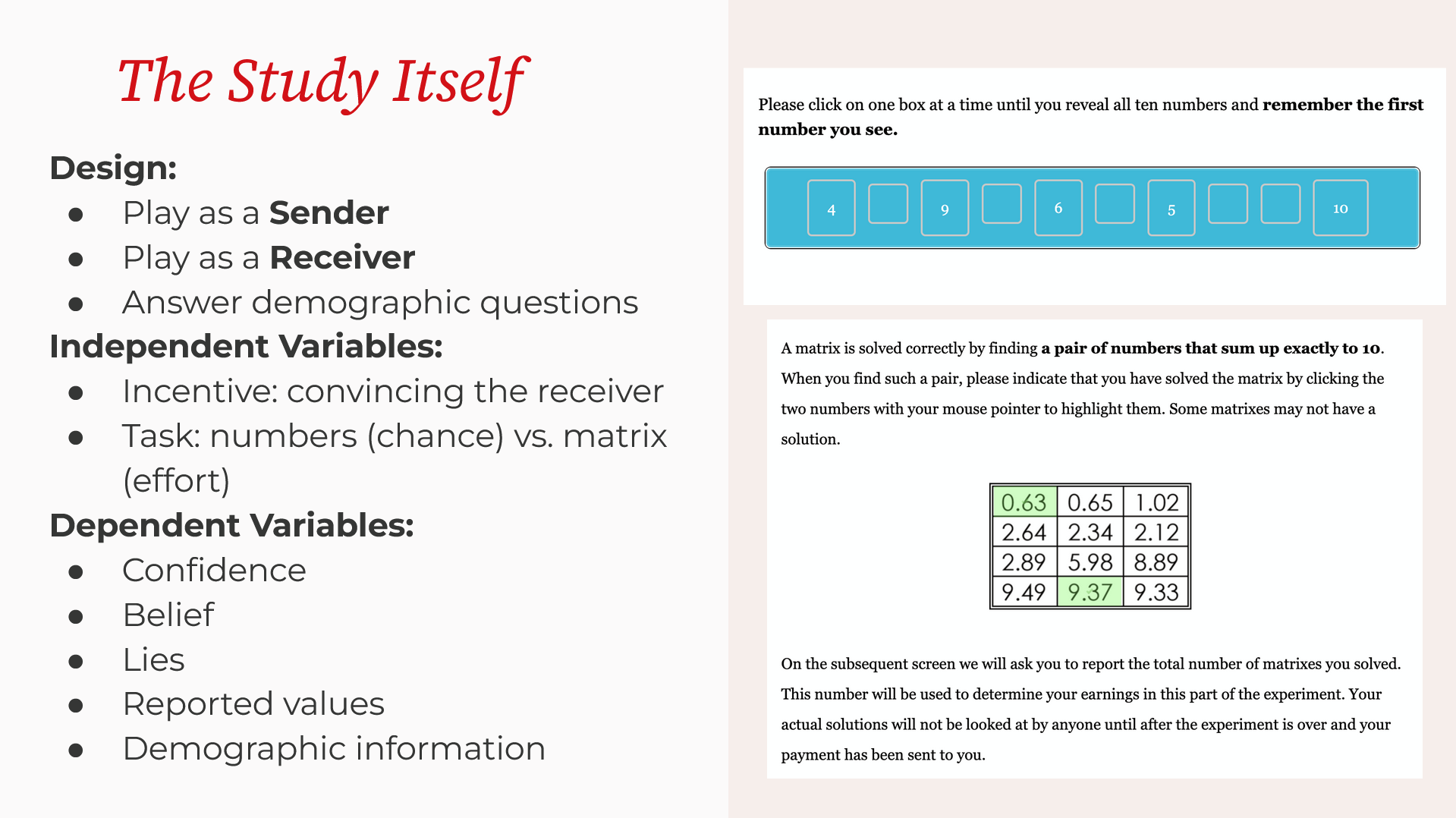
Almost all of our data analysis was conducted using Stata. At first, we focused on senders’ truth-telling and receivers’ trusting behavior between conditions where senders were and were not incentivized to be believed. From there, we began to expand and explore other topics of interest. Items of particular interest were receivers’ confidence in their choices, participants’ perception of their peers, and participants’ earnings from the experiment.
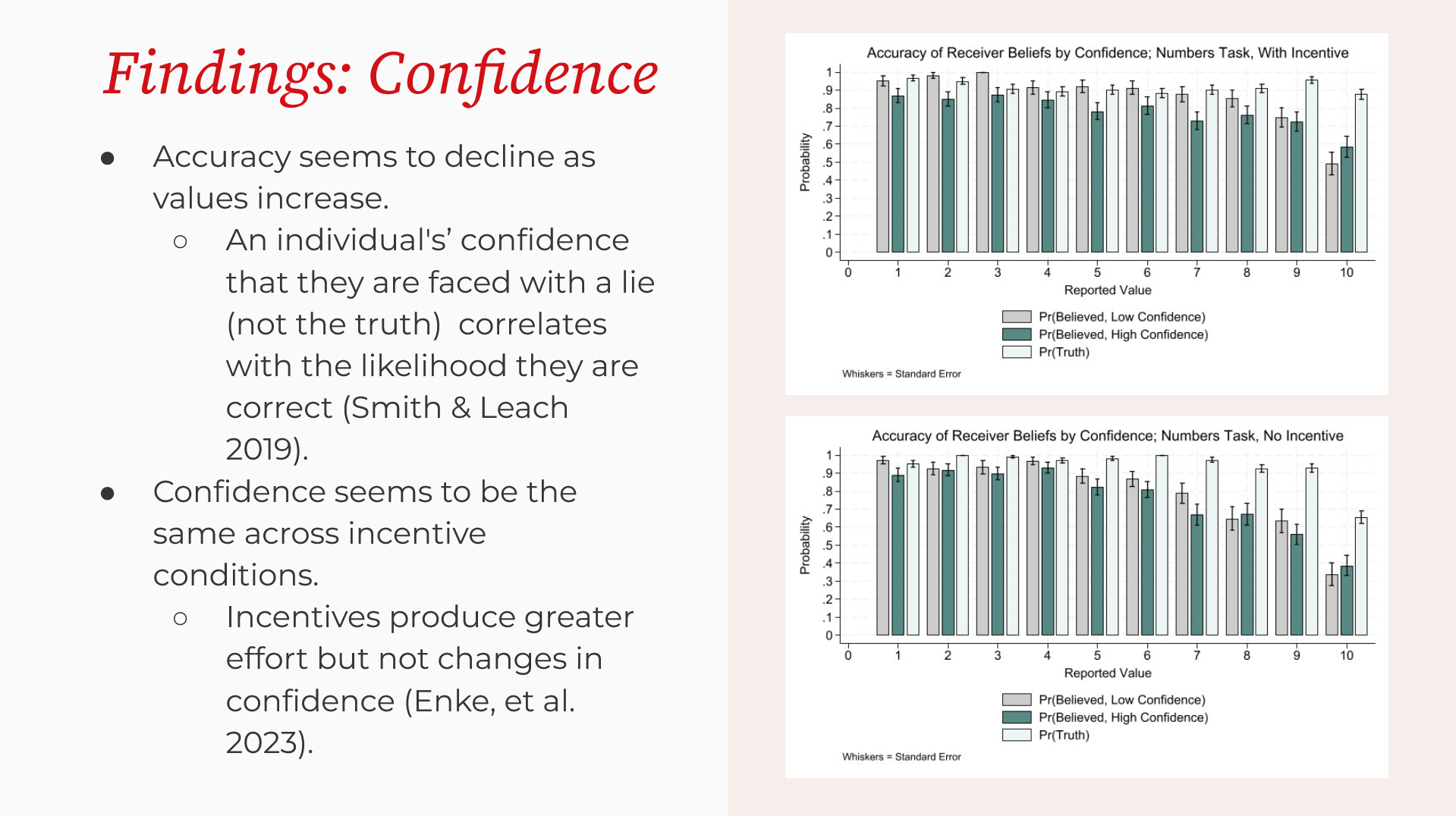
As results were found, we conducted a literature review to explore other studies centered on deception to interpret our results. The information drawn from the literature review, especially relating to confidence, appears to paint a more complex picture of how receivers discern the messages that they receive. During this time, I also assisted with creating a summary statistics table and ran regressions for the probability of senders reporting the truth and the overall size of senders’ reports.
I am honored and thrilled to have been able to participate in this rewarding project. In a world of constant communication, learning about lies are both detected and communicated was poignant to me. For me, this project has allowed me to grow as a researcher and find deeper meaning in how we interpret one another’s messages.