Awardee: Kirsten Menking, Neil Curri
Semester of Award: 2024-2025
Materials Awarded: Three (3) Garmin GLO2 GNSS receivers and carrying cases
Project Description:
The units purchased, along with the existing Earth Science and Geography Department’s Garmin GLO2 unit, were used in two different courses.
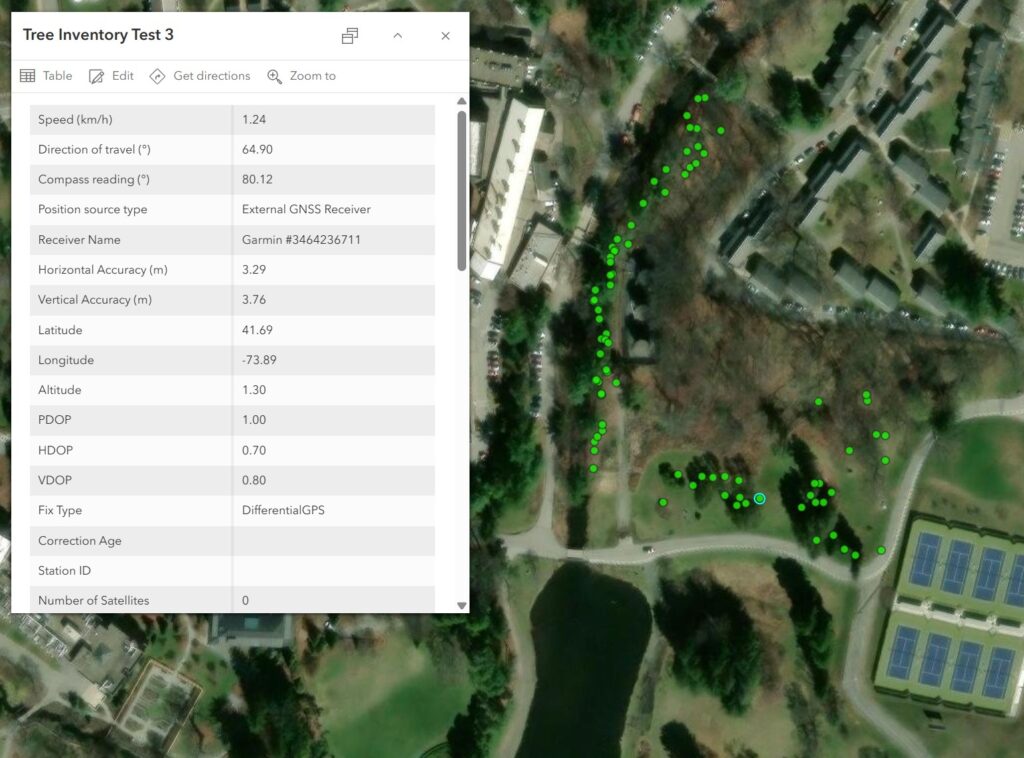
During the Spring 2025 semester, Curri used the devices for a field data collection exercise in GIS: Spatial Analysis (GEOG 224). Together with the Department’s existing GLO2 unit, the four units facilitated splitting up the students into the four groups – each with its own unit — and each student in each group had ample time operating the device during the field exercise. Students were shown how the devices paired with the Earth Science and Geography Department’s iPads, and how to obtain and assess positional accuracy statistics. This provided an opportunity to reinforce GNSS concepts taught in class and gave students a peak into how GNSS receivers – from these simple, recreational units to professional mapping and survey-grade receivers – function and are operated. Students learned how to prepare a data form in ArcGIS Field Maps, which was used as the data collection software during the exercise, and we discussed the extent to which our form met the needs of the tabular data collection once we were out in the field.
During the Fall 2025 semester, the units were also used in Anthropology/Environmental Studies 217 (Land Use History, instructors: April Beisaw/Keri VanCamp) to collect archaeological sampling locations. Students had more difficulty in this class using the units, partly because the equipment lacked the accuracy needed for this work. In addition, because the connection settings between the GLO2 units and iPads are buried in the iOS settings, it was not always clear to users whether the GLO2 units were connected to the iPads, or which one was connected to the other. Nevertheless, we learned from this experience that these archeological field exercises could be accomplished with fewer units, but required more powerful ones capable of higher accuracy, and with device-specific software that facilitates managing connections with the iPads. Beisaw and Curri researched and chose units with those capabilities, and requested funds to purchase them in a 2025-2026 Fergusson application.
During the Spring 2026 semester, the GLO2 units will be used for field mapping exercises in Environmental Studies 254, Environmental Science in the Field.