“Apple is a schizophrenic company: a self-professed revolutionary closely allied with both of the greatest forces of information, the entertainment conglomerates and the telecommunications industry”, writes Tim Wu in The Master Switch (273).
Of Microsoft, he writes, “Even if Windows was never as advanced or well designed as Apple’s operating system, it enjoyed one insuperable advantage: it worked on any computer, supported just about every type of software, and could interface with any printer, modem, or whatever other hardware one could design” (279).
The Microsoft-Apple feud has become a major staple of American culture. More so than your choice of Verizon over AT&T, your choice of cable television over satellite, or even your choice of Pepsi over Coke, your choice of Mac over PC classifies you and tells the world something about your personality.
This is now:
This is then:
Apple started as a revolutionary company- this was not just a marketing strategy. In 1983, IBM (running a Microsoft OS) and Commodore owned the lion’s share of the market, and the Apple II had just 8%. But in 1984, it created the Macintosh and ran this ad during the Super Bowl.
It was the first major computer with a desktop interface- the icons and mouse we’ve come to know and love. Apple had sacrificed open-source programming and open architecture for user-friendliness. This has been its policy ever since. But what this has meant for Apple has been vertical integration. No one but Apple can make a Mac OS compatible computer, and there are severe limitations on how much you can alter the code on any Apple product. This is why there are no Mac viruses, and also why there are companies who make a profit off of “jailbreaking” iPhones.
It’s also why by the 1990’s, Apple products were failing. I would go into my elementary school computer class, filled with Macintoshes, and groan in frustration when I couldn’t right-click, or bring in the PC game that had come with my cereal box.
In 1997, Macintoshes accounted for just 3% of all computers sold, and PC’s accounted for the other 97%. Apple was close to failing when, at a conference, Steve Jobs revealed a groundbreaking partnership.
Had Apple failed, Microsoft would have held a monopoly and likely been broken up by antitrust laws. By adding an infusion of capital to Apple, Microsoft saved its own majority status. Apple, in order to save its company, stopped fighting Microsoft, but instead welcomed it.
PCs still account for the majority share in personal computers, but Apple owns the market in MP3 players (75% in 2008, versus Microsoft’s 3%). Apple has almost triple Microsoft’s share in the Smartphone market. Macs have a huge share among young consumers, too, so much so that Vassar students with PCs stand out and in effect become rebels. It seems as if Microsoft and Apple, as the only remaining players in the computer game, have entered into a cycle in which they will inevitably reverse roles. Is Apple’s 25 year marketing strategy as a rebel company expiring?
As technology progresses, the world becomes more connected and communication improves dramatically. Wu’s The Master Switch follows the progression of communication technology starting with the telephone, going to the radio, then to film, and so on. With each new device, people become more connected to each other and are able to communicate in different ways. The telephone allows two people to hear each other across distances. The radio allows people to hear multiple types of media, from talk shows to music to presidential speeches from remote locations. With film, viewers can see and hear stories come to life. Wu mentions “the power of an open technology like radio broadcasting to inspire hope for mankind by creating a virtual community” (39). The first thing that springs to my mind when I think of a “virtual community” is the Internet, and YouTube in particular.
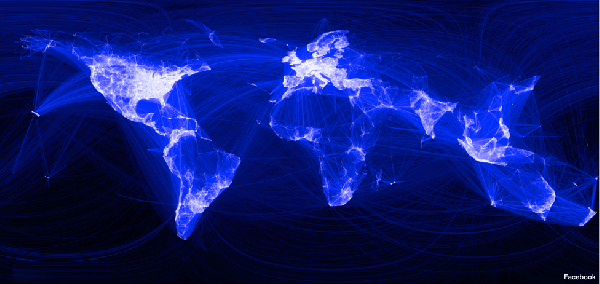
Through the Internet, we can share information and ideas with anyone else in the world who also has access to the Internet. This map, which shows the global connections via Facebook, illustrates just how connected the world is via the Internet:
This connectivity is extremely apparent on YouTube where an enormous community of video bloggers, or vloggers, has sprung up. Many people think of YouTube as just a site for video clips of adorable kittens and of people running into stop signs. However, there is so much user-generated content that goes unnoticed by the greater public. Audiences interact with vloggers through comments and making video responses. In addition to interaction between vloggers and their audiences, there is a great deal of interaction among vloggers. Most of the vloggers I watch are members of the same YouTube community, called Nerdfighteria. Nerdfighteria began when two brothers, John and Hank Green (the “vlogbrothers” on YouTube), began a vlogging project in which they would communicate without text for an entire year. They built up an audience around their vlogs and call themselves and their audience “nerdfighters” (because we fight for nerds and fight to decrease world suck, which is exactly what it sounds like). Here is one of John’s vlogs (which actually talks about community a bit):
Many of the vloggers of Nerdfighteria are friends through YouTube and through this community. The community has brought people together from around the globe, showing the connective power of the Internet and YouTube. One of the best examples of the YouTube community is the “collab channel.” A collab channel is a YouTube channel run by multiple people; typically, each person posts a video one day a week. For example, on the channel FiveAwesomeGirls each of five girls posts one video on a specific day of the week. Kristina posts on Mondays, Lauren on Tuesdays, Kayley on Wednesdays, and so on. The five girls do not live near each other and did not know each other personally before they began their collab channel, but have become close friends through the YouTube community.
Something I have noticed about video bloggers is that they tend to use similar techniques. For example, they usually use a lot of jump cuts, something that is frowned upon in movies. Why do vloggers use jump cuts? It could be because they simply can’t remember everything they have to say to do the vlog in one take, or it could be that it makes the video more visually interesting. After all, most vloggers are just talking to a camera, so they need to do something to hold their viewers’ attention. Furthermore, most popular vloggers use a lot of hand gestures. Again, this could be to make their videos more interesting or it could be to help get their points across. Here is a video from one of my favorite vloggers, Charlie McDonnell (“charlieissocoollike” on YouTube):
What do you notice about John and Charlie’s videos? Why are they interesting (or why aren’t they interesting)?
Wu mentions the “mix of both entrepreneurial and humanitarian motives” that “drives the opening up of a media” (36). YouTube is primarily humanitarian—vlogging is generally not an economically sound job (although you can earn money from running ads on your videos). Most vloggers make videos because they genuinely love doing so and have a message they want to share with the world.
There are so many different communities on the Internet—the YouTube community is just the one with which I am most familiar. Furthermore, the Internet is just the next step in connectivity. According to Wu, “what we call invention, while not easy, is simply what happens once a technology’s development reaches the point where the next step becomes available to many people” (19). Connectivity and communication will thus continue to increase as technology improves. There is an exceptional amount of global connectivity due to the Internet, but can we improve on it? What will be the next step? Can the world become even more connected than it currently is? Can we continue to build our global community?
In Signs of Recognition, one of Keane’s main points is that all communicative efforts in social encounters are liable to misinterpretation, resulting in a “hazardous” outcome for the unfortunate speaker. He writes that scenes of encounter “iconically represent social action as a form of dialogue between a pair of speakers” (139): in other words, a situational exchange of speech becomes a complete icon of a larger conflict, so that any discrepancy in the deliverance of linguistic cues and meanings threatens to render the issue at hand beyond resolution. Since all that is known to both parties is that which is expressed in the presence of both parties (i.e. a scene of encounter), “nothing is known except that which has been presented formally… within the… frame of the event.” (156) Therefore, that which is presented becomes the only source of knowledge for negotiation, so presenting things “correctly” becomes very important.
Keane outlines the roles in everyday speech in the beginning of Chapter Six: the animator “voices the words;” the author “determines what words are… said;” and “the words are attributed” to the principal “who is held responsible for them.” (Goffman 1979 in Keane 1997:139) Balancing all three roles may be difficult as one may have clear intentions but lack oratorical charisma, or possess a strong speaking voice but have difficulty forming thoughts into coherent phrases. The difficulty of balancing these three roles is a potential cause of misfires in speech acts. Another source of hazard is in-group “debates over procedure” (148) in which members of a party bicker amongst themselves over correct protocol, further inhibiting the party’s ability to clearly articulate its intents.
As such linguistic errors would be hazardous (in the sense of invoking social embarrassment and stalling the negotiation’s progress,) one way that actors can ensure the efficacy of a social encounter is to employ mediators they know will correctly communicate the necessary information. The Anakalangese accomplish this by appointing wunang to act as mediators between two opposing parties (in events such as bridal negotiations); similarly, other cultures appoint specialists like lawyers to act out similar roles in similar events requiring compromise. Both the wunang and the lawyers take on the role of author and animator, as they are skilled in articulating and composing their principals’ intents in the formal discourse of the situation (the wunang employing structured formal speech and the lawyer using law jargon). There is safety in the explicit nature of formality, and employing a specialist to present one’s case in such terms lessens the likelihood of hazardous speech acts while working towards a negotiation.
Lawyers and wunang also use their expertise “to restrain the excesses and tempers of their principals” (154), preventing their clients from saying something that will ruin the state of their negotiations. How many times have we seen a character in a book or movie lose their case because they wanted to “act as their own lawyer?” The same consequences befall any principal not well-versed in the terms of the conflict. Keane writes that people are often prompted to defend themselves because “the public forum… places… pressure on people’s pride and reputation… [and] gives so many people a say in what transpires” (149), but by electing a representative (“one who represents” the sentiments of another party) to act as a mediator between potentially combative forces in a forum, the principals ensure correct and safe conduct throughout the discussion.
Lawyers can represent anyone (and we actually use the phrase “represent”) just as wunang can stand in for men and women of any class. Likewise, there are not specialized lawyers for men, women, or age groups—any lawyer can represent anyone. Lawyers tend to use deictic, demonstrative speech (“My client says that he left at six o’ clock”), while the wunang actually personifies the person they are referring to by “adopting the ‘voice'” of an individual they are representing (i.e. by using “female speaker kin terms” in formal address [163]). Nonetheless, both forms of speech are still highly presentational in that they emphasize the intentions of the principals in formalized, structured discourse.
One major difference is that there are actually two wunang per Anakalangese party (the “sitting” wunang and the “traveling” wunang) while there is only one lawyer per side (they communicate information to the principals and the larger court, fulfilling the roles of both types of wunang.) A lawyer still engages in their own form of motion, moving between the judge, witness, and jury, and conferring with all. The more public the principals’ intentions are made through the mediator (wunang/lawyer), the more likely it is that negotiations will go smoothly.
To highlight a few crucial differences between wunang and lawyers, I direct you towards the following clip— I recommend watching first minute or so, then skipping to 3:50 and watching to the end (unless you just really like Legally Blonde, which is also fine):
While acknowledging that this is a highly dramatized clip, for all of the wunang’s idiosyncratic alterations in couplet-choice to match the context of their principals’ debate (161), no Anakalangese speaker could ever do what Elle Woods just did. I do not mean that wunang would be incapable of making such a dramatic performance, but that committing such infractions against the formal structure of negotiations would be hazardous to the point of an ancestral intervention resulting in bad luck or an actual fatality. For the Anakalangese, going against an ancestral structure literally endangers the natural order of things, whereas (Western) lawyers going against the grain are often viewed as martyrs, heroes, or geniuses. Even as a principal, Mrs. Windham makes what would be a startling choice to the Anakalangese by choosing Elle to represent her; she chooses a personal favorite over her appointed representative, and values Elle’s creativity over the former lawyer’s formal technique.
Elle’s informal speech actually threatens the breakdown of the scene of encounter, but “formality… may open up possibilities as much as foreclose them.” (144) While methodically and formulaically approaching a case ensures a scrutinizing objectivity, if Elle hadn’t deviated from the formal approach of question-and-answer to deliver an anecdote about her sorority days, the witness never would have been prompted to confess the murder. Nonetheless, Elle’s individualistic approach is largely a Western ideal. Keane warns how “the necessary delegation of voice” to the wunang “threatens to become full detachment” (170) if the wunang is too free with their interpretations, which would fully separate them from the principals’ intents. Thus, if any Anakalangese wunang stepped forward like Elle in a social encounter, the current negotiations would be in danger of immediate termination, and social or spiritual punishments would be brought upon the affronting wunang for such “bald speech” (164) (see 164 for an example).
This is not to say that the Anakalangese dismiss all personal talent in this sphere. When Elle announces her desire to take the case, Mrs. Windham’s former lawyer snaps, “She’s a law student— she can’t defend you.” Practicing law requires specific credentials, whereas “the knowledge just comes” to wunang. (155) Personal skill is valued as not just anyone can become a wunang, but at the same time the specialists’ skill is expected to accentuate ancestral values (and thus, value formal structure) as opposed to developing a new form of negotiation.
* What are some other similarities and differences between Western and Anakalangese legal structures?
* How does the materiality of language play a part in wunangs’ affects? How does a different ideology of language affect Western lawyers’ presentations?
* What are some other examples of delegation of voice?
“Mental hygiene” films were shown to kids in schools all across America in the ’40s and ’50s with the intention of instructing them in sanctioned behavior and the proper roles of the nuclear family. I’ve always found these kinds of videos to be quite entertaining and kind of funny, and was reminded of the one about eating with your family when I read about feasting in Signs of Recognition.
Among the Anakalangese nobility generosity (boraku) as well as wealth is required of them, and feasting is one of the ways that males use to display their rank, power and wealth (5-7, 58). A failure to live up to traditional standards is something causes Anakalangese to lament about the good old days (58). In ’50s America, formality of eating was reintroduced to thousands, maybe millions of people, modeled by a “typical” nuclear white middle class family, by this video:
Formality, defined as the representation of roles and/or hierarchy, is embodied in speech events and rites/rituals (8) and social exchanges are facilitated by working within this “ritual frame” (Keane 5).
“You can be yourself. Just be sure it’s your best self.” And what constitutes their best selves? Pleasantness and relaxation are the key qualities emphasized in this propaganda video. Ritualized, traditional order is also facilitated through ritual speech, and what the family can talk about is restricted to “pleasant, unemotional conversation.” One is not to monopolize the conversation or discuss unpleasant topics! No arguing, don’t insult your brothers and remember to compliment mom on the cooking. The people don’t have personal names but are addressed as mother, father, sister, brother and junior, emphasising the “stereotypical performance roles” in the formality. By engaging in formality, participants are able to interactively define themselves and each other (7) thus creating self-awareness of their roles and their family hierarchy. The seating arrangements, who serves and the order of serving and saying grace are all embodied parts of the representation. Whether they are really happy or not is irrelevant; all that matters is acting as though they are happy by performing pleasantness. “Even the simple norms of everyday propriety, among the least dramatic elements of any cultural account, may serve” the interests of domination, (6) and in ’50’s America that certainly included dinner time.
I couldn’t find any equivalent modern videos; any videos on family eating were on how to eat healthy and make meals more quickly. I would conjecture that it means the importance of enforcing family hierarchies through eating rituals has largely disappeared in popular culture. To bring authority, sources of power and legitimate agency together requires persistent effort (9) and most people seem to have difficulty “finding the time” to eat together as a family. Do you think that more people would manage to find time for formalized family dinners if they thought their family dynamic and personal happiness were dependent on it? Why do you think the importance of performativity of roles has decreased since the post-War era? Even though it is less visible now in media, what kinds of formalities in the video do you think are still performed in American households?