The Appalachian Trail: Alternatives to Thru-Hiking
September 9, 2018 by lgordon
The Appalachian Trail and other American long-distance trails such as the Pacific Crest Trail are primarily known for the thousands of people who take months away from their lives every year in attempting their notorious and daunting thousands of mile long end-to-end “thru-hikes”. Though it is relatively commonplace in the communities neighboring the trails, media representations in novels like Bill Byson’s A Walk in the Woods and Cheryl Strayed’s Wild, have so instilled in my conscious the sanctity of the thru-hike that it almost feels like sacrilege to break these trails into smaller, more digestible sections.

Day hikers on the path.
Last Friday, my perception of the Appalachian Trail as an inseparable 2,200 mile stretch was challenged by being taken on an approximately 2.5 mile long white-blazed section off of NY Route 55. The reputation of this small section of the trail came from a nuclear accident in a small research facility next to a lake. Nuclear Lake, as it is now known, is surely not unique in its colorful past within the grand scope of the Appalachian trail. The trail, I’m sure, is an endless mosaic of 2 or 3 mile sections with their own storied, compelling, and sometimes suspect histories.

Nuclear Lake from the side of the Appalachian Trail on an overcast afternoon.
Though anecdotes of an environmental accident hung over me when traversing past Nuclear Lake, I realized that the scenery therein left no trace of the hazards for which it is known. The sky being gray the day of our hike was mere coincidence and had nothing to do with nuclear winter. The lake had a beautiful andenchanting mist cascading down from the forested hills peeking out of the fog in the distance. The only actual visible trace of explicitly harmful human impact was a mountain of glass bottles and discarded electronics farther down the trail on the opposite side of Route 55.
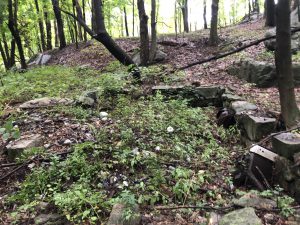
A mountain of bottles and a discarded television set a few feet off a section of the Appalachian Trail.
One of the most remarkable things about the Appalachian Trail is that it hasn’t been a feature of the Eastern Seaboard of the United States since the dawn human history. No, in a nation dominated by the ideas of private property and quick transportation, the Appalachian trail started as the humble grassroots idea that the coast should be united by a public footpath available to all. It is difficult to wrap my head around the countless hurdles which must have stood in the way of bringing this trail into existence. Yet somehow, almost 100 years later, this small section of trail around Nuclear Lake stands as evidence that the people’s path has persisted.